
Resources
Explore a wide range of valuable resources on GCED to deepen your understanding and enhance your research, advocacy, teaching, and learning.
4 Results found
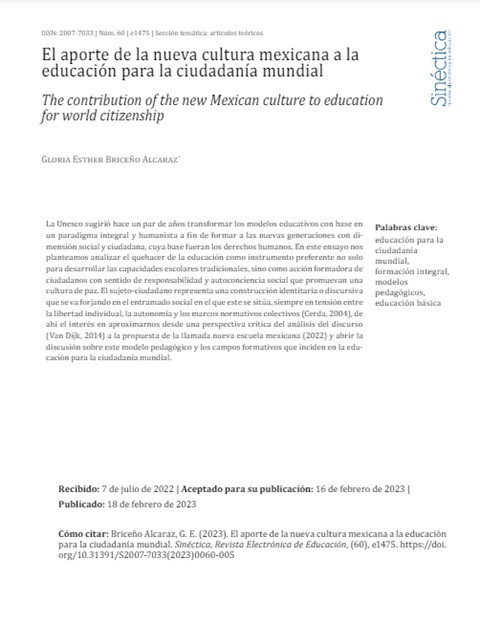 The Contribution of the New Mexican Culture to Education for World Citizenship(Sinéctica, Revista electrónica de educación; no. 60) Year of publication: 2023 Author: Gloria Esther Briceño Alcaraz Corporate author: Sinéctica, Revista Electrónica de Educación A couple of years ago, UNESCO suggested transforming educational models based on an in-tegral and humanist paradigm in order to train new generations with a social and civic di-mension, based on human rights. In this essay we propose to analyze the work of education as a preferential instrument not only to develop traditional school skills, but also as an ac-tion to form citizens with a sense of responsibility and social self-awareness that promote a culture of peace. The citizen-subject represents an identity or discursive construction that is forged in the social framework in which it is situated, always in tension between individual freedom, autonomy and collective normative frameworks (Cerda, 2004), hence the interest in approaching from a critical perspective of discourse analysis (Van Dijk, 2014) to the pro-posal of the new educational model of Mexico called the New Mexican School (2022) and open the discussion on this pedagogical model and the formative fields that affect education for global citizenship. El aporte de la nueva cultura mexicana a la educación para la ciudadanía mundial(Sinéctica, Revista electrónica de educación; núm. 60) Year of publication: 2023 Author: Gloria Esther Briceño Alcaraz Corporate author: Sinéctica, Revista Electrónica de Educación La UNESCO sugirió hace un par de años transformar los modelos educativos con base en un paradigma integral y humanista a fin de formar a las nuevas generaciones con dimensión social y ciudadana, cuya base fueran los derechos humanos. En este ensayo nos planteamos analizar el quehacer de la educación como instrumento preferente no solo para desarrollar las capacidades escolares tradicionales, sino como acción formadora de ciudadanos con sentido de responsabilidad y autoconciencia social que promuevan una cultura de paz. El sujeto-ciudadano representa una construcción identitaria o discursiva que se va forjando en el entramado social en el que este se sitúa, siempre en tensión entre la libertad individual, la autonomía y los marcos normativos colectivos (Cerda, 2004), de ahí el interés en aproximarnos desde una perspectiva crítica del análisis del discurso (Van Dijk, 2014) a la propuesta de la llamada nueva escuela mexicana (2022) y abrir la discusión sobre este modelo pedagógico y los campos formativos que inciden en la educación para la ciudadanía mundial.
 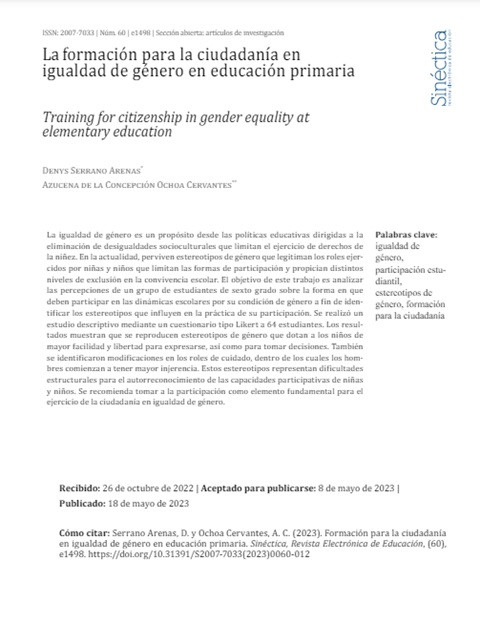 Training for Citizenship in Gender Equality at Elementary Education(Sinéctica, Revista electrónica de educación; no. 60) Year of publication: 2023 Author: Denys Serrano Arenas | Azucena de la Concepción Ochoa Cervantes Corporate author: Sinéctica, Revista Electrónica de Educación Gender equality is a purpose from educational policies aimed to eliminating sociocultu-ral inequalities that limit the exercise of children's rights. At present, gender stereotypes that legitimize the roles exercised by girls and boys that limit the forms of participation persist, promoting different levels of exclusion in school life. The objective of this work is to analyze the perceptions of a group of sixth grade students, about how they consider they should participate in school dynamics due to their gender condition, to detect tho-se stereotypes that influence the practice of their participation. A descriptive study was carried out using a Likert-type questionnaire to 64 students. The results show that gen-der stereotypes are reproduced that provide children with greater ease and freedom to express themselves, as well as to make decisions. Modifications in the care roles were also identified, within which, they begin to have greater interference. In parallel, it was found that these stereotypes represent structural difficulties for the self-recognition of the par-ticipatory capacities of girls. It is recommended to take participation as a fundamental element for the exercise of citizenship in gender equality. La formación para la ciudadanía en igualdad de género en educación primaria(Sinéctica, Revista electrónica de educación; núm. 60) Year of publication: 2023 Author: Denys Serrano Arenas | Azucena de la Concepción Ochoa Cervantes Corporate author: Sinéctica, Revista Electrónica de Educación La igualdad de género es un propósito desde las políticas educativas dirigidas a la eliminación de desigualdades socioculturales que limitan el ejercicio de derechos de la niñez. En la actualidad, perviven estereotipos de género que legitiman los roles ejercidos por niñas y niños que limitan las formas de participación y propician distintos niveles de exclusión en la convivencia escolar. El objetivo de este trabajo es analizar las percepciones de un grupo de estudiantes de sexto grado sobre la forma en que deben participar en las dinámicas escolares por su condición de género a fin de identificar los estereotipos que influyen en la práctica de su participación. Se realizó un estudio descriptivo mediante un cuestionario tipo Likert a 64 estudiantes. Los resultados muestran que se reproducen estereotipos de género que dotan a los niños de mayor facilidad y libertad para expresarse, así como para tomar decisiones. También se identificaron modificaciones en los roles de cuidado, dentro de los cuales los hombres comienzan a tener mayor injerencia. Estos estereotipos representan dificultades estructurales para el autorreconocimiento de las capacidades participativas de niñas y niños. Se recomienda tomar a la participación como elemento fundamental para el ejercicio de la ciudadanía en igualdad de género.