
Resources
Explore a wide range of valuable resources on GCED to deepen your understanding and enhance your research, advocacy, teaching, and learning.
4 Results found
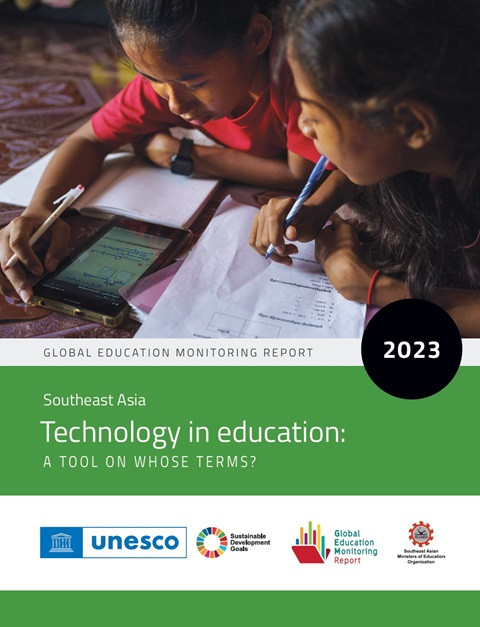 Global Education Monitoring Report 2023, Southeast Asia: Technology in Education; A Tool on Whose Terms? Year of publication: 2023 Corporate author: Global Education Monitoring Report Team | Southeast Asian Ministers of Education Organization (SEAMEO) Developed in partnership with the Southeast Asia Ministers of Education Organization (SEAMEO), and with the contribution of EdTech Hub, the fifth regional report focuses on technology in education in Southeast Asia. Characterized by a variety of contexts and resources, Southeast Asia has experienced a rapid growth in digital technology applications. In education, digital technologies have been identified for their potential to transform education and meet the region’s development aspirations. The regional report investigates both challenges and potentials, which technology as a tool and as a process can potentially contribute to, across and within countries, and education levels. The regional report on Southeast Asia covers 11 countries, Brunei Darussalam, Cambodia, Lao PDR, Indonesia, Malaysia, Myanmar, Philippines, Singapore, Thailand, Timor-Leste and Viet Nam. Extensive background research informs the regional analysis: 9 country case-studies compiled by local research teams and independent experts; 5 thematic studies produced by SEAMEO centers on open and distance learning, technology for students with disabilities, integration of technology in teaching practices, key policies issues in ICT in education; technology in technical and vocational education and training, and 3 research inputs on ICT in education practices produced by SEAMEO affiliate members and partners.
  Technology and Values-Driven Transformation in Education (Journal of Southeast Asian Education: The Official Journal Of SEAMEO; Vol. 1, Special issue) Year of publication: 2023 Corporate author: Southeast Asian Ministers of Education Organization (SEAMEO) The 11th SEAMEO-University of Tsukuba Symposium under the theme Technology and Values Driven Transformation in Education held on 20-22 February 2023 successfully engaged over 19,860 participants from 45 countries. With 30 speakers from 10 countries, the symposium provided the platform to share and exchange best practices carried out by schools and universities apart from identifying the challenges encountered by teachers, students and academicians. SEAMEO and UT have selected quality articles emerging from the symposium and put them together in the Journal of Southeast Asian Education. For example: - Lifelong Learning in the Digital Age- A Breakthrough of Values-Driven Strategies in Using Multimedia-Based Instruction (MMBI): A Course Towards Sustainable Transformative Education- Leave No One Behind: The Solution to an Inclusive Future- Unplugged Computational Thinking with Colouring Books
 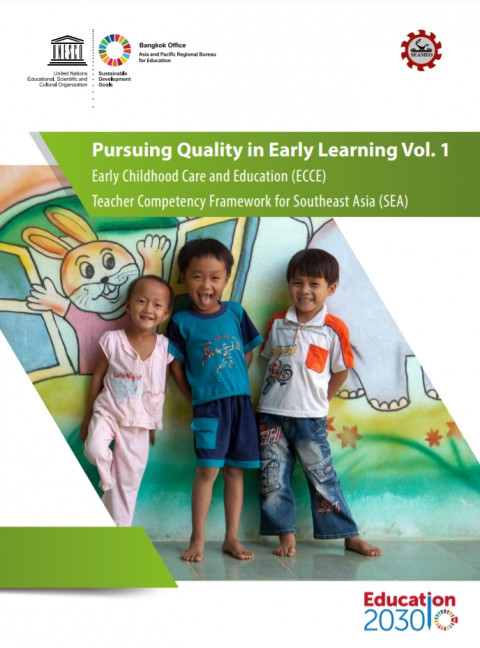 Pursuing quality in early learning, vol. 1: Early childhood care and education (ECCE) teacher competency framework for Southeast Asia (SEA) Year of publication: 2018 Corporate author: Southeast Asian Ministers of Education Organization (SEAMEO) | UNESCO Bangkok With the United Nation’s (UN) Sustainable Development Goals (SDGs) as a platform for achieving quality early childhood care and education outcomes by 2030, ECCE policy-makers, practitioners, and academicians from Asia-Pacific countries gathered at the second Asia-Pacific Regional Policy Forum on Early Childhood Care and Education in Putrajaya, Malaysia in 2016 to share experiences, innovations, and lessons learned in developing and implementing ECCE policies and initiatives. This document first provides a brief background, and discusses the purposes and intended audience for which the framework was developed (Section I). A succeeding section reflects on the regional ECCE landscape (Section II), before proceeding to a discussion of the ECCE teacher competency framework for Southeast Asia (Section III). Section IV suggests possible uses of the ECCE teacher competency framework; a final section concludes with areas for future action.
  Measuring Global Citizenship Education in Southeast Asia: A SEA PLM Approach Year of publication: 2018 Author: Ethel Agnes P. Valenzuela Corporate author: Southeast Asian Ministers of Education Organization (SEAMEO) | UNESCO Institute for Statistics (UIS) Audit of Curricula for the Southeast Asia Primary Learning Metrics (March 2016), an early issue confronted in developing an assessment framework for SEA-PLM wasdetermining how to design and construct a single assessment program across all ASEAN member countries.The design and approach needed to take account of the similarities and differences in the curriculum frameworks in each country for the four domains that were to be assessed through SEA-PLM: Mathematics, Reading, Writing, and Global Citizenship.