
Resources
Explore a wide range of valuable resources on GCED to deepen your understanding and enhance your research, advocacy, teaching, and learning.
8 Results found
 Asia-Pacific Digital Transformation Report 2024: Digital Innovation for Smarter Climate Action Year of publication: 2024 Corporate author: UN. Economic and Social Commission for Asia and the Pacific (UN. ESCAP) In Asia and the Pacific, the climate crisis intersects with digital transformations through a complex mix of challenges and opportunities, creating a series of vicious but also potentially virtuous cycles. The Asia-Pacific Digital Transformation Report 2024 considers how digital transformations will structurally and irreversibly affect the trajectory of climate change. It presents a digital-growth-climate nexus to better understand the diverse and dynamic picture and considers ways in which the region can follow the most positive trajectory to avert a climate catastrophe. The Report showcases good practices and country examples of digital applications in addressing climate change, in terms of mitigation and adaptation. These can involve the use of artificial intelligence, the Internet of Things, big data, digital twins, geospatial technologies and others, which have been employed in infrastructure, government, mobility, industry and trade, digital data centres, disaster risk reduction, agriculture and biodiversity ecosystems. The Report then explores key drivers of digital transformation for climate change and outlines three future scenarios. It concludes with the key findings of the Report and proposes policy actions aligned with the five actors of the Digital Transformation Index Framework.
  Leveraging Digitalization for Productivity and Decent Employment: Asia-Pacific Countries with Special Needs Development Report 2024 Year of publication: 2024 Corporate author: UN. Economic and Social Commission for Asia and the Pacific (UN. ESCAP) The Asia-Pacific Countries with Special Needs Development Report is a recurrent ESCAP annual publication that discusses issues of interest for Asia-Pacific least developed countries (LDCs), landlocked developing countries (LLDCs) and small island developing States (SIDS), collectively referred to as countries with special needs (CSN). The Asia-Pacific Countries with Special Needs Development Report 2023: Strengthening Regional Cooperation for Seamless and Sustainable Connectivity examines how regional cooperation on seamless and sustainable connectivity can facilitate a long-term transformation towards a net zero carbon emissions future. Recognising ongoing efforts and existing initiatives and considering the large financing gaps in the countries in special situations, the Report underscores the need to seek synergies between transport, energy, and digital connectivity initiatives in the region.
  Asia and the Pacific: SDG Progress Report 2021 Year of publication: 2021 Corporate author: UN. Economic and Social Commission for Asia and the Pacific (UN. ESCAP) This report analyses progress towards the Sustainable Development Goals (SDGs) in Asia and the Pacific and its five subregions as well as the availability of data. It assesses gaps which must be closed to achieve the goals by 2030. This assessment is designed to ensure the region’s actions remain on target and shortcomings are addressed as they arise. It is a resource for all stakeholders involved in prioritization, planning, implementation and follow-up of the 2030 Agenda for Sustainable Development in Asia and the Pacific.
  Asia and the Pacific SDG Progress Report 2025: Engaging Communities to Close the Evidence Gap Year of publication: 2025 Corporate author: UN. Economic and Social Commission for Asia and the Pacific (UN. ESCAP) The SDG progress report 2025 presents the latest data and insights on progress toward the Sustainable Development Goals (SDGs) in the Asia-Pacific region. While celebrating regional achievements, it also highlights persistent challenges—such as climate change, natural disasters, and critical data gaps—that risk leaving marginalized communities behind. By showcasing innovative community-level partnerships, the report explores how local efforts can help bridge the evidence gap, ensuring that progress toward the SDGs is inclusive and leaves no one behind.
 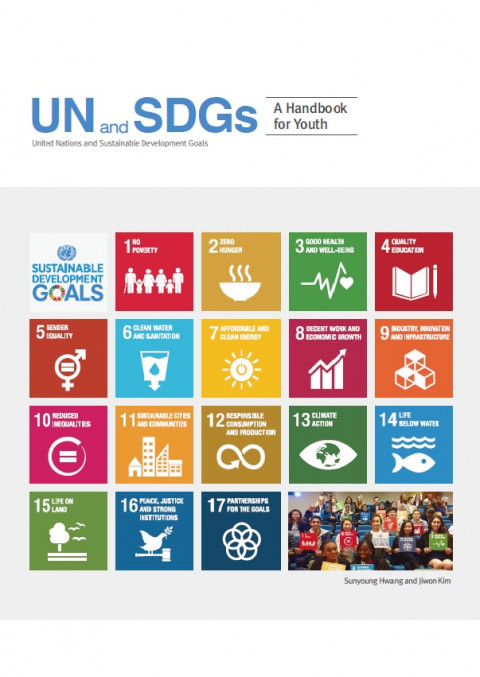 UN and SDGs: A Handbook for Youth Year of publication: 2017 Author: Sunyoung Hwang | Jiwon Kim Corporate author: UN. Economic and Social Commission for Asia and the Pacific (UN. ESCAP) | Asian Development Bank (ADB) | United Nations Development Programme (UNDP) "UN and SDGs: A Handbook for Youth" is an outcome of ESCAP East and North-East Asia’s internship program that brings young people closer to the work of the United Nations, as well as to the achievement of the ambitious set of Sustainable Development Goals (SDGs). As young leaders of tomorrow, it is pivotal that youth are informed and engaged with the global vision for the future. Over the next fifteen years, youth will not only directly experience the outcome of SDGs and plans, but will also be the key driver for their successful implementation. For this reason, it is vital to raise awareness about the recently adopted 17 SDGs and the 2030 Agenda for Sustainable Development among youth, build a platform for discussion, and create the conditions for active engagement. This Handbook explores SDGs and the 2030 Agenda from a youth perspective. In the first chapter, it introduces the concept of sustainable development and outlines its historical development through the transition from Millennium Development Goals (MDGs) to SDGs. The second chapter discusses how youth can be harnessed as a major agent of change in achieving sustainable development, focusing on several pertinent youth issues in Asia and the Pacific. The final chapter introduces the UN system and its regional arm, ESCAP, explaining their role in the successful implementation of SDGs. 청년을 위한 UN과 SDGs 핸드북 Year of publication: 2017 Author: Sunyoung Hwang | Jiwon Kim Corporate author: UN. Economic and Social Commission for Asia and the Pacific (UN. ESCAP) | Asian Development Bank (ADB) | United Nations Development Programme (UNDP) 이 핸드북은 유엔의 업무와 지속가능발전목표(SDGs)에 대해 배울 수 있는 유엔 인턴십 프로그램을 통해 만들어졌습니다. 청년들이 내일의 리더로써 미래 글로벌 비전을 인식하고, 이에 적극 동참하는 일은 매우 중요합니다. 그들은 향후 15년간 SDGs의 결과를 체험하고, 목표를 성공적으로 이행할 핵심 주체가 될 것입니다. 그러므로 지속가능발전을 위한 2030 의제와 SDGs에 대한 청년들의 인식을 함양하고, 논의의 장을 늘리고, 적극적인 참여를 유도하기 위한 환경을 조성하는 것이 중요합니다. '청년을 위한 UN과 SDGs 핸드북'은 청년들의 관점에서 2030 의제와 SDGs를 개괄합니다. 제1장에서는 지속가능발전에 대한 개념을 소개하고 새천년개발목표 (MDGs)에서 SDGs로의 이행을 통한 역사적인 발전에 대해 알아보며, 제2장에서는 아시아태평양지역 내 청년과 관련된 여러가지 사안에 초점을 맞춰 청년들이 지속가능발전을 실현하기 위해 어떤 역할을 할 수 있는지에 대해 논의합니다. 제3장에서는 유엔 시스템과 지역기구인 ESCAP에 대해 소개하면서 SDGs의 성공적 이행 과정에 있어서의 청년들의 역할에 대해 알아봅니다.
  Accelerating Progress: An Empowered, Inclusive and Equal Asia and the Pacific Year of publication: 2019 Corporate author: UN. Economic and Social Commission for Asia and the Pacific (UN. ESCAP) | Asian Development Bank (ADB) | United Nations Development Programme (UNDP) Accelerating progress: An empowered, inclusive and equal Asia and the Pacific responds to the theme of the 6th Asia Pacific Forum on Sustainable Development and the 2019 session of the high-level political forum on sustainable development.The report proposes a framework of four synergistic elements necessary to advance inclusion, empowerment and equality: rights and justice; norms and institutions; resources and capabilities; participation and voice. The need for action on all four fronts is illustrated by a deeper look at three pivotal challenges confronted by the region – (1) climate change and its potential to deepen inequality; (2) the urgent need to boost domestic resource mobilization; and (3) the need to strengthen social accountability and civic engagement. It draws out policy messages on how an empowerment-and-inclusion approach to policymaking can be fostered, including on addressing violence against women and girls. The report provides strong evidence that promoting empowerment and inclusion are necessary approaches to reduce inequality and accelerate progress towards a broad array of Sustainable Development Goals. It is a contribution to the ongoing national, regional and global dialogues on opportunities to empower people, ensure their inclusion and advance equality.The report is produced by the Asia-Pacific SDG partnership, comprising of the United Nations Economic and Social Commission for Asia and the Pacific (ESCAP), the Asian Development Bank, and the United Nations Development Programme.
  Asia-Pacific Migration Report 2024: Assessing Implementation of the Global Compact for Migration Year of publication: 2024 Corporate author: UN. Economic and Social Commission for Asia and the Pacific (UN. ESCAP) | International Labour Organization (ILO) | International Organization for Migration (IOM) | UN. Office of the United Nations High Commissioner for Human Rights (UN. OHCHR) | United Nations Centre for Human Settlement Programme (UN Habitat) | United Nations Entity for Gender Equality and the Empowerment of Women (UN Women) | United Nations Development Programme (UNDP) | UNESCO | UN. Office of the United Nations High Commissioner for Refugees (UNHCR) | UN. Office on Drugs and Crime (UNODC) | World Bank This report aims to assess the state of GCM implementation in the region, its progress and its challenges since the first Asia-Pacific Regional Review of Implementation of the Global Compact for Migration in 2021, in which a Chair’s summary was adopted. Chapters 2 to 5 each consider clusters of GCM objectives, as presented in General Assembly resolution 73/326 and following the same groupings as in the Asia-Pacific Migration Report (APMR) 2020. These chapters open with a summary of the discussions from the first regional review of the GCM, held in 2021, drawing from the Chair’s summary. Chapter 6 provides overarching recommendations to support and accelerate GCM implementation in Asia and the Pacific. At the end of the report are annexes with information on the GCM objectives and guiding principles, references to migration in Voluntary National Reviews to the High-Level Political Forum on Sustainable Development, and GCM pledges at the level of the State or City, Municipality and Local Authority.