
Resources
Explore a wide range of valuable resources on GCED to deepen your understanding and enhance your research, advocacy, teaching, and learning.
20 Results found
 Justice in Matters Involving Children in Conflict with the Law: Model Law on Juvenile Justice and Related Commentary Year of publication: 2013 Corporate author: UN. Office on Drugs and Crime (UNODC) This Model Law and the related Commentary are designed to provide legal guidance to States in the process of juvenile justice reform and assist them in drafting juvenile justice legislation. It translates compelling international juvenile justice standards and norms into a national context and aims at harmonizing national legislation with international requirements. International standards and norms in the area of juvenile justice are detailed. Правосудие: Вопросы, Касающиеся Детей, Находящихся в Конфликте с Законом Year of publication: 2013 Corporate author: UN. Office on Drugs and Crime (UNODC) Данный Типовой Закон и соответствующие комментарии являются руководством для проведения реформы правосудия по делам несовершеннолетних в различных странах и призван помочь в создании законодательства по делам несовершеннолетних. Данный Типовой Закон объединяет международные нормы и стандарты законодательства по делам несовершеннолетних, которые необходимо привести в соответствие с национальным законодательством с тем, чтобы гармонизировать национальное и международное законодательства. Данная работа детально описывает международные стандарты и нормы законодательства по делам несовершеннолетних.
  Preventing Violent Extremism through Sport: Technical Guide; Criminal Justice Handbook Series Year of publication: 2020 Corporate author: UN. Office on Drugs and Crime (UNODC) The Technical Guide on Preventing Violent Extremism through Sport, developed in consultation with international experts, recognizes the importance of promoting the well-being of children and youth. It applies an approach that encourages prosocial behaviour and good safeguarding and welfare practices, with particular emphasis on educational and social development measures in line with the United Nations Guidelines for the Prevention of Crime.The guide, addressed mainly to policy makers and implementing organizations, has been carefully designed to support effective integration of sport-based learning in primary prevention frameworks. By adopting a five-zone approach to prevent violent extremism namely safe space, empowerment, resilience, social inclusion and education, it supports informed policy development and a Theory of Change that can shape curriculum design and content. To further support global efforts in preventing violent extremism, UNODC is also developing an e-learning module and a practical tool for trainers that will be published soon and will complement this technical guide.
  Annual Report for 2021 (UNODC Regional Office in Central Asia) Year of publication: 2022 Corporate author: UN. Office on Drugs and Crime (UNODC) This Annual Report provides an account of the main results achieved by the United Nations Office on Drugs and Crime, Regional Office for Central Asia (UNODC ROCA), in 2021. UNODC has stepped up efforts to help people in these challenging times, addressing emerging threats in line with human rights and gender equality standards, and the rule of law. Through our strategic interventions, we have contributed to strengthening peace, preventing conflict, and tackling the root causes and drivers of instability and violence. Годовой отчет за 2021 (Региональное представительство УНП ООН в Центральной Азии) Year of publication: 2022 Corporate author: UN. Office on Drugs and Crime (UNODC) Отчет содержит сведения об основных результатах, достигнутых Региональным представительством Управления Организации Объединенных Наций по наркотикам и преступности в Центральной Азии (РЦПДЦА УНП ООН) в 2021 году. УНП ООН наращивает свои усилия с целью оказания помощи людям в непростое время, помочь противостоять возникающим угрозам с учетом стандартов в области прав человека и гендерного равенства, а также верховенства закона. Благодаря стратегическим инициативам, способствуют укреплению мира, предотвращению конфликтов, устранению коренных причин и факторов нестабильности и насилия.
  Analysis of State and Administrative (departmental) Statistics in the Field of Gender Discrimination with a Focus on Violence and Human Trafficking Year of publication: 2018 Corporate author: UN. Office on Drugs and Crime (UNODC) The analytical review includes brief information on the legislative bases of statistics in the field of gender discrimination, violence, and human trafficking, as well as departmental regulations regulating the collection of statistics on this issue in state statistics bodies, the judicial system, internal affairs bodies, health authorities, prosecutors, the penitentiary service, crisis centers and courts of elders. The analysis makes it possible to understand what information flows in the field of gender discrimination, violence, and human trafficking exist in the authorized bodies state bodies, what indicators are collected in them, and how statistics are generated at the national level. For each authorized state body, the structure of the information system, the movement of information flows, and a list of indicators on gender-based crimes, family violence, and human trafficking are given. Анализ государственной и административной (ведомственной) статистики в сфере гендерной дискриминации с фокусом на насилие и торговлю людьми Year of publication: 2018 Corporate author: UN. Office on Drugs and Crime (UNODC) Аналитический обзор включает краткую информацию о законодательных основах статистики в сфере гендерной дискриминации, насилия и торговли людьми, а также ведомственные нормативные акты, регулирующие сбор статистки по данному вопросу в органах госстатистики, судебной системе, органах внутренних дел, органах здравоохранения, прокуратуры, службе исполнения наказаний, кризисных центрах и судах аксакалов. Проведенный анализ дает возможность понять, какие информационные потоки в сфере гендерной дискриминации, насилия и торговли людьми существуют в уполномоченных государственных органах, какие показатели в них собираются, и как формируется статистика на национальном уровне. По каждому уполномоченному государственному органу приводится структура информационной системы, движение информационных потоков, перечень показателей по гендерно-обусловленным преступлениям, семейному насилию и торговле людьми.
  Asia-Pacific Migration Report 2024: Assessing Implementation of the Global Compact for Migration Year of publication: 2024 Corporate author: UN. Economic and Social Commission for Asia and the Pacific (UN. ESCAP) | International Labour Organization (ILO) | International Organization for Migration (IOM) | UN. Office of the United Nations High Commissioner for Human Rights (UN. OHCHR) | United Nations Centre for Human Settlement Programme (UN Habitat) | United Nations Entity for Gender Equality and the Empowerment of Women (UN Women) | United Nations Development Programme (UNDP) | UNESCO | UN. Office of the United Nations High Commissioner for Refugees (UNHCR) | UN. Office on Drugs and Crime (UNODC) | World Bank This report aims to assess the state of GCM implementation in the region, its progress and its challenges since the first Asia-Pacific Regional Review of Implementation of the Global Compact for Migration in 2021, in which a Chair’s summary was adopted. Chapters 2 to 5 each consider clusters of GCM objectives, as presented in General Assembly resolution 73/326 and following the same groupings as in the Asia-Pacific Migration Report (APMR) 2020. These chapters open with a summary of the discussions from the first regional review of the GCM, held in 2021, drawing from the Chair’s summary. Chapter 6 provides overarching recommendations to support and accelerate GCM implementation in Asia and the Pacific. At the end of the report are annexes with information on the GCM objectives and guiding principles, references to migration in Voluntary National Reviews to the High-Level Political Forum on Sustainable Development, and GCM pledges at the level of the State or City, Municipality and Local Authority.
 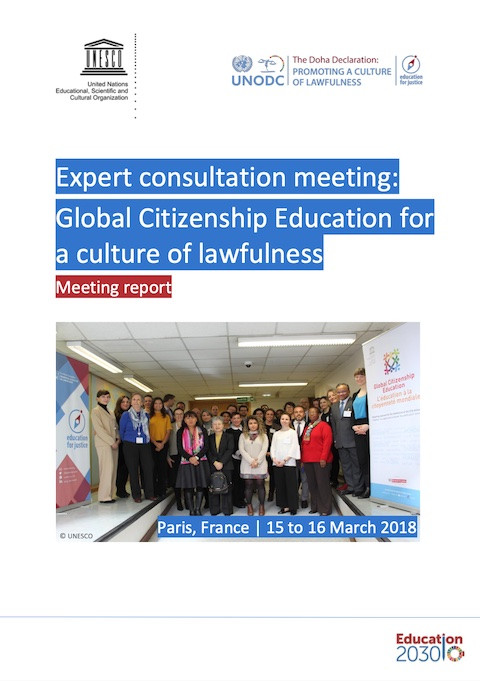 Expert Consultation Meeting: Global Citizenship Education for a Culture of Lawfulness; Meeting Report Year of publication: 2018 Corporate author: UNESCO | UN. Office on Drugs and Crime (UNODC) In the context of a UNESCO/UNODC partnership on “Global Citizenship Education for a Culture of Lawfulness”, an expert consultation meeting was held in Paris on March 15 and 16 of 2018. The purpose of the partnership is to strengthen the capacities of educational systems to promote the rule of law. To this end, the partnership aims to empower and equip learners to act and engage in society as constructive and ethically responsible agents of change, supporting peace, justice, and strong institutions. This notably contributes to the achievement of the 2030 Agenda for Sustainable Development, and in particular Sustainable Development Goals 4 and 16. Additionally, the partnership intends to enable learners to be both motivated and capable to respond resiliently to crime and violence. The meeting had three broad objectives: To help clarify the conceptual foundation of the partnership; to identify the measures that can be taken in the education sector to promote a culture of lawfulness; and to identify effective educational approaches. Thus, the meeting is meant to elucidate core concepts and identify promising educational approaches in the promotion of a culture of lawfulness by asking fundamental questions, including: What constitutes the rule of law and a culture of lawfulness? How do we create demand for the rule of law? How do we ensure learners apply these principles? How do we ensure they survive in a context where there is no rule of law?
  Empowering Students for Just Societies: A Handbook to Teach Integrity in Secondary Schools Year of publication: 2024 Corporate author: UNESCO | UN. Office on Drugs and Crime (UNODC) The importance of education lies in its power to shape the values of upcoming generations and equip them with the knowledge to make informed decisions. Contemporary challenges, including corruption must be addressed through education, transparency, accountability and the rule of law, among other efforts. This joint publication by UNODC and UNESCO is a response to this important issue. It is aimed at educators who are striving to inspire and prepare future generations to actively contribute to societies grounded in integrity, ethics and respect for the rule of law. The handbook builds on the first two launched in 2019. This publication highlights the transformative power of education in strengthening the knowledge, skills, attitudes and values necessary for addressing global challenges, especially those that stem from a lack of integrity, like corruption. It underlines the crucial role education plays in nurturing critical thinking, empathy, ethical behaviour, and a commitment to justice and equality among people. The handbook presents a catalogue of educational activities, lesson plans and outside the classroom resources designed to empower youth to reject corrupt practices and become agents of change, promoting integrity and upholding democratic values.