
Resources
Explore a wide range of valuable resources on GCED to deepen your understanding and enhance your research, advocacy, teaching, and learning.
1,583 Results found
 Aichi-Nagoya Declaration on Education for Sustainable Development Year of publication: 2014 Corporate author: UNESCO We, the participants of the UNESCO World Conference on Education for Sustainable Development held in AichiNagoya, Japan, from 10 to 12 November 2014, adopt this Declaration and call for urgent action to further strengthen and scale up Education for Sustainable Development (ESD), in order to enable current generations to meet their needs while allowing future generations to meet their own, with a balanced and integrated approach regarding the economic, social and environmental dimensions of sustainable development. This Declaration recognises that people are at the centre of sustainable development and builds on the achievements of the United Nations (UN) Decade of ESD (2005-2014); the deliberations of the UNESCO World Conference on ESD in Aichi-Nagoya; and the Stakeholder Meetings held in Okayama, Japan, from 4 to 8 November 2014, namely, UNESCO ASPnet International ESD events, the UNESCO ESD Youth Conference, the Global Regional Centres of Expertise Conference, and other relevant events and consultation processes, including regional ministerial meetings. We express our sincere gratitude to the Government of Japan for hosting the UNESCO World Conference on ESD. Déclaration d'Aichi-Nagoya sur l'Éducation pour le Développement Durable Year of publication: 2014 Corporate author: UNESCO Développement durable tenu à Aichi Nagoya, au Japon, du 10 au 12 Novembre 2014, adopte la présente Déclaration et appel à une action urgente pour renforcer et intensifier l'éducation pour le développement durable (EDD), afin de permettre aux générations actuelles de répondre à leurs besoins tout en permettant l'avenir générations à répondre à leurs propres, avec une approche équilibrée et intégrée en ce qui concerne les dimensions économiques, sociales et environnementales du développement durable. Cette Déclaration reconnaît que les gens sont au centre du développement durable et se fonde sur les résultats de la Décennie des Nations Unies (ONU) de l'EDD (2005-2014); les délibérations de la conférence mondiale sur EDD UNESCO à Aichi-Nagoya; et les réunions des parties prenantes tenues à Okayama, au Japon, du 4 au 8 Novembre 2014, à savoir, le réseau des écoles associées à l'UNESCO (réSEAU), les événements JED International, la Conférence des jeunes de l'UNESCO sur l'EDD, la Conférence des centres régionaux d'expertise, et d'autres événements pertinents et les processus de consultation, y compris les réunions ministérielles régionales. Nous exprimons notre sincère gratitude au Gouvernement du Japon pour avoir accueilli la Worldconférenceon EDD UNESCO. Déclaration d'Aichi-Nagoya sur l'Education au Développement Durable Year of publication: 2014 Corporate author: UNESCO We, the participants of the UNESCO World Conference on Education for Sustainable Development held in AichiNagoya, Japan, from 10 to 12 November 2014, adopt this Declaration and call for urgent action to further strengthen and scale up Education for Sustainable Development (ESD), in order to enable current generations to meet their needs while allowing future generations to meet their own, with a balanced and integrated approach regarding the economic, social and environmental dimensions of sustainable development. This Declaration recognises that people are at the centre of sustainable development and builds on the achievements of the United Nations (UN) Decade of ESD (2005-2014); the deliberations of the UNESCO World Conference on ESD in Aichi-Nagoya; and the Stakeholder Meetings held in Okayama, Japan, from 4 to 8 November 2014, namely, UNESCO ASPnet International ESD events, the UNESCO ESD Youth Conference, the Global Regional Centres of Expertise Conference, and other relevant events and consultation processes, including regional ministerial meetings. We express our sincere gratitude to the Government of Japan for hosting the UNESCO World Conference on ESD.
 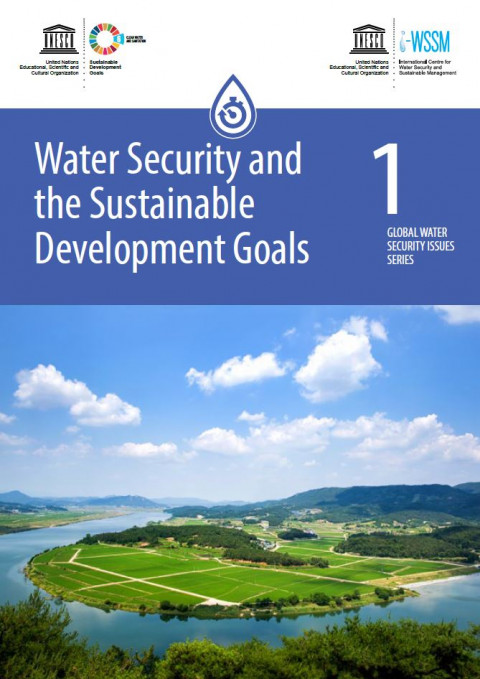 Water Security and the Sustainable Development Goals (Global Water Security Issues Series, 1) Year of publication: 2019 Corporate author: UNESCO | International Centre for Water Security and Sustainable Management (i-WSSM) The ‘Global Water Security Issues (GWSI) series’ is the product of synergy within the UNESCO system, in particular the International Water Security and Sustainable Management (i-WSSM).The first edition of the GWSI series also seeks to demonstrate that water has a central role in all aspects of economic development and social welfare, and that concerted action via a collective approach of the water-using sectors is needed to ensure water’s many benefits are maximized and shared equitably and that water-related development goals are achieved.While this publication is factual, containing the most current information available concerning the state of knowledge on water security in the perspective of sustainable development and covering the most recent developments that affect it, this publication also provides decision-makers with concrete examples of approaches and potential responses for addressing water security-related challenges from the perspectives of both the sustainable development goals (SDGs) and a broader political and sectoral scope, which covers development, financing, capacity-building, institutional reform and technology.It is hoped that this publication will be a reference source on water security as it covers all aspects of human development and the cases and solutions introduced in the GWSI series can be invaluable for decision-makers, their advisors and anyone interested in – and concerned about – water security, and that this first edition will reach an ever-widening audience that includes actors outside the ‘water box’ who make or influence broad socio-economic policies that can affect water security. 爱知县名古屋可持续发展教育宣言 Year of publication: 2014 Corporate author: UNESCO We, the participants of the UNESCO World Conference on Education for Sustainable Development held in AichiNagoya, Japan, from 10 to 12 November 2014, adopt this Declaration and call for urgent action to further strengthen and scale up Education for Sustainable Development (ESD), in order to enable current generations to meet their needs while allowing future generations to meet their own, with a balanced and integrated approach regarding the economic, social and environmental dimensions of sustainable development. This Declaration recognises that people are at the centre of sustainable development and builds on the achievements of the United Nations (UN) Decade of ESD (2005-2014); the deliberations of the UNESCO World Conference on ESD in Aichi-Nagoya; and the Stakeholder Meetings held in Okayama, Japan, from 4 to 8 November 2014, namely, UNESCO ASPnet International ESD events, the UNESCO ESD Youth Conference, the Global Regional Centres of Expertise Conference, and other relevant events and consultation processes, including regional ministerial meetings. We express our sincere gratitude to the Government of Japan for hosting the UNESCO World Conference on ESD. Plan de mise en oeuvre international de la décennie des Nations Unies pour l'éducation au service du développement durable, 2005-2014 Year of publication: 2005 Corporate author: UNESCO In December 2002, the UN General Assembly adopted a resolution to put in place a UN Decade of Education for Sustainable Development, lasting from 2005 to 2014. UNESCO was tasked with leading the Decade and developing an International Implementation Scheme (IIS).
  Monitoring the implementation of the Lisbon Recognition Convention - Council of Europe Higher Education Series No. 23 Year of publication: 2019 Corporate author: UNESCO | Council of Europe In accordance with the Lisbon Recognition Convention, the Committee of the Convention shall oversee its implementation and guide the competent authorities in implementing the convention and in their consideration of applications for the recognition of foreign qualifications. The Rules of procedure (adopted by the Committee in Vilnius in 1999) reiterate this role – the function of the Committee is to promote the application of the convention and oversee its implementation. Article II. of the convention states that where the central authorities of a party are competent to make decisions in recognition cases, that party shall be immediately bound by the provisions of the convention and shall take the necessary measures to ensure the implementation of its provisions on its territory. Where the competence to make decisions in recognition matters lies with individual higher education institutions or other entities, each party, according to its constitutional situation or structure, shall transmit the text of this convention to those institutions or entities and shall take all possible steps to encourage the favourable consideration and application of its provisions. The provisions of Article II. are central to determining the obligations of the parties to the convention. This article places upon these parties an obligation to make sure that information on the provisions is disseminated to all competent recognition authorities, and that these institutions are encouraged to abide by the convention (Explanatory report to the convention). The objective of this monitoring exercise has been to oversee the implementation of the main provisions of the convention and to report to parties on the outcome of this monitoring, presenting the main findings and recommendations. This monitoring report is also a contribution to the commitment set out in the Yerevan Communiqué (2015) to review national legislation to ensure full compliance with the convention, and to ask the Convention Committee, in co-operation with the ENIC (Council of Europe and UNESCO European Network of National Information Centres on academic recognition and mobility) and NARIC (EU Network of National Academic Recognition Information Centres) networks, to prepare an analysis of the national legislation reports by the end of 2017, taking due account of this monitoring report. This is the first monitoring of implementation of the Lisbon Recognition Convention (LRC) since its signature in 1997. The questionnaire used for the monitoring exercise was drawn up by the Bureau of the Convention Committee, namely Gunnar Vaht, President of the Committee, Gayane Harutyunyan, Vice-President, Allan Bruun Pedersen, Vice-President, and Baiba Ramina, Rapporteur, together with the joint Council of Europe/UNESCO Secretariat. The monitoring covers the 10 main provisions of the convention and comprises 22 questions relating to implementation of the main principles. The questions focus primarily on how the convention requirements are regulated at national level and to what extent the rules are reflected in national legislation. In cases where some or all of the provisions are not regulated at national level and where the higher education institutions have total autonomy in establishing the principles of the convention, the aim has been to discover how national authorities oversee implementation of the principles of the convention at institutional level. As stated above, the objective of this monitoring report is to monitor implementation of the convention by the parties to the convention. The executive summary focuses on the key findings and the conclusions focus on the recommendations made by the Convention Committee Bureau, which will require political decisions from the Convention Committee and from national authorities for follow-up action. The various chapters of the report elaborate further on both the key findings and the recommendations. The questionnaire was sent to 53 states parties to the LRC, and replies were received from 50 countries. The initial deadline given was 15 February 2015, but this was extended to June 2015. The analysis by the members of the Convention Committee Bureau took place from June to November 2015 and was assisted and reviewed by the Council of Europe and UNESCO, the joint Secretariat of the LRCC Bureau.
 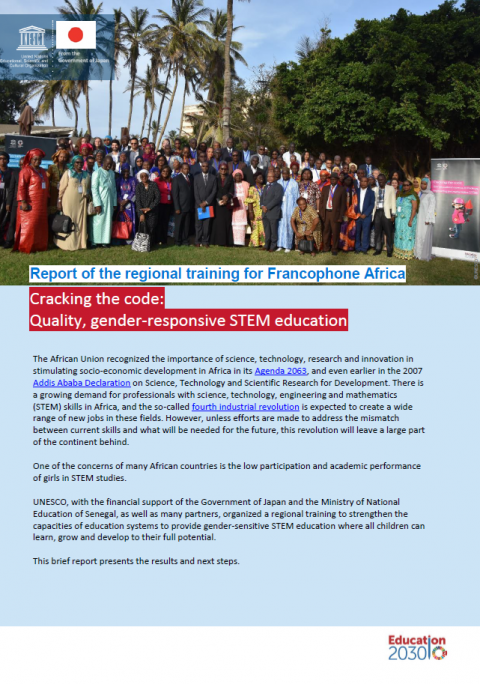 Report of the regional training for Francophone Africa, cracking the code: quality, gender-responsive STEM education Year of publication: 2019 Corporate author: UNESCO The African Union recognized the importance of science, technology, research and innovation in stimulating socio-economic development in Africa in its Agenda 2063, and even earlier in the 2007 Addis Ababa Declaration on Science, Technology and Scientific Research for Development.There is a growing demand for professionals with science, technology, engineering and mathematics (STEM) skills in Africa, and the so-called fourth industrial revolution is expected to create a wide range of new jobs in these fields. However, unless efforts are made to address the mismatch between current skills and what will be needed for the future, this revolution will leave a large part of the continent behind.One of the concerns of many African countries is the low participation and academic performance of girls in STEM studies. UNESCO, with the financial support of the Government of Japan and the Ministry of National Education of Senegal, as well as many partners, organized a regional training to strengthen the capacities of education systems to provide gender-sensitive STEM education where all children can learn, grow and develop to their full potential. This brief report presents the results and next steps.
 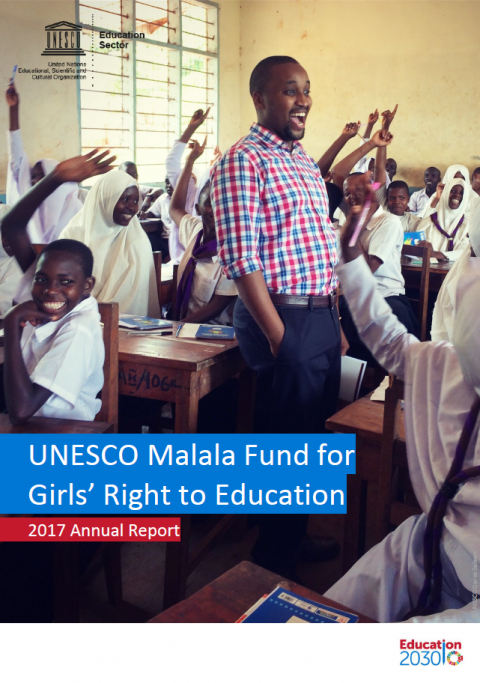 UNESCO Malala Fund for Girls' Right to Education: 2017 annual report Year of publication: 2018 Corporate author: UNESCO The brutal assassination attempt made against Pakistani teenager and activist for girls’ education Malala Yousafzai gave birth to the UNESCO Malala Fund for Girls’ Right to Education. Part of the “Better Life, Better Future” Global Partnership for Girls’ and Women’s Education, the fund was established in 2012 to expand girls’ access to quality and gender-responsive education and ensure safe learning environments, especially in countries affected by conflict and disaster. The Islamic Republic of Pakistan initially committed 10 million USD to the Fund, and since 2014 the CJ Group is another major contributor to the Fund, along with other supporters.Fund objectivesThe Fund supports the implementation of holistic programmes which aim to: Expand access to education for girls and women, especially those hardest to reach and affected by conflict and disaster Improve the quality and relevance of education, ensuring that content, teaching practices, learning processes and environments are gender-sensitive Strengthen policy and capacity to ensure safe learning environments
 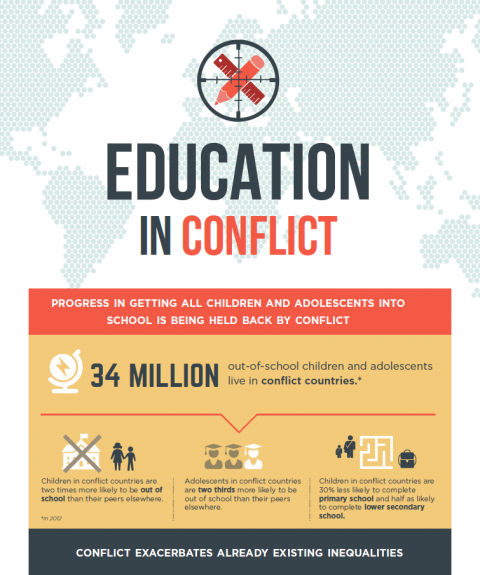 EDUCATION IN CONFLICT Corporate author: EFA Global Monitoring Report Team | UNESCO PROGRESS IN GETTING ALL CHILDREN AND ADOLESCENTS INTO SCHOOL IS BEING HELD BACK BY CONFLICT - 34 million out-of-school children and adolescents live in conflict countries. - Children in conflict countries are two times more likely to be out of school than their peers elsewhere.- Adolescents in conflict countries are two thirds more likely to be out of school than their peers elsewhere.- Children in conflict countries are 30% less likely to complete primary school and half as likely to complete lower secondary school.- Girls are almost two and a half times more likely to be out of school if they live in a conflict country than those elsewhere.- Adolescent girls are almost 90% more likely to be out of secondary school than young women elsewhere.- The poorest children in conflict countries are twice as likely to be out of school as the poorest elsewhere.