
Resources
Explore a wide range of valuable resources on GCED to deepen your understanding and enhance your research, advocacy, teaching, and learning.
792 Results found
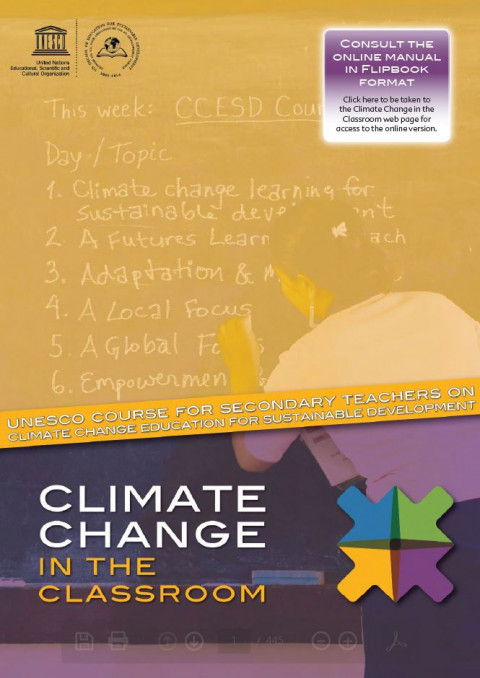 Climate change in the classroom: UNESCO course for secondary teachers on climate change education for sustainable development Year of publication: 2013 Author: David Selby | Fumiyo Kagawa Corporate author: UNESCO This course has been created with the goal of bringing climate change education outside the science classroom into the many other subject areas upon which climate change now has an impact, or will impact in the future, such as ethics, social studies, economics, political science, among others. The course materials are organized into four parts: 1. Course Framework and Overview, 2. Teachers’ Education Course daily materials, 3. Regional Resource Packs, 4. Daily Classroom Materials for teachers. These materials are all described in more detail and can be accessed from the Start Menu found on the following pages. This course is designed to enable teachers at the secondary level from diverse subject areas to introduce climate change education for sustainable development (CCESD) across the curriculum. UNESCO has identified the professional development of teachers in education for sustainable development as the top priority in recognition of the transformative role that teachers and teacher educators need to play in re-orienting education to help realize a sustainable future (UNESCO, 2005, p. 19). But good intentions for the professional development of teachers have fallen short in practice. Although taken up by enthusiasts, teacher education for sustainable development has rarely been mainstreamed, and, where there are courses, is often approached within a disciplinary as opposed to an interdisciplinary frame (Wals, A., 2009). If professional development in education for sustainable development is at an adolescent stage, teacher education in climate change education for sustainable development is in its infancy. For instance, according to a 2009 international comparative study on climate change education and sustainable development in ten countries, climate change education has peripheral status in educational research and practice, and when it is addressed it is only within science education (Læssøe,J. Schnack, K., Breiting, S. & Rolls, S., 2009). There is a clear and present need to respond to climate change challenges through systematic teacher education programmes that are not restricted to a single subject area. This teacher education course is an attempt to fill the current gap and is in line with one of UNESCO’s key objectives for climate change education for sustainable development, that is, to support teacher training on climate change for sustainable development (UNESCO, 2010, p. 9). The programme has four distinctive features: 1. It helps teachers to understand the causes, dynamics and impacts of climate change through a holistic approach. 2. Teachers are exposed to, and experience, a range of pedagogical approaches and techniques, that they can use in their own school environment. This includes engagement of themselves and their students in whole school and school-in-community approaches. 3. Teachers will develop their capacities to facilitate students’ community based learning. 4. Teachers will develop future-oriented and transformative capacities in facilitating climate change mitigation, adaptation, and disaster risk reduction learning.
  Education sector technical notes: climate change education Year of publication: 2013 Corporate author: UNESCO Climate change is a major challenge to sustainable development. The ten hottest years on record have occurred since 1998. Sea-levels are rising. Rainfall patterns are changing, causing droughts and floods. Extreme weather events such as storms, cyclones and heat waves are becoming more frequent and intense. Climate change poses a number of interconnected challenges, including water security, rising pressures on food production and health and disaster risks. ◗ Climate change disproportionately affects developing countries and vulnerable people within those countries, thereby seriously threatening progress towards the Millennium Development Goals (MDGs) and Education for All (EFA). It is already having a reverse impact on enrolment rates, the delivery of quality education and safe learning environments. ◗ Education has a key role to play in concerted local and global climate change mitigation and adaptation efforts. ◗ UNESCO promotes climate change education within the overall context of Education for Sustainable Development (ESD). ◗ UNESCO supports Member States in building the capacity of policy makers and educators to enhance the education sector response to climate change. ◗ Closer alignment of Climate Change Education with Disaster Risk Reduction (DRR) education contributes to safeguarding development gains and building resilience in countries vulnerable to the negative impacts of climate change. Odpowiedzi sektora edukacji na homofobiczna przemoc rówiesnicza Year of publication: 2014 Corporate author: UNESCO This publication is part of a Good Policy and Practice series that addresses key themes of UNESCO’s work with the education sector including HIV and AIDS and safe, healthy educational environments for all learners. This volume, on the theme of homophobic bullying in educational institutions, builds on UNESCO’s work on gender, discrimination and violence in schools.
  International Technical Guidance on Sexuality Education: An Evidence-Informed Approach for Schools, Teachers and Health Educators Year of publication: 2009 Corporate author: UNESCO Based on a rigorous and current review of evidence on sexuality education programmes, this International Technical Guidance on Sexuality Education is aimed at education and health sector decision-makers and professionals. It has been produced to assist education, health and other relevant authorities in the development and implementation of school-based sexuality education programmes and materials. Volume I focuses on the rationale for sexuality education and provides sound technical advice on characteristics of effective programmes. A companion document, (Volume II ) focuses on the topics and learning objectives to be covered in a ‘basic minimum package’ on sexuality education for children and young people from 5 to 18+ years of age and includes a bibliography of useful resources. The International Technical Guidance is relevant not only to those countries most affected by HIV and AIDS, but also to those facing low prevalence and concentrated epidemics.
  Holocaust Remembrance and Education: Our Shared Responsibility; International Day of Commemoration in Memory of the Victims of the Holocaust Year of publication: 2018 Corporate author: 联合国教科文组织 (UNESCO) This brochure describes the occasion "International Day of Commemoration in Memory of the Victims of the Holocaust". For this occasion, from 22nd to 25th January, UNESCO, in partnership with the Shoah Memorial, has organised a series of events: a screening of Claude Lanzmann’s Four Sisters, a round table, an official ceremony, and exhibitions.
 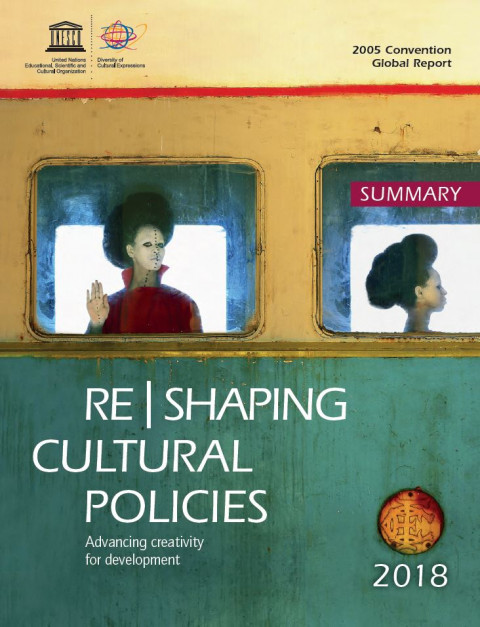 [Summary] Re|shaping Cultural Policies: Advancing Creativity for Development; 2005 Convention Global Report, 2018: Summary Year of publication: 2017 Corporate author: UNESCO The Global Report series has been designed to monitor the implementation of the UNESCO Convention on the Protection and Promotion of the Diversity of Cultural Expressions (2005). It also provides evidence of how this implementation process contributes to attaining the United Nations 2030 Sustainable Development Goals and targets.The 2018 Global Report analyses progress achieved in implementing the 2005 Convention since the first Global Report was published in 2015.Grounded in the analysis of the Quadrennial Periodic Reports submitted by Parties to the Convention and relevant new findings, this report examines how the 2005 Convention has inspired policy change at the global and country level in ten areas of monitoring. It puts forward a set of policy recommendations for the future, addressing the adaptation of cultural policies to rapid change in the digital environment, based on human rights and fundamental freedoms.When deployed together, the two editions of the Global Report are beginning to produce new and valuable evidence to inform cultural policy making and advance creativity for development.
  Human Right and Encryption Year of publication: 2016 Author: Wolfgang Schulz | Joris van Hoboken Corporate author: UNESCO This publication follows UNESCO’s new approach to Internet issues, as endorsed in November 2015 on the occasion of its 38th General Conference. Our 195 Member States have adopted the CONNECTing the Dots Outcome Document, in which 38 options for future action from UNESCO are set out; and the Internet Universality principles (R.O.A.M.),which advocates for a Human-rights-based, Open and Accessible Internet, governed by Multi-stakeholder participation.Encryption is a hot topic in the current global discussion on Internet governance. This research delves into the subject, to outline a global overview of the various means of encryption, their availability and their potential applications in the media and communications landscape. The research explains how the deployment of encryption is affected by different areas of law and policy, and it offers detailed case studies of encryption in selected jurisdictions.It analyzes in-depth the role of encryption in the media and communications landscape, and the impact on different services, entities and end users. Built on this exploration and analysis, the research provides recommendations on encryption policy that are useful for various stakeholders. These include signaling the need to counter the lack of gender sensitivity in the current debate, and also highlighting ideas for enhancing “encryption literacy”.
 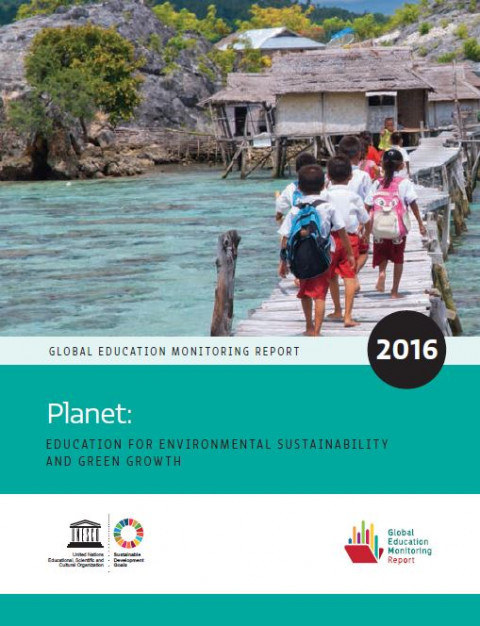 Global Education Monitoring Report, 2016: Planet: Education for Environmental Sustainability and Green Growth Year of publication: 2016 Corporate author: UNESCO PLANET: Education for environmental sustainability and green growth, a publication taken from the full 2016 Global Education Monitoring Report, explores the knowledge and skills needed for sustainable and inclusive economic growth that does not damage our planet.This publication demonstrates how education can help people understand and respond to environmental issues and climate change. Environmental education can increase green knowledge and build sustainability practices. The publication warns that while education contributes to economic growth, education systems must be careful not to encourage unsustainable lifestyles and all learners must acquire the knowledge and skills needed to promote sustainable development.It also argues that we must continue to learn throughout our lives in order to make production and consumption sustainable, and to provide green skills for green industries. Creating green industries relies on high-skill workers with specific training, yet by 2020 there could be 40 million too few workers with tertiary education relative to demand. Higher education and research should also be oriented towards green innovation and growth; innovation depends on cooperation in higher education and investment in research and development to transform production in vast swaths of the economy.It also recognises that education must change in order to keep up with the changing face of work. Green and transferable skills should be taught in both school and the workplace. The greening of industries requires not only the production of more high-skill workers, but the continued training and education for low and medium skill workers, often on the job. “To ensure the Sustainable Development Goals are implemented, everyone involved needs to think, to work, to organise, to communicate and to report in ways that are completely different from what has been done up till now. Education truly is key to a wide appreciation not just of the SDGs but the new ways of thinking and working that are going to be necessary to fulfil them. So the challenge to all of us is to re-learn, and that does not just apply to educators, but it applies to all of us.”
 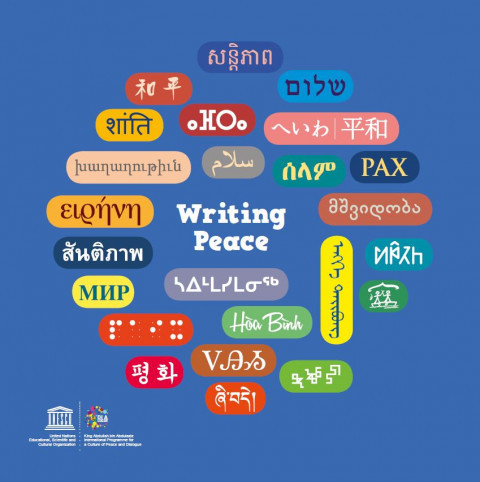 Writing Peace Year of publication: 2017 Author: Eric Cattelain Corporate author: UNESCO “Writing Peace” is a manual that invites young audiences to discover contemporary writings through the introduction of various languages. Its goal is to make the world appear a little closer and a little more familiar. "Writing Peace" encourages children (ages8 to 14) to become aware of the interdependence of cultures through familiarization with contemporary writing systems, their history, and their borrowings.The manual contains 24 activity sheets. Each section presents the characters of a writing system, an introductory text and historical background, the word “peace” and the word “hello,” the language(s) attached to the system(s), and an activity whose answers appear at the end of manual.Six thousand years after the advent of writing, what do we know about others, their systems of thought, and the transcriptions of their writing systems? How can different writing systems contribute to a better understanding of the world and our place within it? By beginning to learn about these writings and their fascinating beauty, the manual connects children to diversity, thus opening their eyes to the concept of peace and our awareness of it.
 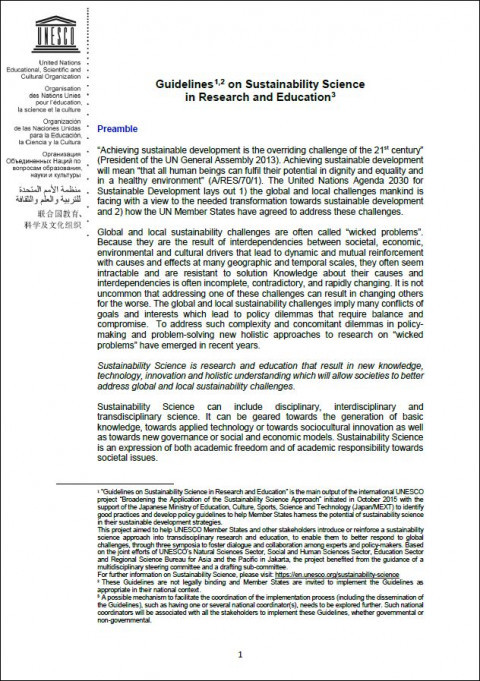 Guidelines on Sustainability Science in Research and Education Year of publication: 2017 Corporate author: UNESCO “Guidelines on Sustainability Science in Research and Education” is the main output of the international UNESCO project “Broadening the Application of the Sustainability Science Approach” initiated in October 2015 with the support of the Japanese Ministry of Education, Culture, Sports, Science and Technology (Japan/MEXT) to identify good practices and develop policy guidelines to help Member States harness the potential of sustainability science in their sustainable development strategies.This project aimed to help UNESCO Member States and other stakeholders introduce or reinforce a sustainability science approach into transdisciplinary research and education, to enable them to better respond to global challenges, through three symposia to foster dialogue and collaboration among experts and policy-makers. Based on the joint efforts of UNESCO’s Natural Sciences Sector, Social and Human Sciences Sector, Education Sector and Regional Science Bureau for Asia and the Pacific in Jakarta, the project benefited from the guidance of a multidisciplinary steering committee and a drafting sub-committee.For further information on Sustainability Science, please visit: https://en.unesco.org/sustainability-science