
Resources
Explore a wide range of valuable resources on GCED to deepen your understanding and enhance your research, advocacy, teaching, and learning.
1,578 Results found
 دور اليونسكو في تعزيز التعليم بوصفه أداة لدرء التطرف العنيف Year of publication: 2015 Corporate author: UNESCO This item has been included in the provisional agenda of the 197th session of the Executive Board at the request of the United States of America and co-sponsored by Bosnia and Herzegovina, Bulgaria, Costa Rica, Côte d’Ivoire, Djibouti, Finland, France, Germany, Jordan, Kenya, Latvia, Nigeria, Norway, Pakistan, Philippines, Republic of Korea, Rwanda, Senegal, Slovenia, Suriname, Switzerland and Turkey UNESCO's role in promoting education as a tool to prevent violent extremism Year of publication: 2015 Corporate author: UNESCO This item has been included in the provisional agenda of the 197th session of the Executive Board at the request of the United States of America and co-sponsored by Bosnia and Herzegovina, Bulgaria, Costa Rica, Côte d’Ivoire, Djibouti, Finland, France, Germany, Jordan, Kenya, Latvia, Nigeria, Norway, Pakistan, Philippines, Republic of Korea, Rwanda, Senegal, Slovenia, Suriname, Switzerland and Turkey La Función de la UNESCO en la promoción de la educación como instrumento para prevenir el extremismo violento Year of publication: 2015 Corporate author: UNESCO This item has been included in the provisional agenda of the 197th session of the Executive Board at the request of the United States of America and co-sponsored by Bosnia and Herzegovina, Bulgaria, Costa Rica, Côte d’Ivoire, Djibouti, Finland, France, Germany, Jordan, Kenya, Latvia, Nigeria, Norway, Pakistan, Philippines, Republic of Korea, Rwanda, Senegal, Slovenia, Suriname, Switzerland and Turkey Rôle de l'UNESCO dans la promotion de l'éducation comme outil de prévention de l'extrémisme violent Year of publication: 2015 Corporate author: UNESCO This item has been included in the provisional agenda of the 197th session of the Executive Board at the request of the United States of America and co-sponsored by Bosnia and Herzegovina, Bulgaria, Costa Rica, Côte d’Ivoire, Djibouti, Finland, France, Germany, Jordan, Kenya, Latvia, Nigeria, Norway, Pakistan, Philippines, Republic of Korea, Rwanda, Senegal, Slovenia, Suriname, Switzerland and Turkey
  دور اليونسكو في تعزيز التعليم باعتباره وسيلة لدرء التطرف العنيف Year of publication: 2016 Corporate author: UNESCO The Director-General reports on the progress made on the implementation of 197 EX/Decision 46 on “UNESCO’s role in promoting education as a tool to prevent violent extremism”. This report presents the activities that have been implemented as well as those that are underway to take forward the Decision. UNESCO's role in promoting education as a tool to prevent violent extremism Year of publication: 2016 Corporate author: UNESCO The Director-General reports on the progress made on the implementation of 197 EX/Decision 46 on “UNESCO’s role in promoting education as a tool to prevent violent extremism”. This report presents the activities that have been implemented as well as those that are underway to take forward the Decision. La Función de la UNESCO en la promoción de la educación como instrumento para prevenir el extremismo violento Year of publication: 2016 Corporate author: UNESCO The Director-General reports on the progress made on the implementation of 197 EX/Decision 46 on “UNESCO’s role in promoting education as a tool to prevent violent extremism”. This report presents the activities that have been implemented as well as those that are underway to take forward the Decision. Rôle de l'UNESCO dans la promotion de l'éducation comme outil de prévention de l'extrémisme violent Year of publication: 2016 Corporate author: UNESCO The Director-General reports on the progress made on the implementation of 197 EX/Decision 46 on “UNESCO’s role in promoting education as a tool to prevent violent extremism”. This report presents the activities that have been implemented as well as those that are underway to take forward the Decision.
  Replantear la educación: ¿Hacia un bien común mundial? Year of publication: 2015 Corporate author: UNESCO The changes in the world today are characterized by new levels of complexity and contradiction. These changes generate tensions for which education is expected to prepare individuals and communities by giving them the capability to adapt and to respond. This publication contributes to rethinking education and learning in this context. It builds on one of UNESCO’s main tasks as a global observatory of social transformation with the objective of stimulating public policy debate. It is a call for dialogue among all stakeholders. It is inspired by a humanistic vision of education and development, based on respect for life and human dignity, equal rights, social justice, cultural diversity, international solidarity, and shared responsibility for a sustainable future. These are the fundamentals of our common humanity. This book enhances the vision provided by the two landmark UNESCO publications: Learning to Be: The world of education today and tomorrow (1972), the ‘Faure Report’, and Learning: The treasure within (1996), the ‘Delors Report’.
 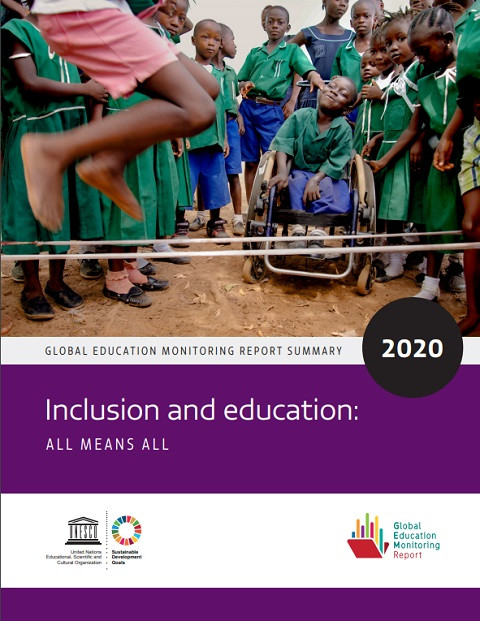 [Resumen] Resumen del informe de seguimiento de la educación en el mundo 2020: Inclusión y educación; Todos sin excepción Year of publication: 2020 Corporate author: UNESCO | Global Education Monitoring Report Team En el Informe de Seguimiento de la Educación en el Mundo 2020 se examinan los mecanismos sociales, económicos y culturales que discriminan a niños, jóvenes y adultos desprotegidos, manteniéndolos excluidos de la educación o marginados dentro de ella. Estimulados por su compromiso de hacer realidad el derecho a la educación inclusiva, los países están ampliando su visión de la inclusión en la educación y otorgando a la diversidad un lugar central en sus sistemas. Sin embargo, la aplicación de leyes y políticas bienintencionadas suele flaquear. El informe, publicado a principios del decenio de acción que culmina en 2030 y en el contexto de la crisis de Covid-19 que ha exacerbado las desigualdades subyacentes, sostiene que la resistencia a atender las necesidades de todos los educandos es una verdadera amenaza para el logro de los objetivos mundiales de educación.