
Resources
Explore a wide range of valuable resources on GCED to deepen your understanding and enhance your research, advocacy, teaching, and learning.
1,578 Results found
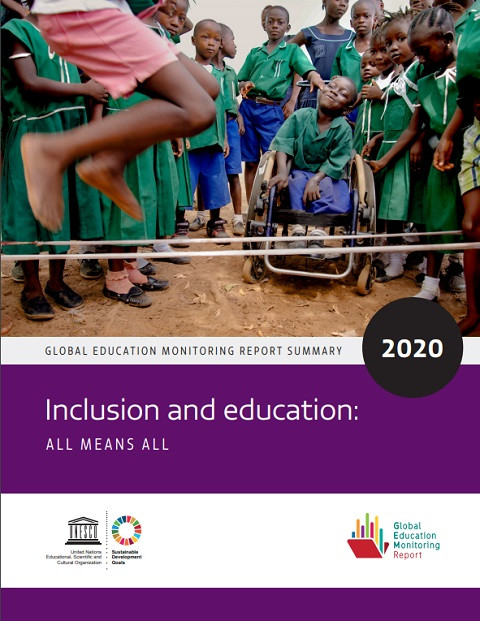 [Résumé] Résumé du rapport mondial de suivi sur l’éducation 2020: Inclusion et éducation; Tous, sans exception Year of publication: 2020 Corporate author: UNESCO | Global Education Monitoring Report Team L’édition 2020 du Rapport mondial de suivi sur l’éducation examine les mécanismes sociaux, économiques et culturels qui discriminent les enfants, les jeunes et les adultes défavorisés, les tenant à l’écart de l’éducation ou les marginalisant en son sein. Encouragés par leur engagement à réaliser le droit à l’éducation inclusive, les pays élargissent leur vision de l’inclusion dans l’éducation afin de placer la diversité au cœur de leurs systèmes. Pourtant, la mise en œuvre de lois et de politiques bien intentionnées échoue souvent. Publié au début de la décennie d’action à l’horizon 2030, et en pleine crise de COVID-19 qui a exacerbé les inégalités existantes, rapport affirme que la résistance à la prise en compte des besoins de chaque apprenant constitue une menace réelle pour la réalisation des objectifs mondiaux d’éducation. [요약문] 세계 교육 현황 보고서 요약본 2020: 포용과 교육; 모두는 모든 이를 의미한다 (All Means All) Year of publication: 2020 Corporate author: UNESCO | Global Education Monitoring Report Team 『2020 세계 교육 현황 보고서』는 취약계층 아동, 청소년 및 청년을 차별하여 교육에서 배제시키거나 소외시키는 사회적, 경제적, 문화적 메커니즘을 살펴본다. 포용적 교육에 대한 권리를 실현하겠다는 약속에 힘입어 모든 국가는 다양성을 교육제도의 핵심에 두기 위해 포용에 대한 비전을 확대하고 있다. 그러나 선의의 법과 정책의 시행은 종종 비틀거리곤 한다. 2030년까지 10년간의 실행이 시작되는 시점이자 근본적인 불평등을 악화시킨 코로나19 위기의 중간에 발표된 이 보고서는 모든 학습자의 요구를 해결하는 것에 대한 저항이 세계 교육 목표를 달성하는데 실질적인 위협이라고 주장한다. 『포용과 교육: 모두는 모든 이를 의미한다(ALL MEANS ALL)』는 거버넌스와 재정, 교육과정, 교과서 및 평가, 교사 교육, 학교 인프라, 그리고 포용의 과정을 밝힐 수 있는 학생, 학부모, 지역사회와의 관계 등에서 많은 실천들을 확인할 수 있다. 이 보고서는 학습자의 다양성을 사회적 응집력으로 만들기 위한 정책 권고안을 제공한다.
  Principes directeurs à l'attention des éducateurs pour combattre l'intolérance et la discrimination à l'encontre des musulmans: aborder l'islamophobie à travers l'éducation Year of publication: 2013 Corporate author: UNESCO | Council of Europe | OSCE. Office for Democratic Institutions and Human Rights (ODIHR) Intolerance and discrimination against Muslims are not new phenomena. However, they have evolved and gained momentum in recent years, particularly under conditions of the “war on terror”, the global economic crisis, anxieties about national identity and difficulties in coping with the increased diversity in many societies. Such developments have contributed to a growth in resentment and fear of Muslims and Islam that often been fuelled by sections of the media and by some political discourse. Muslims are often portrayed as extremists who threaten the security and well-being of others.These stereotypes have impact not only on young people but also on their parents, as well as on teachers and other education professionals. This presents a new challenge for educators. While teachers cannot be expected to resolve the political and social tensions among communities, they can play a central role in shaping the attitudes and behaviours of young people. The actions and approaches adopted by teachers and school administrators can be crucial in promoting respect for diversity and mutual understanding, both in schools and in society.Developed by OSCE/ODIHR, the Council of Europe and UNESCO, these Guidelines aim to support educators in countering intolerance and discrimination against Muslims. They are intended for a wide audience, including teachers, principals and head teachers, education policymakers and officials, teacher trainers, teacher unions and professional associations, and NGOs. The Guidelines are relevant for both primary and secondary education and can also be used in non-formal education settings.
  عدسة التعليم من أجل التنمية المستدامة أداة استعراض السياسات والممارسات Year of publication: 2010 Corporate author: UNESCO The UN Decade of Education for Sustainable Development (DESD) calls on the Governments to consider the inclusion of measures to implement the Decade in their respective education systems and strategies and, where appropriate, into national development plans’.2 This ESD Lens provides tools to start this process. It can be adapted to different educational contexts, and country specific policy and practice needs. It is not prescriptive, but provides guidelines and starting points for reviewing education policy and practice using an ESD perspective. ESD Lens Review Tools are provided for planning, for building knowledge of ESD, for reviewing national policy and the aims of education, for reviewing quality learning outcomes, and for reviewing more specific and detailed aspects of the education system such as curriculum, learning materials, assessment and teacher education. The tool is flexible and can be used at different levels of the system.Some of the tools are more suited to policy-makers, while others can be used by teachers and principals in schools. Ideally they should all be used to ensure a more systemic re-orientation of the education system in a country, province, region or district.The pilot testing of the ESD Lens showed that it helps to build synergy for understanding and implementing ESD at national level and at sub-regional levels. The key question being addressed by the ESD Lens is:How can education policies, curriculum and other support processes sufficiently integrate the principles of ESD to inform and strengthen the quality of learning experiences for sustainable development?
 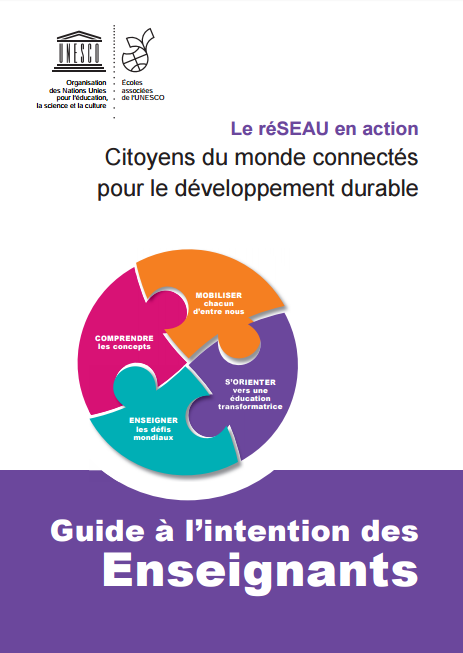 Le réSEAU en action: Citoyens du monde connectés pour le développement durable: guide à l'intention des enseignants Year of publication: 2017 Corporate author: UNESCO Le guide à l’intention des enseignants : donne aux élèves une idée de ce que signifie pour eux « devenir des citoyens du monde » ainsi que des suggestions pour contribuer au développement durable ; propose des idées d’activités en classe pour aider les élèves du secondaire à développer des connaissances, des compétences, des valeurs, des attitudes et des comportements en faveur de l’ECM et de l’EDD ; présente une sélection d’activités sur l’ECM et l’EDD mises en œuvre par les écoles du réSEAU du monde entier. Shaping the education of tomorrow: 2012 full length report on the UN Decade of Education for Sustainable Development Year of publication: 2012 Author: Arjen E.J. Wals Corporate author: UNESCO This report represents the second review of the DESD and is conducted in the context of its Global Monitoring and Evaluation Framework (GMEF). It appears twenty years after the Rio Earth Summit, at a time where the challenge of SD is greater than ever. It is all the more timely because there is increased recognition that this challenge cannot be solved solely through technological advances, legislative measures and new policy frameworks. While such responses are necessary, they need to be accompanied by changes in mindsets, values and lifestyles and a strengthening of people’s capacities to bring about change.The report shows that many governments, NGOs, UN agencies and indeed, companies are increasingly emphasizing the importance of learning and capacity-building as they search for solutions to sustainability challenges including climate change, disaster risk management, biodiversity loss and sustainable production and consumption.
 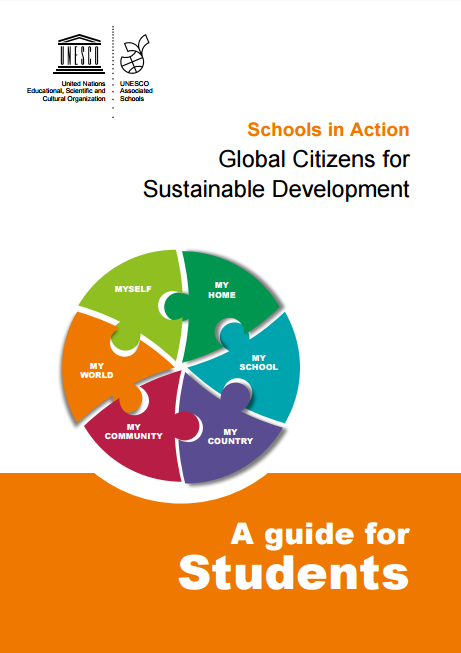 Schools in action, global citizens for sustainable development: a guide for students Year of publication: 2016 Corporate author: UNESCO The UNESCO Associated Schools Project Network (ASPnet) in Action: Global Citizens for Sustainable Development student guide aims to introduce secondary school students to Global Citizenship Education (GCED) and Education for Sustainable Development (ESD) and provide them with ideas and activities to contribute proactively to a more peaceful and sustainable world. The guide draws on the discussions and activities of almost 1,100 participants from 104 countries, including ASPnet National Coordinators, school principals, teachers, students and experts who contributed to the ASPnet Online Collaborative Platform: Global Citizens Connected for Sustainable Development in 2014 and 2015 [http://en.unesco.org/aspnet/globalcitizens]. You will find in this student guide: An overview of what it means to be a global citizen and of how you can contribute to sustainable development. Ideas for getting active yourself, as part of your home, school, community, country and globally. Selected activities on GCED and ESD from ASPnet schools around the world. Escuelas en acción Ciudadanos del mundo para el desarrollo sostenible: guía para el alumnado Year of publication: 2016 Corporate author: UNESCO The UNESCO Associated Schools Project Network (ASPnet) in Action: Global Citizens for Sustainable Development student guide aims to introduce secondary school students to Global Citizenship Education (GCED) and Education for Sustainable Development (ESD) and provide them with ideas and activities to contribute proactively to a more peaceful and sustainable world. The guide draws on the discussions and activities of almost 1,100 participants from 104 countries, including ASPnet National Coordinators, school principals, teachers, students and experts who contributed to the ASPnet Online Collaborative Platform: Global Citizens Connected for Sustainable Development in 2014 and 2015 [http://en.unesco.org/aspnet/globalcitizens]. You will find in this student guide: An overview of what it means to be a global citizen and of how you can contribute to sustainable development. Ideas for getting active yourself, as part of your home, school, community, country and globally. Selected activities on GCED and ESD from ASPnet schools around the world. Le réSEAU en action: Citoyens du monde connectés pour le développement durable: guide à l'intention des enseignants Year of publication: 2016 Corporate author: UNESCO The UNESCO Associated Schools Project Network (ASPnet) in Action: Global Citizens for Sustainable Development student guide aims to introduce secondary school students to Global Citizenship Education (GCED) and Education for Sustainable Development (ESD) and provide them with ideas and activities to contribute proactively to a more peaceful and sustainable world. The guide draws on the discussions and activities of almost 1,100 participants from 104 countries, including ASPnet National Coordinators, school principals, teachers, students and experts who contributed to the ASPnet Online Collaborative Platform: Global Citizens Connected for Sustainable Development in 2014 and 2015 [http://en.unesco.org/aspnet/globalcitizens]. You will find in this student guide: An overview of what it means to be a global citizen and of how you can contribute to sustainable development. Ideas for getting active yourself, as part of your home, school, community, country and globally. Selected activities on GCED and ESD from ASPnet schools around the world.
  Multi-Stakeholder Approaches to Education for Sustainable Development in Local Communities: Towards Achieving the Sustainable Development Goals in Asia Year of publication: 2020 Corporate author: UNESCO The idea for this publication first emerged from the ‘10th Asia-Pacific RCE Regional Meeting and Symposium on the Sustainable Development Goals: From Goals to Action’, held from 2 to 4 November 2017 at the India Habitat Centre in New Delhi, India. The case studies presented at the symposium became the basis for this publication.The cases presented in this publication show how RCEs create solutions that enable sustainable development practices in local communities by utilizing education, innovative learning methods and multi-stakeholder partnerships. Local stakeholders take ownership of the sustainability processes, consistently address the targeted SDGs, and demonstrate RCE contributions to the ESD for 2030 priority action areas – policy, education and training settings, educators, youth and community.