
Resources
Explore a wide range of valuable resources on GCED to deepen your understanding and enhance your research, advocacy, teaching, and learning.
1,578 Results found
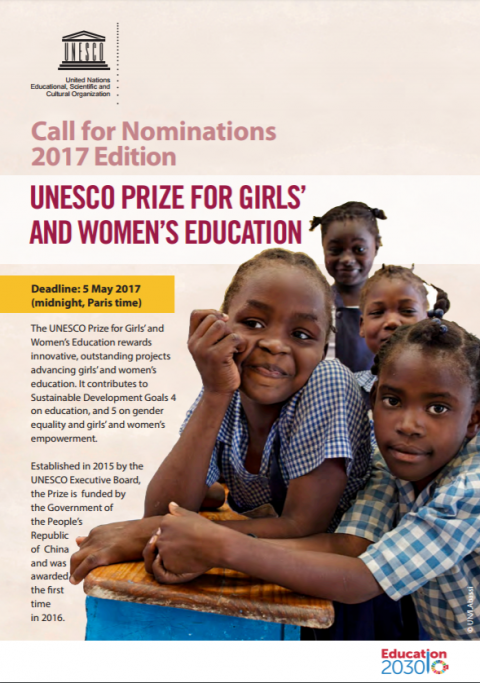 Premio UNESCO de educación de las niñas y las mujeres, edición de 2017: solicitud de candidaturas Year of publication: 2017 Corporate author: UNESCO The UNESCO Prize for Girls’ and Women’s Education rewards innovative, outstanding projects advancing girls’ and women’s education. It contributes to Sustainable Development Goals 4 on education, and 5 on gender equality and girls’ and women’s empowerment. Prix UNESCO pour l'éducation des filles et des femmes, édition 2017: appel à candidatures Year of publication: 2017 Corporate author: UNESCO The UNESCO Prize for Girls’ and Women’s Education rewards innovative, outstanding projects advancing girls’ and women’s education. It contributes to Sustainable Development Goals 4 on education, and 5 on gender equality and girls’ and women’s empowerment. Прием заявок в номинации Конкурс 2017. ПРЕМИЯ ЮНЕСКО ЗА ДОСТИЖЕНИЯ В ОБЛАСТИ ОБРАЗОВАНИЯ ДЕВОЧЕК И ЖЕНЩИН Year of publication: 2017 Corporate author: UNESCO The UNESCO Prize for Girls’ and Women’s Education rewards innovative, outstanding projects advancing girls’ and women’s education. It contributes to Sustainable Development Goals 4 on education, and 5 on gender equality and girls’ and women’s empowerment. 联合国教科文组织女童和妇女教育奖 - 2017年 - 征集提名 Year of publication: 2017 Corporate author: UNESCO The UNESCO Prize for Girls’ and Women’s Education rewards innovative, outstanding projects advancing girls’ and women’s education. It contributes to Sustainable Development Goals 4 on education, and 5 on gender equality and girls’ and women’s empowerment.
 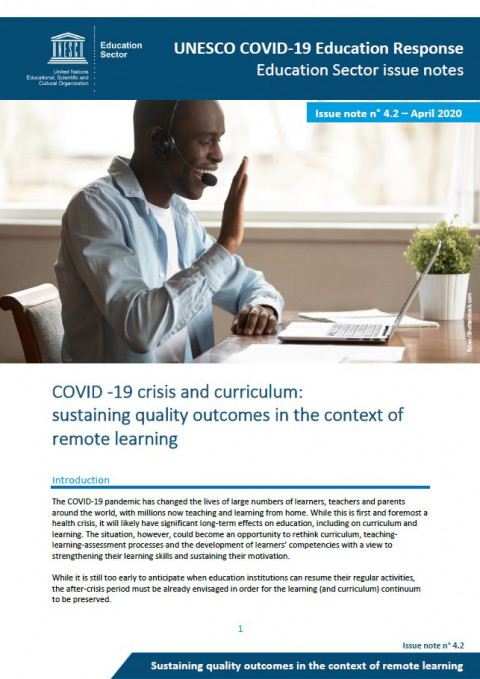 COVID-19 Crisis and Curriculum: Sustaining Quality Outcomes in the Context of Remote Learning (Issue Note no. 4.2 – April 2020) Year of publication: 2020 Corporate author: UNESCO The COVID-19 pandemic has changed the lives of large numbers of learners, teachers and parents around the world, with millions now teaching and learning from home. While this is first and foremost a health crisis, it will likely have significant long-term effects on education, including on curriculum and learning. The situation, however, could become an opportunity to rethink curriculum, teaching-learning-assessment processes and the development of learners’ competencies with a view to strengthening their learning skills and sustaining their motivation.This crisis will likely provide an opportunity for schools to strengthen their ties with families, and for teachers to communicate and cooperate better with parents in the interest of learners. In the same vein, the crisis means teachers and parents may become more involved in decisions regarding curriculum appropriateness. This can support the development of a learner-centred, participative and inclusive learning paradigm that takes into account the interests of learners, as well as their environments and aspirations. Crisis y currículo durante el COVID-19: mantención de los resultados de calidad en el contexto del aprendizaje remoto (Nota temática No. 4.2 – Abril 2020) Year of publication: 2020 Corporate author: UNESCO La pandemia del COVID-19 ha cambiado la vida de una gran cantidad de estudiantes, docentes, padres y madres a lo largo del mundo y millones actualmente enseñan y aprenden desde sus hogares. Aunque se trata principalmente de una crisis sanitaria, es probable que tenga importantes secuelas a largo plazo en la educación, incluso en el currículo y el aprendizaje. No obstante, la situación puede transformarse en una oportunidad para reexaminar el currículo, los procesos de evaluación de la enseñanza y del aprendizaje y el desarrollo de las competencias de las y los estudiantes, en vista de fortalecer sus habilidades de aprendizaje y mantener su motivación.Es probable que la crisis ofrezca una oportunidad para que las escuelas fortalezcan sus vínculos con las familias y para que las y los docentes se comuniquen y cooperen mejor con los padres y las madres en beneficio de las y los estudiantes. En la misma línea, la crisis significa que docentes, madres y padres podrían participar más en las decisiones respecto de la idoneidad del currículo. Esto puede servir como apoyo al paradigma de aprendizaje inclusivo, participativo y centrado en la y el estudiante, que considera tanto los intereses de las y los estudiantes como sus entornos y aspiraciones.
  Education for 'Global Citizenship': A Framework for Discussion Year of publication: 2013 Author: Sobhi Tawil Corporate author: UNESCO The notion of ‘global citizenship’ has recently gained prominence in international development discourse with the recently-adopted United Nations Secretary-General’s Global Education First Initiative (2012). Among the three priority areas outlined in this global initiative, the third aims to ‘foster global citizenship’.The notion of ‘global citizenship’, however, remains very broad, if not contested, and consequently difficult to operationalize in education. There are two possible reasons for this. Firstly, it is unclear whether the very notion of ‘global citizenship’ is a metaphor, a contradiction of terms, or an oxymoron (Davies, 2006). Secondly, when applied to education, the notion of ‘global citizenship’ implies a certain degree of confusion. This paper discusses the following questions. What does ‘global citizenship’ possibly imply both from a legal perspective, as well as from that of collective identity, sense of belonging, and civic engagement? Is ‘global citizenship education’ (or ‘education for global citizenship’) merely an expression of a fundamental purpose of education systems? Does it also refer to a broad area of teaching and learning? If so, what are the contours of this domain? How does it relate to other often overlapping areas of learning associated with civic and political socialization?
  Lucha contra la violencia y el acoso en el entorno escolar: la labor de la UNESCO Year of publication: 2017 Corporate author: UNESCO This item has been included in the provisional agenda of the 201st session of the Executive Board at the request of Morocco, with the support of Algeria, Cambodia, Côte d’Ivoire, Egypt, France, Italy, Lebanon, Qatar and Sudan. Combattre la violence et le harcèlement en milieu scolaire: action de l'UNESCO Year of publication: 2017 Corporate author: UNESCO This item has been included in the provisional agenda of the 201st session of the Executive Board at the request of Morocco, with the support of Algeria, Cambodia, Côte d’Ivoire, Egypt, France, Italy, Lebanon, Qatar and Sudan. Борьба с насилием и притеснениями в школьной среде: деятельность ЮНЕСКО Year of publication: 2017 Corporate author: UNESCO This item has been included in the provisional agenda of the 201st session of the Executive Board at the request of Morocco, with the support of Algeria, Cambodia, Côte d’Ivoire, Egypt, France, Italy, Lebanon, Qatar and Sudan.