
Resources
Explore a wide range of valuable resources on GCED to deepen your understanding and enhance your research, advocacy, teaching, and learning.
1,578 Results found
 World Programme for Human Rights Education: Plan of Action; Third Phase Year of publication: 2017 Corporate author: Office of the United Nations High Commissioner for Human Rights (OHCHR) | UNESCO The plan of action for the third phase (2015–2019) of the World Programme, which benefited from the input and review of governmental and nongovernmental experts and practitioners, proposes a concrete strategy and practical ideas for further implementing human rights education and training in the above-mentioned areas at the national level. Its key elements are highlighted below:Human rights education in the primary and secondary school systems and in higher education, and human rights training for teachers and educators, civil servants, law enforcement officials and the military.
  Роль ЮНЕСКО в популяризации образования в качестве инструмента предотвращения насильственного экстремизма Year of publication: 2016 Corporate author: UNESCO The Director-General reports on the progress made on the implementation of 197 EX/Decision 46 on “UNESCO’s role in promoting education as a tool to prevent violent extremism”. This report presents the activities that have been implemented as well as those that are underway to take forward the Decision. 教科文组织在促进利用教育手段预防暴力极端主义方面的作用 Year of publication: 2016 Corporate author: UNESCO The Director-General reports on the progress made on the implementation of 197 EX/Decision 46 on “UNESCO’s role in promoting education as a tool to prevent violent extremism”. This report presents the activities that have been implemented as well as those that are underway to take forward the Decision.
 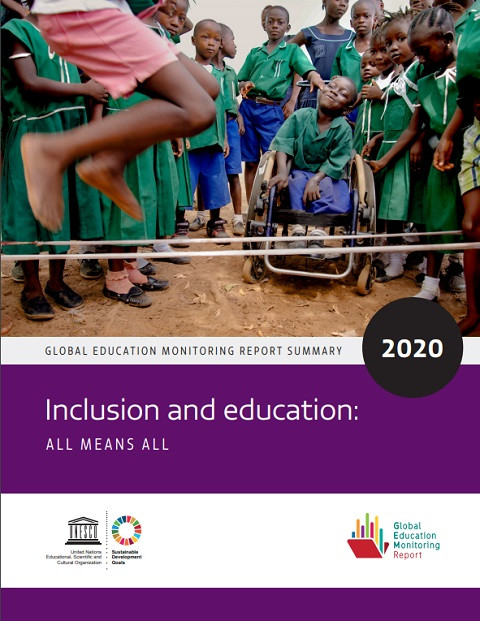 ملخص التقرير العالمي لرصد التعليم 2020: التعليم الشامل للجميع; الجميع بال استثناء Year of publication: 2020 Corporate author: UNESCO | Global Education Monitoring Report Team ينظر التقرير العالمي لرصد التعليم لعام 2020 في اآلليات االجتماعية واالقتصادية والثقافية التي تميز ضد األطفال والشباب والبالغين المحرومين، مما يحرمهم من التعليم أو يجعلهم مهمشين فيه. وبفضل حافز التزامها بإعمال الحق في التعليم الشامل، تعمل البلدان على توسيع نطاق رؤيتها للتعليم الشامل بإدراج التنوع في صلب ً ما يتعثر تنفيذ القوانين والسياسات الهادفة التي تنطوي نظمها التعليمية. لكن غالبا على نوايا حسنة. ويرى التقرير الذي صدر في بداية عقد العمل حتى عام 2030 ، وفي خضم األزمة الناجمة عن جائحة كوفيد-19 ،التي أسفرت عن تفاقم أوجه عدم ً أمام ً حقيقيا المساواة الكامنة، أن مقاومة تلبية احتياجات كل متعلم تشكل تهديدا تحقيق أهداف التعليم العالمية. [Summary] Global Education Monitoring Report Summary 2020: Inclusion and Education; All Means All Year of publication: 2020 Corporate author: UNESCO | Global Education Monitoring Report Team The 2020 Global Education Monitoring Report looks at social, economic and cultural mechanisms that discriminate against disadvantaged children, youth and adults, keeping them out of education or marginalized in it. Spurred by their commitment to fulfil the right to inclusive education, countries are expanding their vision of inclusion in education to put diversity at the core of their systems. Yet implementation of well-meaning laws and policies often falters. Released at the start of the decade of action to 2030, and in the middle of the Covid-19 crisis, which has exacerbated underlying inequalities, the Report argues that resistance to addressing every learner’s needs is a real threat to achieving global education targets.
  Periodismo, “Noticias Falsas” & Desinformación : Manual de Educación y Capacitación en Periodismo Year of publication: 2020 Author: Julie Posetti | Cherilyn Ireton | Claire Wardle | Hossein Derakhshan | Alice Matthews | Magda Abu-Fadil | Tom Trewinnard | Fergus Bell | Alexios Mantzarlis Corporate author: UNESCO Esta guía tiene como objetivo proporcionar un plan de estudios modelo relevante a nivel internacional, abierto a la implementación y/o adaptación, que responda al problema global emergente de la desinformación que afrontan las sociedades en general y el periodismo en particular. Este plan de estudios modelo está diseñado para brindar a los educadores y formadores de periodistas un marco de referencia y lecciones, a fin de ayudar a estudiantes y profesionales del periodismo a lidiar con los problemas relativos a las “noticias falsas”.El texto reúne el aporte de los principales educadores, investigadores y pensadores internacionales del periodismo que están ayudando a actualizar el método y la práctica del periodismo para afrontar los desafíos de la desinformación y la información errónea. Las lecciones son contextuales, teóricas y, en el caso de la verificación en línea, extremadamente prácticas. Empleadas juntas como un curso, o de manera independiente, pueden ayudar a actualizar los módulos de enseñanza existentes o crear nuevas ofertas.La Guía forma parte de la “Iniciativa Mundial para la Excelencia en la Enseñanza del Periodismo”, elemento esencial del Programa Internacional para el Desarrollo de la Comunicación de la UNESCO (PIDC). La Iniciativa tiene como objetivo contribuir con la enseñanza, la práctica y la investigación del periodismo, desde una perspectiva global, incluyendo el intercambio de buenas prácticas internacionales.
  Journalisme, fake news & désinformation : Manuel pour l’enseignement et la formation en matière de journalisme Year of publication: 2019 Author: Julie Posetti | Cherilyn Ireton | Claire Wardle | Hossein Derakhshan | Alice Matthews | Magda Abu-Fadil | Tom Trewinnard | Fergus Bell | Alexios Mantzarlis Corporate author: UNESCO Cette publication vise à fournir un modèle de programme applicable à l’échelle internationale, qui peut être adopté tel quel ou adapté, pour répondre au problème de la désinformation auquel sont confrontées toutes les sociétés en général, dans le monde, et le secteur du journalisme en particulier. Ce modèle de programme a été conçu pour fournir aux formateurs et aux enseignants en journalisme un cadre et une série de leçons, destinés aux étudiants et aux professionnels du journalisme, sur les questions associées aux « fake news ».Ce manuel a été rédigé avec la contribution de journalistes, enseignants, chercheurs et intellectuels internationaux de premier plan, engagés dans l’innovation des méthodes et des pratiques journalistiques face aux menaces de la mésinformation et de la désinformation. Ces leçons sont contextuelles, théoriques et, en ce qui concerne la vérification en ligne, extrêmement pratiques. Qu’elles soient utilisées dans le cadre d’un cours complet ou chacune séparément, elles peuvent contribuer à mettre à jour les modules d’enseignement existants ou à créer une nouvelle offre. Cette publication fait partie de l’« Initiative mondiale d’excellence pour l’enseignement du journalisme » qui est au centre du Programme international pour le développement de la communication (PIDC) de l’UNESCO. Cette initiative souhaite traiter l’enseignement, la pratique et la recherche en matière de journalisme dans une perspective mondiale, y compris par le partage de bonnes pratiques internationales.
 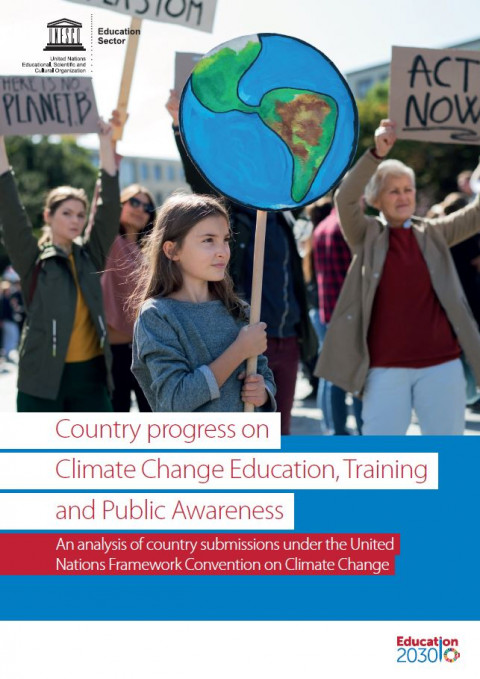 Country Progress on Climate Change Education, Training and Public Awareness: An Analysis of Country Submissions Under the United Nations Framework Convention on Climate Change Year of publication: 2019 Corporate author: UNESCO Since its entry into force, the 1992 United Nations Framework Convention on Climate Change (UNFCCC) in Article 6 has recognised the importance of ‘education, training and public awareness’ in mitigating ‘dangerous human interference with the climate system’. Article 12 of the Paris Agreement (2015) reaffirms this recognition.This document provides a status report on the implementation of climate change education in countries. It outlines key findings from an analysis of country submissions to the UNFCCC Secretariat as part of UNFCCC reporting processes and highlights achievements and remaining gaps in the area of climate change education.The analysis shows that almost all countries include some reference to climate change education in their country submissions under the UNFCCC reporting processes. This shows a certain level of commitment, which provides a good basis to further scale up educational responses to climate change. However, important gaps remain. Addressing them will be crucial in order to fully mobilize the power of education in response to this greatest challenge of our times. Progrès nationaux en matière d'éducation, de formation et de sensibilisation du public aux changements climatiques: Analyse des comptes rendus nationaux au titre de la Convention-cadre des Nations Unies sur les changements climatiques Year of publication: 2019 Corporate author: UNESCO Depuis son entrée en vigueur, la Convention-cadre des Nations Unies sur les changements climatiques (CCNUCC, 1992) reconnaît, dans son article 6, l’importance de l’éducation, de la formation et de la sensibilisation du public pour atténuer toute perturbation anthropique dangereuse du système climatique. L’article 12 de l’Accord de Paris (2015) réaffirme cette prise de conscience.Le présent document dresse un état des lieux de la mise en place de l’éducation aux changements climatiques dans les pays. Il souligne les principaux résultats issusde l’analyse des comptes rendus nationaux présentés au Secrétariat de la CCNUCC dans le cadre du processus d’établissement des communications à ce titre. Il met en lumière les réalisations accomplies et les lacunes à combler dans le domaine de l’éducation aux changements climatiques.L’analyse démontre que pratiquement tous les pays mentionnent l’éducation aux changements climatiques dans leurs comptes rendus nationaux soumis dans le cadre du processus d’établissement des communications au titre de la CCNUCC. Cela démontre un certain niveau d’engagement, garantie d’une bonne base pour renforcer les actions éducatives face aux changements climatiques. Cependant, d’importantes disparités persistent. Il sera crucial de les résorber afin de mobiliser le plein potentiel de l’éducation pour affronter le plus grand défi de notre époque.
 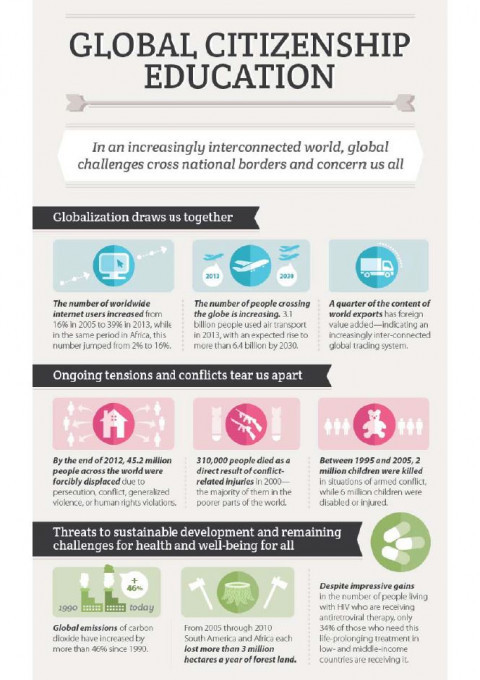 Global Citizenship Education infographic Year of publication: 2014 Corporate author: UNESCO In an increasingly interconnected world, global challenges cross national borders and concern us all. With issues like these threatening human and environmental well-being, we need to re-think the role and relevance of education. We need Global Citizenship Education. Global Citizenship Education is transformative. What are the barriers to this kind of education? What needs to change in education? What is UNESCO doing? What can you do?