
Resources
Explore a wide range of valuable resources on GCED to deepen your understanding and enhance your research, advocacy, teaching, and learning.
792 Results found
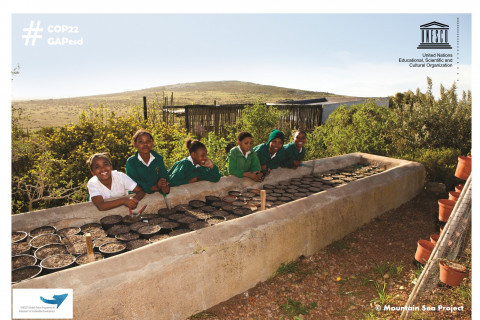 ESD Zoom Newsletters: COP22 Climate Action Year of publication: 2016 Corporate author: UNESCO ESD Zoom Newsletter COP22: Climate Action- COP22 advocates central role for education in international response to climate change- Education is key for green future says UNESCO Director-General at COP22- UNESCO launches two new publications International Events- First UNESCO Symposium on the Future of ESD held in Japanese town- ESD Prize 2016 awarded by UNESCO's Director-General in Paris- "Future of Education and Skills" meeting discusses conceptual learning framework and competencies On the Ground- In Ecuador, UNESCO launches Spanish version of "Tanah", a free game app to respond to earthquakes and tsunamis- Local communities in Tanzania learn to mitigate climate change- Promoting ESD through Community Learning Centres in Viet Nam GAP Key Partners- New app to discover the SDGs and share sustainable actions- OMEP launches Resource Bank on Early Childhood Education and ESD- Beijing International Forum on ESD gathers more than 300 experts- ESD guidelines for schools developed by Japan now availiable in English- Listen to Hilary Ewang Ngide speak about the commitment to the GAP of his organization CCREAD-Cameroon, following the winning of the UNESCO-Japan Prize on ESD- "Empowering the teacher of tomorrow" at LTN Conference in Tallinn
 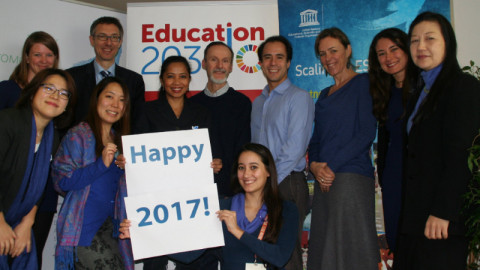 ESD Zoom Newsletters (January 2017) Year of publication: 2017 Corporate author: UNESCO ESD Zoom Newsletter Highlight- UNESCO opens nominations for UNESCO-Japan Prize on ESD 2017 International Events- Call for youth: Join online discussion to participate in UNESCO Week in Canada- Asia-Pacific Network for SDG4 launched at regional meeting on Education 2030- UNESCO ASPnet trains teachers to address climate change- ESD at heart of new Mediterranean Action Plan GAP Key Partners- GAP regional meeting: The role of cities in living sustainably- GAP key partner from Peru wins prestigious Rolex Award for Enterprise- Japan holds eighth National UNESCO ASPnet Conference- Video message by Okayama Youth- Winners of International Essay Contest for Young People awards- "Green Impact": The numbers speak for themselves
  Historical efforts to implement the UNESCO 1974 Recommendation on Education in light of 3 SDGs Targets Year of publication: 2017 Corporate author: UNESCO This paper presents an analytical overview of historical efforts by Member States of the United Nations Educational, Scientific and Cultural Organization (UNESCO) to implement the 1974 Recommendation concerning education for international understanding, cooperation and peace education relating to human rights and fundamental freedoms. The author of the review was hired in April 2016 to undertake an analysis of Member States’ progress reports submitted for the fourth (2008) and fifth (2012) consultations on implementation of the 1974 Recommendation. The main purpose of the review was to provide a historical overview of efforts to achieve Sustainable Development Goal (SDG) Targets 4.7, 12.8 and 13.3 and their proposed measurement indicators, based on states’ historical reporting on the Recommendation. A total of 94 country reports were reviewed for the exercise: 37 from the 4th Consultation (2008); and 57 from the 5th Consultation (2012). The coding involved retrofitting the content of reportsto conceptsthat may have been developed at a later date for the Sustainable Development Agenda and coding for data that was not explicitly requested in the Consultations. Following the coding, a quantitative and qualitative analysis was undertaken and is presented in the following report.
  Unpacking Sustainable Development Goal 4 Education 2030: Guide Year of publication: 2017 Corporate author: UNESCO This guide, organized around a set of questions and answers to “unpack” SDG4, provides overall guidance for a deeper understanding of SDG4 within the 2030 Agenda for Sustainable Development, in order to support its effective implementation. The guide outlines the key features of SDG4-Education 2030 and the global commitments expressed in the SDG4 targets as articulated in the Incheon Declaration and the Education 2030 Framework for Action. The guide also examines the implications of translating these global commitments within, and through, national education development efforts. This guide supplements the UNESCO technical guidelines (2016) for Mainstreaming SDG4-Education 2030 into sector-wide policy and planning. It was developed by Sobhi Tawil, Margarete Sachs-Israel, Huong Le Thu, and Matthias Eck of the UNESCO Section of Partnerships, Cooperation and Research (PCR) within the Division for Education 2030 Support and Coordination.
 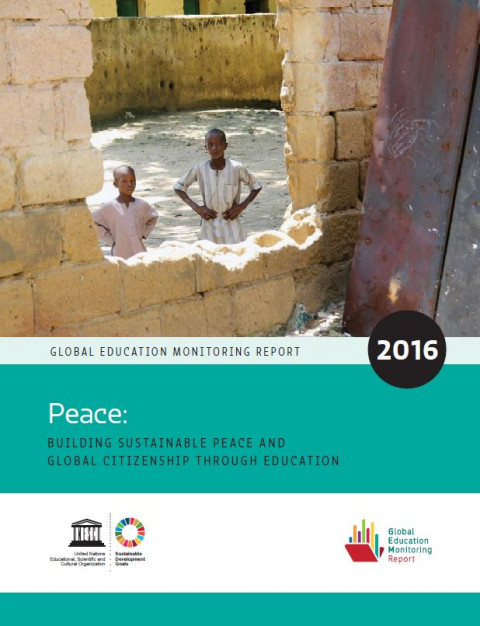 Peace: building sustainable peace and global citizenship through education;Global education monitoring report summary 2016 Year of publication: 2017 Corporate author: UNESCO The 2016 GEM Report, the first of a new 15-year series, shows that education will not deliver its full potential to catapult the world forward unless rates of improvement dramatically shift, and education systems consider sustainable development in the way services are delivered. This Peace: Building sustainable peace and global citizenship through education publication is a select extract from the full 2016 Global Education Monitoring (GEM) Report: Education for people and planet: Creating sustainable futures for all. It contains two chapters from that full Report – one on peace, political participation and access to justice and the other on education for global citizenship and sustainable development — , along with the associated policy recommendations and a short section of a recent GEM Report Policy Paper Textbooks pave the way to sustainable development.
 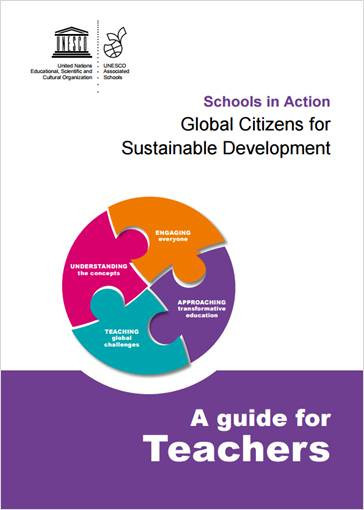 Schools in Action: Global Citizens for Sustainable Development: A Guide for Teachers Year of publication: 2016 Corporate author: UNESCO The Global Citizens for Sustainable Development Teachers’ guide aims to introduce teachers to Global Citizenship Education (GCED) and Education for Sustainable Development (ESD). It provides secondary school teachers with ideas and activities to help students become global citizens and sustainable development actors. The Teachers’ guide draws on the discussions and activities of almost 1,100 participants from 104 countries, including ASPnet National Coordinators, school principals, teachers, students and experts who contributed to the Online Collaborative Platform ASPnet in Action: Global Citizens Connected for Sustainable Development in 2014 and 2015 [http://en.unesco. org/aspnet/globalcitizens] with associated activities and initiatives. The Teachers’ guide provides: An overview of what it means for learners to become global citizens and of how learners can contribute to sustainable development. Ideas for classroom activities that can help secondary school students to develop knowledge, skills, values, attitudes and behaviours that promote GCED and ESD. Selected activities on GCED and ESD from ASPnet schools around the world.
  Citizenship and Culture of Peace in Educational Reform Year of publication: 2005 Author: Raúl Zepeda López, María del Rosario Toj, Edgar Florencio Montúfar Corporate author: UNESCO The concern raised by the themes and contents of civic education and the culture of peace in childhood and youth are issues that are felt in various academic sectors, in social organizations and educational authorities that sometimes translate into articles in the media, where, among other things, one speaks of "the loss of values", generally having as reference to the young generations and making invisible that this loss is mainly present in the adult generations, which are responsible for this situation. These concerns, in spite of that conscious ambiguity, are not gratuitous. They can be a starting point to become aware of the need to develop new capacities and values, the absence of which young Latin Americans identify in their political and social leaders, as has been pointed out in cited studies, carried out by UNICEF for Latin America and for Beatriz de Cazali for Guatemala. The need to respond to this concern is also present in the participants in the dialogues and municipal consensus (2000), as well as among authorities and curriculum developers of MINEDUC in the last five-years.
  Implementing the Right to Education: a Compendium of Practical Examples Year of publication: 2016 Corporate author: UNESCO This publication is a compilation of practical examples of measures taken by Member States in implementing the provisions of the UNESCO Convention and Recommendation against Discrimination in Education. These examples are taken from national reports submitted to UNESCO for the Eighth Consultation of Member States on the implementation of these two international standard-setting instruments. The Convention and the Recommendation celebrated their fi fty-fi fth anniversary in 2015. Both express the fundamental principles of non-discrimination and equality of educational opportunities enshrined in UNESCO’'s Constitution. Since these fundamental principles were essential in the process of Education for All, the instruments have naturally become the cornerstone of this important domain.The Education 2030 development agenda will provide further opportunity to mobilise the Convention and the Recommendation in guiding Member States in the effective realization of the right to education. This compendium seeks to provide an overview of promising measures taken to ensure equality of educational opportunities and non-discrimination, while also serving as a tool for information sharing and advocacy in connection with the right to education.
  Discours du Sous-Directeur général de l'UNESCO pour la culture M. Francesco Bandarin à l'occasion de la Journée internationale de la langue maternelle: Les langues locales pour la citoyenneté mondiale: zoom sur la science; UNESCO, le 21 février 2014 Year of publication: 2014 Corporate author: UNESCO This is an address by Mr. Francesco Bandarin, Assistant Director-General for culture of UNESCO, on the occasion of the International Mother Language Day: Local languages for global citizenship: focusing on science. Although little progress has been made to extend the benefits of multilingual education in the areas such as science, development of science will be considerably consolidated if people better understand and utilize local and international languages.
  YouthXchange: guide sur le changement climatique et les modes de vie Year of publication: 2015 Author: Adam Cade | Rob Bowden Corporate author: UNESCO | United Nations Environment Programme (UNEP) Climate Change and Lifestyles is the first in a series of guidebooks supporting the UNESCO/ UNEP YouthXchange (YXC) Initiative, which was created in 2001 to promote sustainable lifestyles among youth (15-24 years) through education, dialogue, awareness raising and capacity building. The series is being produced for young people and people working with youth, such as educators, teachers, trainers and youth leaders in both developed and developing countries. Almost half of the world’s population is under the age of 25, and nearly 90 per cent of them live in developing countries. Youth is a critical stakeholder in the global economy and will be the main actor and motor for change in the near future. Thus, the energy, motivation and creativity of youth are essential assets to stimulating change. Aims of the YXC Guidebook on Climate Change and Lifestyles:• Explore the links between lifestyles and climate change; • Help young people consider the actions they should take towards more sustainable lifestyles;• Support courses and actions that promote greater understanding of climate change and lifestyles among youth. The guidebook:• Considers the causes and effects of climate change and its human impacts and responses, while connecting them to lifestyle choices and the technical and social infrastructures of a society;• Provides scientific, political, economic, social, ethical and cultural perspectives on climate change;• Explains complex issues in accessible language supported by facts, graphics, images, examples and web links;• Develops the critical skills young people need to make personal choices to address the challenges of climate change.