
Resources
Explore a wide range of valuable resources on GCED to deepen your understanding and enhance your research, advocacy, teaching, and learning.
1,578 Results found
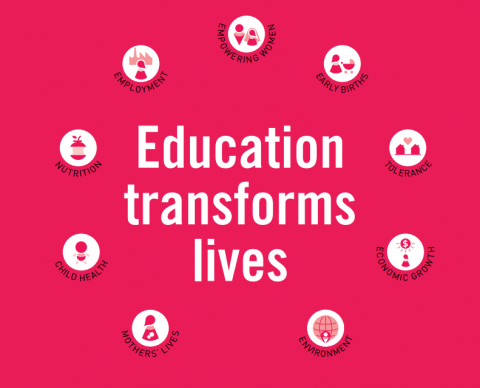 L'Education transforme nos existences Year of publication: 2013 Corporate author: UNESCO Education lights every stage of the journey to a better life, especially for the poor and the most vulnerable. Education’s unique power to act as a catalyst for wider development goals can only be fully realized, however, if it is equitable. That means making special efforts to ensure that all children and young people – regardless of their family income, where they live, their gender, their ethnicity, whether they are disabled – can benefit equally from its transformative power. Education empowers girls and young women, in particular, by increasing their chances of getting jobs, staying healthy and participating fully in society – and it boosts their children’s chances of leading healthy lives. To unlock the wider benefits of education, all children need the chance to complete not only primary school but also lower secondary school. And access to schooling is not enough on its own: education needs to be of good quality so that children actually learn. Given education’s transformative power, it needs to be a central part of any post-2015 global development framework.
  Right to Pre-Primary Education: A Global Study Year of publication: 2021 Corporate author: UNESCO Early childhood care and education is increasingly recognized as an essential element in realizing a wide range of educational, social and economic rights. Children from vulnerable households and communities stand to gain most from access to quality early learning opportunities. With about 50 per cent of children globally not yet enrolled in pre-primary education, enabling their inclusion remains a central question for education policymakers, stakeholders and parents.This Study provides a global overview and an analysis of the adoption of legal provisions for free and compulsory pre-primary education at national level. By offering a rights-based perspective to the implementation of pre-primary education, it aims to complement existing literature on SDG Target 4.2, which focuses mainly on policy outcomes.The results show that pre-primary education is a well determined and defined right in too few countries. Yet, the benefit of free and compulsory education observed is that children appear to have higher rates of early childhood well-being.In light of the research conducted and its main conclusions, a set of levers to promote the inclusion of early childhood and pre-primary education as a human right within long-term education and development objectives are presented in terms of governance and financing, legal framework, societal expectations, monitoring and evaluation and early childhood development overall. Prioritizing the needs of young children and the fulfilment of their right to free and compulsory pre-primary education is a critical opportunity for governments to make positive differences in children’s lives and to achieve broader national, social and economic goals. Education Transforms Lives Year of publication: 2013 Corporate author: UNESCO Education lights every stage of the journey to a better life, especially for the poor and the most vulnerable. Education’s unique power to act as a catalyst for wider development goals can only be fully realized, however, if it is equitable. That means making special efforts to ensure that all children and young people – regardless of their family income, where they live, their gender, their ethnicity, whether they are disabled – can benefit equally from its transformative power. Education empowers girls and young women, in particular, by increasing their chances of getting jobs, staying healthy and participating fully in society – and it boosts their children’s chances of leading healthy lives. To unlock the wider benefits of education, all children need the chance to complete not only primary school but also lower secondary school. And access to schooling is not enough on its own: education needs to be of good quality so that children actually learn. Given education’s transformative power, it needs to be a central part of any post-2015 global development framework.
  United Against Racism Year of publication: 2020 Corporate author: UNESCO This video features messages by the following prominent women and men from the worlds of cinema, the media, music, sport and science alongside UNESCO Director-General Audrey Azoulay: Charlotte Gainsbourg, Freida Pinto, Naomi Campbell, UNESCO Goodwill Ambassador Jean-Michel Jarre, UNESCO Artist for Peace Marcus Miller, Jorge Ramos, UNESCO Goodwill Ambassador Yalitza Aparicio, Rossy de Palma, UNESCO Goodwill Ambassador Sumaya bint Al Hassan, Bobi Wine, UNESCO Goodwill Ambassador Herbie Hancock, UNESCO Goodwill Ambassador Forest Whitaker, UNESCO Champion for Girls’ and Women’s Education Nadia Nadim, Amadou Gallo Fall, Ada Hegerberg and UNESCO Artist for Peace Gilberto Gil.UNESCO has been on the forefront of the fight against racism since its creation in 1945. In 1978, it adopted the Declaration on Race and Racial Prejudice which reaffirms that “All human beings belong to a single species and are descended from a common stock. They are born equal in dignity and rights and all an integral part of humanity.”
  La coopération Sud-Sud et triangulaire en action Year of publication: 2018 Corporate author: UNESCO | UN. Office for South-South Cooperation (UNOSSC) La présente publication est le premier rapport de l’UNESCO qui traite de la coopération SudSud et de la coopération triangulaire. Elle brosse un tableau d’ensemble, illustré par des exemples particuliers, des progrès que ces modalités de coopération ont permis d’accomplir pour faciliter la coopération technique, le renforcement des capacités et le partage des connaissances dans les domaines de compétence de l’UNESCO, et ouvre la voie à de plus amples efforts en la matière.
  Guidelines to Strengthen the Right to Education in National Frameworks Year of publication: 2021 Corporate author: UNESCO These Guidelines aim to strengthen national frameworks by assisting countries and stakeholders in conducting an assessment of the compatibility of their national education legal and policy framework with international standard-setting instruments on the right to education, and in light of SDG 4 commitments. These Guidelines provide a hands-on approach aiming to assist in the review of national education legal and policy frameworks in view of: Developing practical knowledge on the right to education based on the Right to education handbook and supporting capacity development Providing operational tools to assess the status of the right to education at country level and its compatibility with international and regional human rights obligations and international commitments (notably SDG 4) Identifying legal and policy gaps in education at country level and resulting challenges Making recommendations for the full alignment of national constitutions, legislation , singular and policies with international standards and provisions Providing insights on how to implement the recommendations in view of necessary reforms.
  Global Education Coalition Gender Flagship: Highlights of Action in 2020 Year of publication: 2021 Corporate author: UNESCO At the onset of the COVID-19 pandemic in March 2020, UNESCO launched the Global Education Coalition, an international multi-sector partnership aiming to meet the urgent and unprecedented need for continuity of learning. Most governments around the world have temporarily closed educational institutions at some point in 2020 in an attempt to contain the spread of the COVID-19 pandemic. At its peak, these nationwide closures impacted more than 1.5 billion, or over 90% of the world’s student population, from pre-primary to higher education. The Global Education Coalition selected three flagships, or focus areas, covering: teachers, connectivity and gender. The Gender Flagship is rallying coalition members to work together to highlight and address the gender dimensions of the COVID-19 school crisis and safeguard progress made on gender equality in education in recent decades. This report presents the work of the Gender Flagship in 2020, and its plans for 2021.
  Learn For Our Planet: A Global Review Of How Environmental Issues Are Integrated In Education Year of publication: 2021 Corporate author: UNESCO 2020 was the equal hottest year on record. One million species are at risk of extinction. We use more resources than the planet can generate each year - if we continue to live the way we do today, we will need three earths by 2050. The way we currently live is not sustainable. Urgent change is needed, but lasting change is impossible without education.This publication presents the extent to which environmental issues are integrated in primary and secondary education policies and curricula across 46 UNESCO Member States. Over half of education policies and curricula studied made no mention of climate change. Only 19 per cent made reference to biodiversity. Countries have made progress: 83 per cent of education policies and curricula studied addressed the environment at least once, and 69 per cent mentioned sustainability - but it is clear that more needs to be done to prepare learners with the knowledge, skills, values and attitudes to act for our planet. Governments, education policy-makers, academics, and education and environmental stakeholders need to further commit to Education for Sustainable Development.
  Survey on Privacy in Media and Information Literacy With Youth Perspectives Year of publication: 2017 Author: Sherri Hope Culver | Alton Grizzle Corporate author: UNESCO This report aims to provide conceptual, development and policy recommendations to foster privacy in MIL, while enabling the critical engagement of people, including young women and men, in an environment conducive to sustainable development and to freedom of expression online and offline. It seeks to provide clarity on the complex issue of how MIL and privacy intersect.
 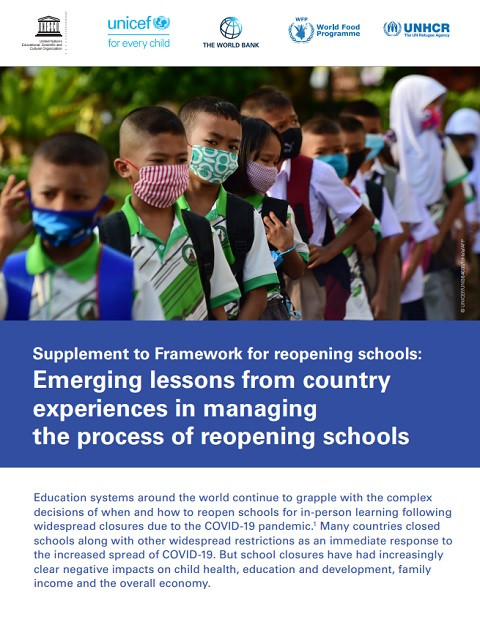 Supplement to Framework for Reopening Schools: Emerging Lessons From Country Experiences in Managing the Process of Reopening Schools Year of publication: 2020 Corporate author: UNESCO | United Nations Children's Fund (UNICEF) | World Bank | World Food Programme | UN. Office of the United Nations High Commissioner for Refugees (UNHCR) Education systems around the world continue to grapple with the complex decisions of when and how to reopen schools for in-person learning following widespread closures due to the COVID 19 pandemic. This supplement to the Framework for reopening schools, originally published jointly by UNICEF, UNESCO, the World Bank, the World Food Programme, and the UN Refugee Agency (UNHCR) in April 2020, summarizes emerging lessons learnt over the past months.The supplement follows the four main dimensions of the Framework (safe operations, focus on learning, wellbeing & protection, and reaching the most marginalized) and highlighting a number of country examples.