
Resources
Explore a wide range of valuable resources on GCED to deepen your understanding and enhance your research, advocacy, teaching, and learning.
792 Results found
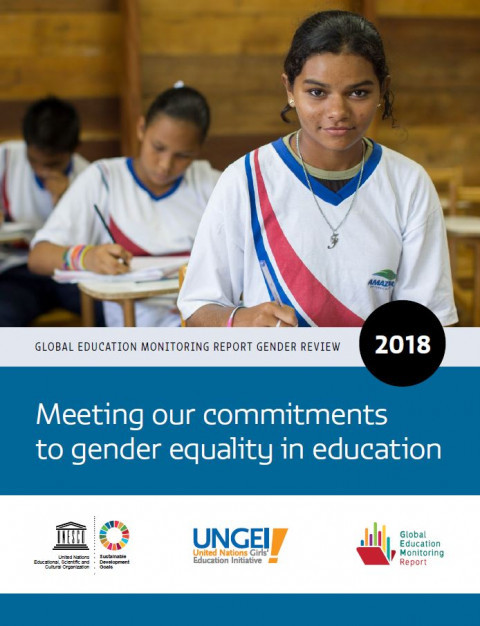 Meeting Our Commitments to Gender Equality in Education: Global Education Monitoring Report Gender Review 2018 Year of publication: 2018 Corporate author: UNESCO The Education 2030 Framework for Action, a tool aimed at helping the international community achieve SDG 4 on education, explicitly recognizes gender equality as a guiding principle linked to the realization of the right to education. It states clearly that girls and boys, women and men, must be equally empowered ‘in and through education’.In this sixth Gender Review, in a series that began in 2011, the Global Education Monitoring Report team maintains the focus on a broad conception of gender equality that extends beyond counting boys and girls in classrooms. The review’s first part examines disparities in participation and skills, in education and political leadership positions, and in selected aspects of infrastructure and curricula. It also examines gender issues in professional development by exploring the role of education in three other SDGs: those concerning agriculture, health, and water and sanitation.The second part of the review analyses institutions, laws and policies to explore ways to determine and enforce accountability for gender equality in education.
  Achieving Gender Equality in Education: Don't Forget the Boys (Policy Paper 35) Year of publication: 2018 Corporate author: UNESCO Achieving gender equality in and through education is central to meeting the targets of the 2030 Agenda for Sustainable Development. While the emphasis tends to be on the effects of gender norms on girls, this paper puts the spotlight on the less recognized effects of these norms on boys’ schooling, particularly at the secondary level and amongst those from the poorest families. It argues that addressing boys’ disadvantage and disengagement in education is an essential part of a response to the challenge of gender inequality, in education and beyond.
  Re|shaping cultural policies: a decade promoting the diversity of cultural expressions for development Year of publication: 2015 Corporate author: UNESCO This Report presents the work of fourteen independent experts, as well as the Secretary of the Convention and the Principal Editor, who have analysed the implementation of the Convention on the Protection and Promotion of the Diversity of Cultural Expressions. Its purpose is to move forward the process of monitoring the Convention’s implementation that was put in place by a mechanism of Quadrennial Periodic Reports (QPRs) approved by the Convention’s Conference of Parties in 2011. The contributors have consulted the 71 reports submitted by Parties, but have also used data derived from other, non-official sources and have drawn upon their own expert experience.
 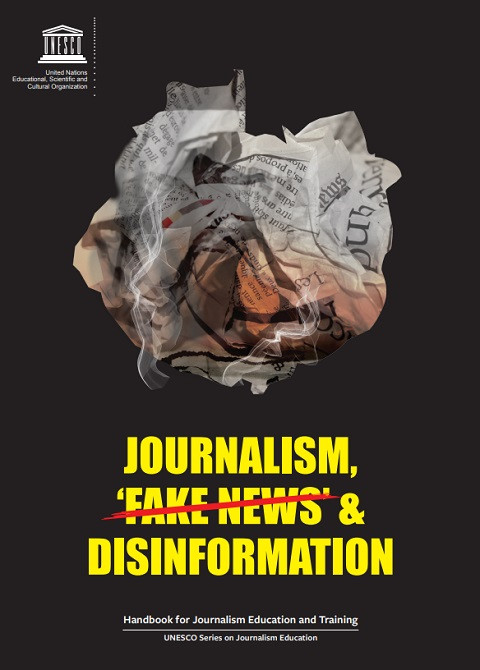 Journalism, Fake News & Disinformation: Handbook for Journalism Education and Training Year of publication: 2018 Author: Julie Posetti | Cherilyn Ireton | Claire Wardle | Hossein Derakhshan | Alice Matthews | Magda Abu-Fadil | Tom Trewinnard | Fergus Bell | Alexios Mantzarlis Corporate author: UNESCO This handbook seeks to provide an internationally-relevant model curriculum, open to adoption or adaptation, which responds to the emerging global problem of disinformation that confronts societies in general, and journalism in particular. Serving as a model curriculum, the publication is designed to give journalism educators and trainers a framework and lessons to help students and practitioners of journalism to navigate the issues associated with ‘fake news’.The contents draw together the input of leading international journalism educators, researchers and thinkers who are helping to update journalism method and practice to deal with the challenges of misinformation and disinformation. The lessons are contextual, theoretical and in the case of online verification, extremely practical. Used together as a course, or independently, they can help refresh existing teaching modules or create new offerings.It is part of the “Global Initiative for Excellence in Journalism Education”, which is a focus of UNESCO’s International Programme for the Development of Communication (IPDC). The Initiative seeks to engage with teaching, practising and researching of journalism from a global perspective, including sharing international good practices.
 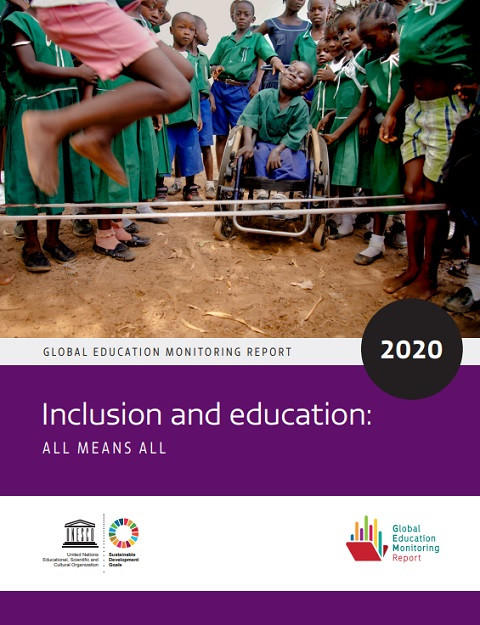 Global Education Monitoring Report 2020: Inclusion and Education; All Means All Year of publication: 2020 Corporate author: Global Education Monitoring Report Team | UNESCO The 2020 Global Education Monitoring Report looks at social, economic and cultural mechanisms that discriminate against disadvantaged children, youth and adults, keeping them out of education or marginalized in it. Spurred by their commitment to fulfil the right to inclusive education, countries are expanding their vision of inclusion in education to put diversity at the core of their systems. Yet implementation of well-meaning laws and policies often falters. Released at the start of the decade of action to 2030, and in the middle of the Covid-19 crisis, which has exacerbated underlying inequalities, the Report argues that resistance to addressing every learner’s needs is a real threat to achieving global education targets. Inclusion and education: All means all identifies the practices in governance and finance; curricula, textbooks and assessments; teacher education; school infrastructure; and relations with students, parents and communities that can unlock the process to inclusion. It provides policy recommendations to make learner diversity a strength to be celebrated, a force for social cohesion. Two new websites complement the fourth edition of the Global Education Monitoring Report. PEER describes how countries approach inclusion, serving as a resource for policy dialogue. SCOPE offers an opportunity to interact with the data and explore selected SDG 4 indicators.
  Global Education Monitoring Report, 2019: Migration, Displacement and Education: Building Bridges, Not Walls Year of publication: 2018 Corporate author: UNESCO | Global Education Monitoring Report Team The 2019 Global Education Monitoring Report examines the education impact of migration and displacement across all population movements: within and across borders, voluntary and forced, for employment and education. It also reviews progress on education in the 2030 Agenda for Sustainable Development.Two new global compacts on migrants and refugees recognize education’s role and set objectives aligned with the global commitment to leave no one behind. This report is a vital toolkit for these compacts. It covers policy issues that address seasonal migrants, rural school consolidation, intercultural curricula, refugee inclusion in national education systems and elimination of segregation, qualifications recognition, targeting of school funding, more effective humanitarian education aid and teacher preparedness for diverse classrooms in emergency, protracted and “new normal” contexts.The report calls on countries to see education as a tool to manage migration and displacement and an opportunity for those needing one.
  [Summary] Global Education Monitoring Report Summary 2019: Migration, Displacement and Education: Building Bridges, Not Walls Year of publication: 2018 Corporate author: UNESCO | Global Education Monitoring Report Team This Report points directly to a major challenge: How can teachers be supported to practise inclusion? It offers us fascinating insights into humanity and the age-old phenomenon of migration. I invite you to consider its recommendations and to act on them. This report is a vital toolkit for these compacts. It covers policy issues that address seasonal migrants, rural school consolidation, intercultural curricula, refugee inclusion in national education systems and elimination of segregation, qualifications recognition, targeting of school funding, more effective humanitarian education aid and teacher preparedness for diverse classrooms in emergency, protracted and “new normal” contexts. This summary of the 2019 GEM Report calls on countries to see education as a tool to manage migration and displacement and an opportunity for those needing one.
  [Summary] Global Education Monitoring Report Summary 2020: Inclusion and Education; All Means All Year of publication: 2020 Corporate author: UNESCO | Global Education Monitoring Report Team The 2020 Global Education Monitoring Report looks at social, economic and cultural mechanisms that discriminate against disadvantaged children, youth and adults, keeping them out of education or marginalized in it. Spurred by their commitment to fulfil the right to inclusive education, countries are expanding their vision of inclusion in education to put diversity at the core of their systems. Yet implementation of well-meaning laws and policies often falters. Released at the start of the decade of action to 2030, and in the middle of the Covid-19 crisis, which has exacerbated underlying inequalities, the Report argues that resistance to addressing every learner’s needs is a real threat to achieving global education targets.
  Media and Information Literacy Curriculum for Teachers Year of publication: 2011 Author: Carolyn Wilson | Alton Grizzle | Ramon Tuazon | Kwame Akyempong | Chi Kim Cheung Corporate author: UNESCO We live in a world where the quality of information we receive largely determines our choices and actions, including our capacity to enjoy fundamental freedoms and the ability for self-determination and development. This Media and Information Literacy Curriculum for Teachers is an important resource for UNESCO Member States and a pioneering publication.First, it is forward looking, drawing on present trends toward the convergence of radio, television, Internet, newspapers, books, digital archives and libraries into one platform. Second, it is specifically designed for integration into the formal teacher education system.UNESCO believes that, ultimately, this curriculum will contribute to innovation and improvement in all levels of education.
 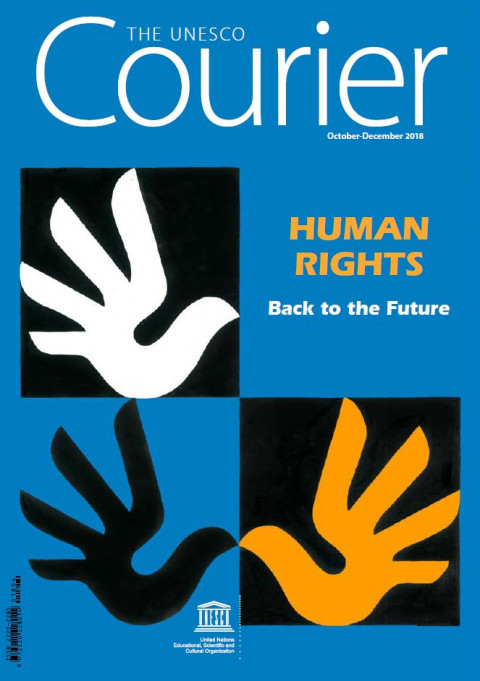 Human Rights: Back to the Future (The UNESCO Courier no. 4, October-December 2018) Year of publication: 2018 Corporate author: UNESCO Benedetto Croce, Aldous Huxley, Humayun Kabir, Harold J. Laski, Lo Chung-Shu, Salvador de Madariaga, Jacques Maritain, F.S.C. Northrop, Arnold Schoenberg, Pierre Teilhard de Chardin – these are some of the contributors to this issue of the Courier. To mark the seventieth anniversary of the Universal Declaration on Human Rights, adopted on 10 December 1948, we decided to take a detour into the past to enable us to better orient ourselves in the future. This explains the title of this issue: “Back to the Future”. Travelling back to 1946, when the world was grappling with the aftermath of the Second World War, “what kind of moral statement could the international community make that would adequately express its collective outrage and hope, however utopian, for a better future?” Mark Goodale discusses this massive international effort in his introductory article for our Wide Angle section, which he also guest-edited. The series of articles in this section uncovers a hitherto little-known part of the history of the Universal Declaration on Human Rights – the inquiry into the origins and philosophic bases of human rights. This initiative was decided upon during the first UNESCO General Conference (November-December 1946) and launched the following year by the Organization’s first Director-General, Julian Huxley. It was coordinated by the young French philosopher, Jacques Havet. For this project, UNESCO brought together leading intellectual figures of the post-war world, thus making an essential contribution to the reflection on human rights at the time. It remains amazingly relevant today. Equally relevant today are the drawings of Our Guest, the Peruvian artist Fernando Bryce, who derives his inspiration from this historic period “when the idea of progress was genuinely linked to a whole new perspective”. His series, The Book of Needs – which takes pages of the Courier between 1948 and 1954 and transforms them into works of art – is featured as a supplement in this issue.