
Resources
Explore a wide range of valuable resources on GCED to deepen your understanding and enhance your research, advocacy, teaching, and learning.
956 Results found
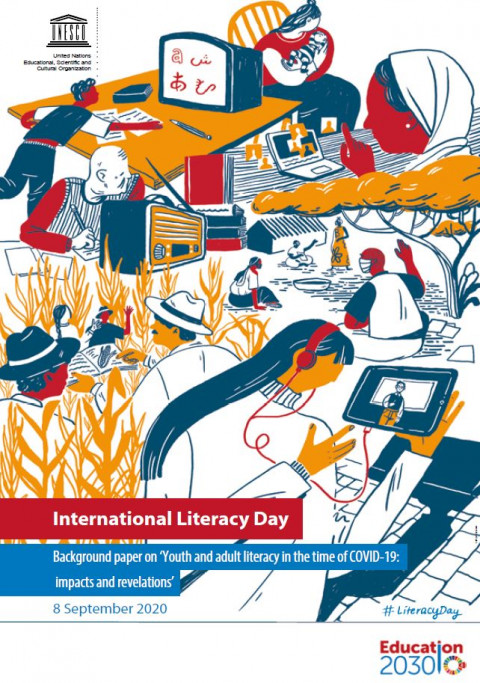 International Literacy Day: Background Paper on 'Youth and Adult Literacy in the Time of COVID-19; Impacts and Revelations' Year of publication: 2020 Corporate author: UNESCO Specially prepared on the occasion of International Literacy Day 2020, this background paper illustrates the impact of the COVID-19 crisis on youth and adult literacy, based on the limited information that is currently available. It provides five regional snapshots and identifies preliminary lessons learned thus far, while aiming to inspire continued reflection and subsequent action. It also makes the case for the ongoing importance of advancing youth and adult literacy, a priority that was already neglected even before the pandemic but which deserves all our attention. ILD 2020 thus seeks to trigger reimaginations of literacy teaching and learning in the COVID-19 crisis and beyond, with a particular focus on the role of educators.
  AI Competency Framework for Students Year of publication: 2024 Author: Fengchun Miao | Kelly Shiohira Corporate author: UNESCO Artificial intelligence is increasingly integral to our lives, necessitating proactive education systems to prepare students as responsible users and co-creators of AI. Integrating AI learning objectives into official school curricula is crucial for students globally to engage with AI safely and meaningfully.The UNESCO AI Competency Framework for Students aims to help educators in this integration, outlining 12 competncies across four dimensions:- A human-centred mindset- Ethics of AI- AI techniques and applications- AI system designThese competencies span three progression levels:- Understand- Apply- Create The framework details curricular goals and domain-specific pedagogical methodologies.Grounded in the vision of students as AI co-creators and responsible citizens, the publication emphasizes critical judgement of AI solutions, awareness of citizenship responsibilities in the AI era, foundational AI knowledge for lifelong learning, and inclusive, sustainable AI design.
  AI Competency Framework for Students Year of publication: 2025 Author: Fengchun Miao | Kelly Shiohira Corporate author: UNESCO Préparer les apprenants à devenir des citoyens responsables et créatifs à l’ère de l’IAL’intelligence artificielle (IA) fait tous les jours davantage partie intégrante de nos vies, ce qui implique d’avoir des systèmes éducatifs proactifs en mesure de préparer les élèves et les étudiants à être des utilisateurs responsables et des cocréateurs de l’IA. L’intégration d’objectifs d’apprentissage de l’IA dans les programmes scolaires officiels est essentielle pour que les apprenants du monde entier puissent s’intéresser en toute sécurité et de manière pertinente à l’IA.Le Référentiel de compétences en IA pour les apprenants de l’UNESCO vise à aider les éducateurs dans cette démarche, en décrivant 12 compétences réparties en quatre dimensions, à savoir une perspective centrée sur l’humain, l’éthique de l’IA, les techniques et applications de l’IA, et la conception de systèmes d’IA. Ces compétences se déploient selon trois niveaux de progression : Comprendre, Appliquer et Créer. Le référentiel détaille les objectifs du programme d’études et les méthodes pédagogiques spécifiques au domaine.Fondé sur une vision des élèves et des étudiants considérés comme cocréateurs de l’IA et citoyens responsables, le référentiel met l’accent sur le jugement critique vis-à-vis des solutions d’IA, la prise de conscience des responsabilités citoyennes à l’ère de l’IA, les connaissances fondamentales en matière d’IA pour l’apprentissage tout au long de la vie, ainsi que la conception d’une IA inclusive et durable.
  AI Competency Framework for Students Year of publication: 2025 Author: Fengchun Miao | Kelly Shiohira Corporate author: UNESCO Preparar a los estudiantes para ser ciudadanos responsables y creativos en la era de la IALa inteligencia artificial (IA) está cada vez más presente en nuestras vidas, lo que requiere sistemas educativos proactivos que preparen a los estudiantes para que sean usuarios responsables y cocreadores de la IA. Integrar los objetivos de aprendizaje de IA en los programas de estudio oficiales de las escuelas es fundamental para que los estudiantes de todo el mundo interactúen de forma segura y significativa con la IA.El objetivo del Marco de competencias para estudiantes en materia de IA de la UNESCO es ayudar a los educadores con esta integración, para lo cual describe 12 competencias que atraviesan cuatro dimensiones: una forma de pensar centrada en el ser humano, la ética de la IA, las técnicas y aplicaciones de la IA, la pedagogía de la IA, y la IA para el diseño de sistemas de IA. Estas competencias abarcan tres niveles de progresión: comprender, aplicar y crear. El marco detalla las metas curriculares y las metodologías pedagógicas específicas para cada dominio.Basado en una visión de los estudiantes como cocreadores de IA y ciudadanos responsables, el marco pone énfasis en el juicio crítico de las soluciones de IA, la conciencia de las responsabilidades ciudadanas en la era de la IA, el conocimiento fundacional de la IA para el aprendizaje a lo largo de la vida, y el diseño de IA inclusiva y sostenible.
  AI Competency Framework for Teachers Year of publication: 2024 Author: Fengchun Miao | Mutlu Cukurova Corporate author: UNESCO AI processes vast information, generates new content, and helps decision-making through predictive analyses. In education, AI has transformed the traditional teacher–student relationship into a teacher–AI–student dynamic.This shift requires a re-examination of teachers’ roles and the competencies they need in the AI era. Yet, few countries have defined these competencies or developed national programmes to train teachers in AI, leaving many educators without proper guidance.The AI competency framework for teachers addresses this gap by defining the knowledge, skills, and values teachers must master in the age of AI. Developed with principles of protecting teachers’ rights, enhancing human agency, and promoting sustainability, the publication outlines 15 competencies across five dimensions: Human-centred mindset, Ethics of AI, AI foundations and applications, AI pedagogy, and AI for professional learning. These competencies are categorized into three progression levels: Acquire, Deepen, and Create.As a global reference, this tool guides the development of national AI competency frameworks, informs teacher training programmes, and helps in designing assessment parameters. It also provides strategies for teachers to build AI knowledge, apply ethical principles, and support their professional growth.
  Référentiel de compétences en IA pour les enseignants Year of publication: 2025 Author: Fengchun Miao | Mutlu Cukurova Corporate author: UNESCO Guider les enseignants à propos de l’usage judicieux ou problématique de l’IA en éducationL’intelligence artificielle (IA) traite une grande quantité d’informations, génère de nouveaux contenus et aide à la prise de décision grâce à des analyses prédictives. Dans le domaine de l’éducation, l’IA a transformé la relation traditionnelle entre l’enseignant et l’apprenant en un triptyque dynamique entre l’enseignant, l’IA et l’apprenant. Cette évolution exige de repenser le rôle des enseignants et les compétences dont ils ont besoin à l’ère de l’IA. Pourtant, peu de pays ont défini ces compétences ou élaboré des programmes nationaux pour former les enseignants à l’IA, ce qui prive de nombreux éducateurs d’un cadre adéquat.Le Référentiel de compétences en IA pour les enseignants comble cette lacune : il définit les connaissances, les habiletés et les valeurs que les enseignants doivent maîtriser à l’ère de l’IA. Élaborée dans le respect de la protection des droits des enseignants, de l’accroissement de l’agentivité humaine et de la promotion de la durabilité, la publication présente 15 compétences réparties en cinq composantes : une approche de l’IA centrée sur l’humain, l’éthique de l’IA, les fondements et les applications de l’IA, la pédagogie de l’IA et l’IA pour l’apprentissage professionnel. Ces compétences sont classées selon trois niveaux de progression : acquérir, approfondir, créer.En tant que référence internationale, cet outil sert de guide pour l’élaboration de référentiels nationaux de compétences en IA, apporte des informations sur les programmes de formation des enseignants et aide à définir des paramètres d’évaluation des apprentissages. Il fournit également aux enseignants des stratégies pour développer leurs connaissances en matière d’IA, respecter des principes éthiques et soutenir leur développement professionnel.
  Marco de competencias para docentes en materia de IA Year of publication: 2025 Author: Fengchun Miao | Mutlu Cukurova Corporate author: UNESCO Orientación para docentes sobre el uso y el mal uso de la IA en la educaciónLa IA procesa enormes cantidades de información, genera nuevos contenidos y ayuda a la toma de decisiones mediante análisis predictivos. En el ámbito educativo, la IA ha transformado la relación tradicional docente-estudiante, creando una nueva dinámica docente-IA-estudiante. Este cambio exige replantear los roles de los docentes y las competencias que necesitan en la era de la IA. Sin embargo, son pocos los países que han definido estas competencias o desarrollado programas nacionales para capacitar a los docentes en IA, lo que deja a muchos educadores sin una orientación adecuada.El Marco de competencias en materia de IA para docentes aborda esta brecha al definir los conocimientos, habilidades y valores que los docentes deben dominar en la era de la IA. Desarrollada bajo los principios de protección de los derechos de los docentes, del fortalecimiento de la capacidad de acción humana y de la promoción de la sostenibilidad, la publicación describe 15 competencias que atraviesan cinco dimensiones: una forma de pensar centrada en el ser humano, la ética de la IA, los fundamentos y aplicaciones de la IA, la pedagogía de la IA, y la IA para el aprendizaje profesional. Estas competencias se clasifican en tres niveles de progresión: adquirir, profundizar y crear.Como una referencia global, esta herramienta orienta el desarrollo de marcos nacionales de competencias en IA, brinda insumos para los programas de formación docente y ayuda a diseñar parámetros de evaluación. También ofrece estrategias para que los docentes desarrollen conocimientos sobre IA, apliquen principios éticos y apuntalen su crecimiento profesional.
  User Empowerment through Media and Information Literacy Responses to the Evolution of Generative Artificial Intelligence (GAI) Year of publication: 2024 Author: Divina Frau-Meigs Corporate author: UNESCO Key messages Artificial Intelligence and Generative AI are having a significant impact on people’s engagement with information, digital technology, and media. This raises concerns about control human agency and autonomy over information, decision making, gender equality, and freedoms in general. User empowerment through Media and Information Literacy (MIL) as a response to GAI, which is still in its infancy, needs to be fully deployed and public policy makers should be concerned in developing it well from the outset. MIL is necessary to build people’s ethical use of synthetic media, i.e. video, text, image or voice content fully or partially generated by AI-systems. The societal opportunities being deepened by GAI include: access to information, participation, employability, creativity, lifelong learning and creative industries. The societal potential risks being deepened by GAI include: disinformation, loss of data privacy, threats to integrity of elections, surveillance, lack of source reliability, discrimination, including gender-based and racial stereotypes, and copyrights violations. Building on familiarity in the face of urgency, AI literacy can be embedded in MIL to teach and train all sorts of communities (educators, librarians, youth workers, women networks, etc.). Ensuring explainable AI is key to both the design of MIL curricula and to the design of policy and governance around GAI. To build trust in information and education, source reliability needs to be revised to encompass the different types of “evidence” provided by GAI. MIL can train informed people from outside the technology industry to participate in the design, implementation and regulation of AI, in a manner that remains human-centered, gender-responsive and mindful of the public interest. Training for MIL is within the remit of governments and institutions of higher education, which have a duty to ensure MIL policy actions are sustained and strengthened over time, to be future-proof, in the face of an ever-evolving AI/GAI. L’autonomisation des utilisateurs grâce aux réponses apportées par l’éducation aux médias et à l’information à l’évolution de l’intelligence artificielle générative (IAG) Year of publication: 2024 Author: Divina Frau-Meigs Corporate author: UNESCO Messages clés L’intelligence artificielle et l’IA générative influent grandement sur les rapports des indivi- dus à l’information, aux technologies numériques et aux médias. Mais cela ne va pas sans inquiétudes quant à leur contrôle, au pouvoir d’action et à l’autonomie dont disposent les utilisateurs vis-à-vis de l’information, à la prise de décisions, à l’égalité des genres et aux libertés en général. . Pour constituer une réponse à l’IAG, technologie qui en est à ses balbutiements, l’autonomisation des utilisateurs grâce à l’éducation aux médias et à l’information (EMI) doit être pleinement déployée, et les autorités publiques doivent s’efforcer de la promouvoir dès le début. L’EMI est indispensable pour garantir une utilisation éthique des médias synthétiques, c’est-à-dire des vidéos, textes, images et sons totalement ou partiellement créés à l’aide de systèmes d’IA. L’IAG offre de nombreuses opportunités sociales dans différents domaines, dont l’accès à l’information, la participation, l’employabilité, la créativité, l’apprentissage tout au long de la vie et les industries créatives, entre autres. Il existe cependant des risques sociaux potentiels aggravés par l’IA générative, dont : la désinformation, la perte de contrôle sur la confidentialité des données, les menaces pour l’intégrité des élections, la surveillance, le manque de fiabilité des sources, la discrimination notamment fondée sur le genre et les stéréotypes raciaux et les violations des droits d’auteur. Pour mettre à profit la familiarité face à l’urgence, la maîtrise de l’IA pourrait être intégrée dans les programmes d’EMI afin d’éduquer et de former des communautés très diverses (éducateurs, bibliothécaires, animateurs pour la jeunesse, réseaux de femmes, etc.). Pour bien concevoir non seulement les programmes d’EMI mais aussi la gouvernance de l’IAG et les politiques connexes, l’IA explicable joue un rôle essentiel. Pour renforcer la confiance dans l’information et l’éducation, la fiabilité des sources doit être réexaminée pour englober tous les différents types de « preuves » fournies par l’IAG. L’EMI peut former des acteurs éclairés n’appartenant pas au secteur de la technologie afin qu’ils contribuent à la conception, à la mise en œuvre et à la réglementation de l’IA d’une manière qui reste centrée sur l’humain, sensible au genre et soucieuse de l’intérêt public. La formation dans le cadre de l’EMI relève des gouvernements et des établissements d’enseignement supérieur, qui doivent veiller à ce que les actions politiques en la matière soient soutenues et renforcées dans la durée, pour s’adapter aux évolutions constantes de l’IA/IAG.
  International Day of Education 2025: Artificial Intelligence and Education: Preserving Human Agency in a World of Automation Year of publication: 2025 Corporate author: UNESCO International Day for Education 2025 aims to: Examine new possibilities offered by AI, especially for teaching, learning, assessment and educational administration. Promote the development of critical AI literacies by equipping educators and learners with the competencies needed to understand, use and influence AI technologies, in line with the UNESCO AI competency frameworks for teachers and students. Ensure that AI complements, rather than replaces, the essential human elements of learning, including the cultivation of in-person relationships and emotional intelligence.