
Resources
Explore a wide range of valuable resources on GCED to deepen your understanding and enhance your research, advocacy, teaching, and learning.
12 Results found
 Construire les sociétés du savoir dans la région arabe: le rôle de la langue arabe en tant que portail du savoir Year of publication: 2019 Corporate author: UNESCO Cairo La construction des économies et des sociétés du savoir est un objectif déclaré dans la région arabe. La plupart des plans de développement dans les pays arabes appellent clairement à des actions pour produire, transférer, localiser et exploiter des connaissances dans divers domaines au service des objectifs de développement humain durable. La langue arabe a un rôle important à jouer dans ce processus fondamental de développement, car la production, l’assimilation et la diffusion de connaissances sont plus efficaces et plus répandues lorsque la langue maternelle est utilisée. Là-dessus, une question fondamentale devrait être posée : dans quelle mesure la langue arabe constitue-t-elle aujourd’hui un vrai point d’accès au savoir dans la région arabe ?Ce rapport, préparé par un groupe d’éminents experts arabes, sous la supervision et la coordination du Bureau régional de l’UNESCO pour les sciences dans les États arabes, cherche à étudier cette question centrale en examinant et en évaluant la situation de connaissances dans la région arabe d’une part, et en analysant le rôle de la langue arabe dans les processus d’instauration des sociétés et d’économies du savoir dans la région arabe, d’autre part. La section générale du rapport aborde la question de connaissances et de la langue dans la région arabe. Il présente également des recherches de terrain menées dans trois pays arabes (l’Arabie saoudite, l’Égypte et le Maroc), ces recherches examinent la situation de connaissances et de la langue arabe dans ces États et reflètant, en quelque sorte, la situation dans les sous-régions arabes dans lesquelles elles étaient menées.
 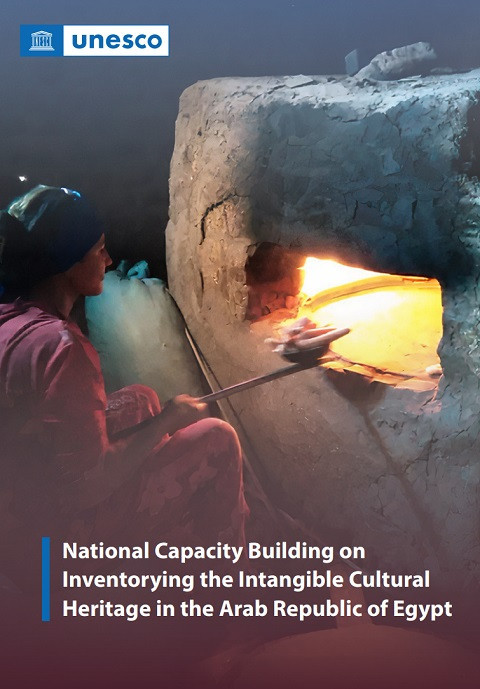 National Capacity Building on Inventorying the Intangible Cultural Heritage in the Arab Republic of Egypt Year of publication: 2024 Author: Ahmed Bahi El Din | Haitham Younes Corporate author: UNESCO | UNESCO Cairo Communities in Egypt are inventorying their living heritage Egypt is famed for its rich civilization and long history. Egyptian identity is presented not only through archaeological sites and Ancient Egyptian civilization, but also through Egypt’s diverse living heritage. More than simply showing who they are today, this living heritage tells the story of how the Egyptians arrived at this point over the generations.To celebrate this identity and strengthen national capacities to safeguard it, UNESCO, alongside the Egyptian government and civil society, implemented the project Strengthening National Capacities for Safeguarding Intangible Cultural Heritage in Egypt for Sustainable Development, which ran from June 2018 to June 2021.The project focused on community-based inventorying of living heritage. This involved training workshops and a pilot community-based inventorying exercise, which took place in six different locations throughout Egypt (Cairo, Fayoum, Gharbeya, Aswan, Assuit, and Marsa Matrouh). Thanks to the project, participating community practitioners and heritage bearers are now equipped to inventory their own living heritage. • This pilot was Egypt’s first step to establishing a national inventory of Intangible Cultural Heritage (ICH) under the Ministry of Culture, in collaboration with community practitioners. • This publication provides recommendations on how to further enhance national capabilities for ICH safeguarding and how to advance community engagement in the inventorying processes in Egypt.