
Resources
Explore a wide range of valuable resources on GCED to deepen your understanding and enhance your research, advocacy, teaching, and learning.
43 Results found
 Tablero de control para el ODS 4: informe sobre el progreso hacia los puntos de referencia nacionales; foco en docentes Year of publication: 2024 Corporate author: Global Education Monitoring Report Team | UNESCO Institute for Statistics (UIS) Esta es la segunda evaluación del progreso de los países hacia los puntos de referencia, o metas nacionales, que los países han establecido para ocho indicadores del ODS 4 para marcar su contribución a las metas globales. La evaluación cubre el período desde 2015 y revisa la probabilidad de que cada país alcance su punto de referencia para 2025 o, cuando no se haya establecido dicho punto de referencia, el valor que habría alcanzado si hubiera progresado al ritmo histórico (2000–15) del 25 % de los países que mejoran más rápidamente.El Tablero de Control para el ODS 4 de 2024 revela que el progreso hacia las metas nacionales está desviado en la mayoría de los indicadores. En dos casos – la brecha de género a expensas de los niños que terminan la educación secundaria alta y el gasto público en educación como proporción del gasto público total – los países incluso están retrocediendo.Por el contrario, el progreso es más rápido en el octavo indicador de referencia, la conectividad a Internet en las escuelas, que se añadió tras la prioridad otorgada a la transformación digital en la Cumbre sobre la Transformación de la Educación en 2022. Un tercio de los países estableció objetivos nacionales en 2023 y el progreso en el indicador está siendo revisado por primera vez en esta edición.El progreso también es relativamente rápido en el porcentaje de docentes con las calificaciones mínimas requeridas, que también es el indicador central de esta edición. Se presenta nueva evidencia sobre políticas nacionales en cuanto a los niveles mínimos de calificación requeridos para ingresar a la profesión docente, políticas de desarrollo profesional continuo obligatorio y políticas de formación docente sobre tecnología en educación.
  Education Finance Watch 2024 Year of publication: 2024 Corporate author: Global Education Monitoring Report Team | UNESCO Institute for Statistics (UIS) | World Bank The Education Finance Watch (EFW) is a collaborative effort between the World Bank, the GEM Report, and the UNESCO Institute for Statistics (UIS). The EFW aims to provide an analysis of trends, patterns, and issues in education financing around the world. The EFW uses various sources of education, economic, and financial data from the World Bank, UIS, the International Monetary Fund, and the Organization of Economic Co-operation and Development (OECD).
 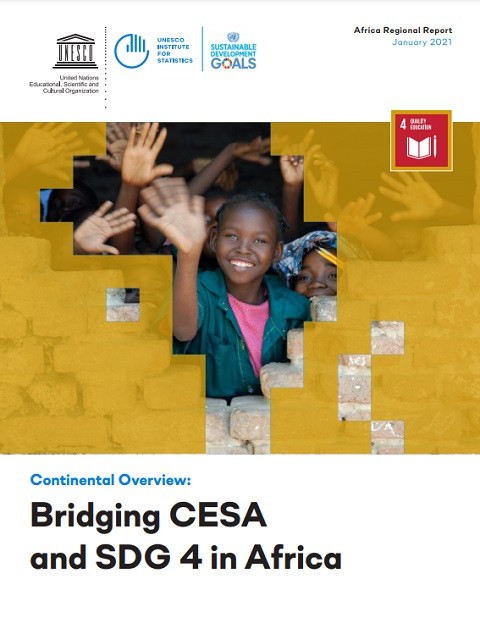 Continental Overview: Bridging CESA and SDG 4 in Africa; Africa Regional Report Year of publication: 2021 Corporate author: UNESCO Institute for Statistics (UIS) Monitoring progress toward Sustainable Development Goal 4 for education (SDG 4) is crucial to ensuring that children around the world have access to a quality education where they can learn and gain the skills they need to meet their full potential. SDG 4 indicators are organized with a view to global, thematic, regional and national targets.This report by the UNESCO Institute for Statistics (UIS) is the first in a series intended to bring a regional focus to SDG 4 monitoring, highlight the work being done in the regions and compare SDG 4 targets with those established by regional bodies.This new series of regional reports serve two purposes. Firstly, to map regional and SDG 4 targets to provide an overview of the symmetries between the two. Continental Overview: Bridging CESA and SDG 4 in Africa looks at how the strategic objectives of the Continental Education Strategy for Africa (CESA) compares with SDG 4 targets. Secondly, it analyses progress towards these objectives by African sub-regions.
  SDG 4 Data Book 2019 Year of publication: 2019 Corporate author: UNESCO Institute for Statistics (UIS) This publication presents the global monitoring indicators used by countries and the international development community to monitor progress towards Sustainable Development Goal 4 (SDG 4) on education. The indicators were produced by the UNESCO Institute for Statistics (UIS), based on the latest available data.The UIS is the official source of internationally-comparable education data and the custodian agency for SDG 4 data. This mandate reflects the trust of the international community in UIS data and its proven track record in methodological work and standard-setting with national statistical offices, line ministries and technical partners in every region. Recueil de données de l’ODD4 Year of publication: 2019 Corporate author: UNESCO Institute for Statistics (UIS) Cette publication présente les indicateurs de suivi mondiaux utilisés par les pays et la communauté du développement international pour surveiller les progrès réalisés sur la voie de l’Objectif de développement durable 4 (ODD 4) relatif à l’éducation. Les indicateurs ont été produits par l’Institut de statistique de l’UNESCO (ISU), sur la base des dernières données disponibles.L’ISU est la source officielle de données comparables au plan international sur l’éducation et l’organisme dépositaire pour les données relatives à l’ODD 4. Ce mandat témoigne de la confiance de la communauté internationale dans les données de l’ISU et de son expérience avérée dans les travaux méthodologiques et l’élaboration de normes avec les bureaux nationaux de statistique, les ministères compétents et les partenaires techniques dans chacune des regions Libro de Datos del ODS 4 Year of publication: 2019 Corporate author: UNESCO Institute for Statistics (UIS) Esta publicación presenta los indicadores de monitoreo global usados por los países y la comunidad internacional para el desarrollo con el fin de realizar el seguimiento del progreso hacia el Objetivo de Desarrollo Sostenible 4 (ODS 4) en educación. Los indicadores han sido producidos por el Instituto de Estadística de la UNESCO (UIS), con base en los últimos datos disponibles más recientes.El UIS es la fuente oficial de datos en educación internacionalmente comparables y la agencia responsable de la custodia de los datos para el ODS 4. Su mandato refleja la confianza de la comunidad internacional en los datos del UIS y su comprobada trayectoria en el trabajo metodológico y elaboración de estándares con las oficinas nacionales de estadística, los ministerios sectoriales y los socios técnicos en cada región.
  Guidelines for Data Collection to Measure SDG 4.7.4 and 4.7.5 Year of publication: 2021 Author: Andres Sandoval-Hernandez | Maria Magdalena Isac | Diego Carrasco | Daniel Miranda Corporate author: UNESCO Institute for Statistics (UIS) This document provides guidance to apply a recently developed strategy to assess two indicators that embody tolerance, respect and sustainable development, namely:Indicator 4.7.4: Percentage of students in lower secondary education showing adequate understanding of issues relating to global citizenship and sustainabilityIndicator 4.7.5: Percentage of students in lower secondary education showing proficiency in knowledge of environmental science and geoscienceFollowing a thorough review and endorsement by the UIS’ Technical Cooperation Group on the Indicators for SDG 4-Education 2030 (TCG), the measurement strategy has since been applied to the last cycles of TIMSS, PISA and ICCS to produce scores to measure Indicators 4.7.4 and 4.7.5 for 60 countries. While this marks a significant achievement, it is important to acknowledge that two- thirds of UN members have yet to participate in these assessments. To promote wider participation among UN members, this document serves as a robust and easy-to-use set of guidelines offering detailed technical guidance for countries on how to collect the data necessary to produce the information to measure and monitor SDG Indicators 4.7.4 and 4.7.5. Notably, these guidelines will aid in the production of information that is comparable with that of the 60 countries for which this data already exists.
  SDG 4 Data Digest 2020: Using Household Survey Data to Monitor SDG 4 Year of publication: 2020 Corporate author: UNESCO Institute for Statistics (UIS) The 2020 edition of the SDG 4 Data Digest by the UNESCO Institute for Statistics focuses on household surveys as an important and underutilized tool to collect the data needed to track progress towards Sustainable Development Goal 4 and to ensure that no one is left behind. The Digest describes existing survey programmes and offers advice on the design and implementation of new surveys. The Digest identifies a number of advantages to using household surveys and describes the categories of indicators best suited for monitoring with survey data. Data from household surveys complement administrative data collected in schools and can be disaggregated to a greater extent than administrative data to facilitate the monitoring of exclusion in education. The definitions and calculation methods of selected indicators are laid out and the combination of household survey data with data from other sources is explained. This issue of the Digest is aimed at government officials, national planners, donors and others who make decisions about the implementation of nationally representative household surveys. It describes the requirements for conducting a household survey and the steps that must be followed from questionnaire design to data collection and analysis, and it gives advice on presentation of the findings. A section on COVID-19 summarizes the impact of the current pandemic on data collection. Additional resources, with suggested survey questions for the collection of education data through household surveys, are also included. Compendio de Datos sobre el ODS 4: Cómo utilizar datos de encuestas de hogares para monitorear el ODS 4 Year of publication: 2020 Corporate author: UNESCO Institute for Statistics (UIS) La edición 2020 del Compendio de Datos sobre el ODS 4 del Instituto de Estadística de la UNESCO se centra en las encuestas de hogares como una importante e infrautilizada herramienta para la recolección de los datos necesarios para rastrear el progreso hacia el Objetivo de Desarrollo Sustentable 4 y para garantizar que nadie quede en el camino. El Compendio describe los programas de encuestas existentes y brinda consejos para el diseño y la implementación de nuevas encuestas. El Compendio identi ca una serie de ventajas en el uso de las encuestas de hogares y describe las categorías de indicadores más adecuados para el monitoreo con datos de encuestas. Los datos de encuestas de hogares complementan los datos administrativos recolectados en las escuelas y pueden ser desglosados a un grado mayor que los datos administrativos, facilitando el monitoreo de la exclusión en la educación. Se han expuesto las de niciones y métodos de cálculo de los indicadores seleccionados y se ha explicado cómo se combinan los datos de encuestas de hogares con los datos de otras fuentes. Esta edición del Compendio está dirigida a los funcionarios de gobierno, plani cadores nacionales, contribuyentes y quienes tomen decisiones sobre la implementación de las encuestas de hogares nacionalmente representativas. Describe los requisitos para la ejecución de una encuesta de hogares y los pasos que deben seguirse desde el diseño del cuestionario hasta la recolección y análisis de datos, además de dar consejos sobre cómo presentar los hallazgos. Una sección sobre el COVID-19 resume el impacto que tiene la actual pandemia sobre la recolección de datos. También se han incluido recursos adicionales, con preguntas de encuestas sugeridas para la recolección de datos educativos mediante las encuestas de hogares. Rapport sur les données de l’ODD 4: Utiliser les données des enquêtes auprès des ménages pour le suivi de l’ODD 4 Year of publication: 2020 Corporate author: UNESCO Institute for Statistics (UIS) L’édition 2020 du Rapport sur les données de l’ODD 4 de l’Institut de statistique de l’UNESCO met l’accent sur les enquêtes auprès des ménages comme un outil important et sous-utilisé pour collecter les données nécessaires au suivi des progrès réalisés sur la voie de l’Objectif du développement durable 4 et pour s’assurer que personne n’est laissé pour compte. Le Rapport décrit les programmes d’enquêtes existants et offre des conseils sur la conception et la mise en œuvre de nouvelles enquêtes. Le Rapport identi e un certain nombre d’avantages à utiliser les enquêtes auprès des ménages et décrit les catégories d’indicateurs les mieux adaptées au suivi avec des données d’enquête. Les données issues des enquêtes auprès des ménages complètent les données administratives recueillies dans les écoles et peuvent être ventilées dans une plus large mesure que les données administratives a n de faciliter le suivi de l’exclusion dans l’éducation. Les définitions et les méthodes de calcul des indicateurs sélectionnés sont présentées et la combinaison des données des enquêtes sur les ménages avec les données provenant d’autres sources est expliquée. Ce numéro du Rapport s’adresse aux responsables gouvernementaux, aux plani cateurs nationaux, aux donateurs et aux autres personnes qui prennent des décisions concernant la mise en œuvre d’enquêtes sur les ménages représentatives au niveau national. Il décrit les conditions requises pour mener une enquête auprès des ménages et les étapes à suivre depuis la conception du questionnaire jusqu’à la collecte et l’analyse des données, et il donne des conseils sur la présentation des résultats. Une section sur le COVID-19 résume l’impact de la pandémie actuelle sur la collecte de données. Des ressources supplémentaires, avec des suggestions de questions d’enquête pour la collecte de données sur l’éducation par le biais d’enquêtes auprès des ménages, sont également incluses.