
Resources
Explore a wide range of valuable resources on GCED to deepen your understanding and enhance your research, advocacy, teaching, and learning.
2 Results found
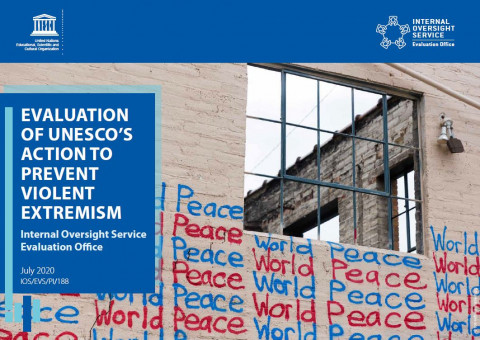 Evaluation of UNESCO’s Action to Prevent Violent Extremism Year of publication: 2020 Corporate author: UNESCO Internal Oversight Service (IOS) The purpose of this evaluation was twofold. To provide evidence, ideas and insights on how UNESCO’s efforts on PVE in the period from 2015-2018 have contributed to enhancing UNESCO’s action and position in the PVE sphere in light of the decisions of Member States. And to provide evidence and formulate lessons learned and good practices on the intersectoral approach with the aim of informing what works and what does not work in intersectoral cooperation.The evaluation found that UNESCO’s work on PVE was context specific and adjusted to respond to the needs of the countries and sub-regions where the work was being implemented.UNESCO’s work is aligned with the agency’s mandate and expertise and makes the most of its strong relationships with government bodies and civil society actors. UNESCO’s work on PVE has led to positive results around the quality, use and effectiveness of guidance documents, around capacity building of UNESCO partners and stakeholders, and around the provision of expertise and policy advice both at national and global level. Using an intersectoral approach led to an increase in information sharing and coordination. However, this was not always translated to intersectoral implementation or delivery of PVE initiatives.
 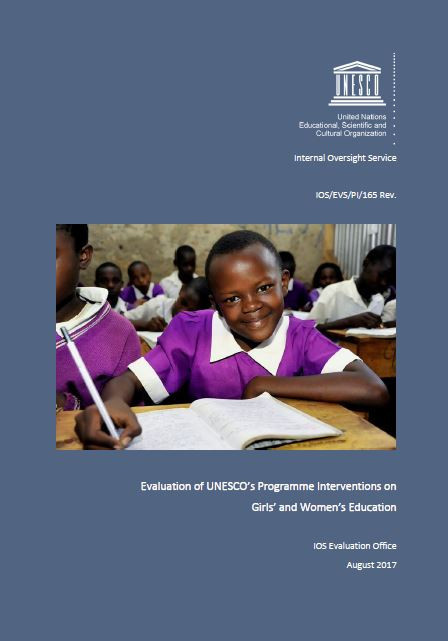 Evaluation of UNESCO's Programme Interventions on Girls' and Women's Education Year of publication: 2017 Author: Michael Reynolds, Martina Rathner, Estelle Loiseau Corporate author: UNESCO Internal Oversight Service (IOS) Since 2008, Gender Equality has been one of two global priorities for UNESCO. In May 2011, UNESCO launched the Global Partnership for Girls’ and Women’s Education, also known as “Better Life, Better Future”, which aims to increase learning opportunities for adolescent girls and women and to find solutions to some of the biggest obstacles to their education. To further advance the global priority of Gender Equality, since 2015 a dedicated Section of Education for Inclusion and Gender Equality specifically addresses the gender dimensions in education that contribute to differential access, participation, completion, and learning outcomes by boys and girls, and men and women. The evaluation examines UNESCO’s programme interventions in girls’ and women’s education during the period 2015 to 2017, in particular to ascertain the relevance, effectiveness, efficiency and sustainability of initiatives, and to clarify the strategic role and positioning of the Organization in supporting girls’ and women’s education at regional and country levels.The evaluation found that although UNESCO’s efforts for enhancing girls’ and women’s education are clearly aligned to SDG 4 and SDG 5 and also broadly in line with the overall principle of leaving no one behind, there is at times a trade-off between targeting the hardest to reach and other donor priorities, and UNESCO needs to more clearly position its efforts in support of girls’ and women’s education and its niche in the 2030 Agenda. Furthermore, continued efforts are required to scale up and/or replicate small-scale interventions, to better ensure sustainability and to consolidate mechanisms for coordination and information sharing among different interventions to seize synergies and enhance organizational learning.