
Resources
Explore a wide range of valuable resources on GCED to deepen your understanding and enhance your research, advocacy, teaching, and learning.
12 Results found
 Promoting sub-regional education for sustainable development in South-East Asia Year of publication: 2011 Corporate author: UNESCO Jakarta UNESCO Office, Jakarta, focuses on five cluster countries, helping their governments to plan and manage the education sector by enhancing national capacities to integrate sustainable development issues and practices into all types and levels of education. Country reports on education for sustainable development: centred on the five cluster countries of UNESCO office, Jakarta Year of publication: 2011 Author: Meeyoung Choi | Robert J. Didham Corporate author: UNESCO Jakarta As the cluster office, UNESCO Office, Jakarta covers the implementation of all major programmes and mandates by UNESCO in these five countries as well as disseminates and shares information and knowledge in the fields of education, science, culture and communication in the Asia and Pacific region. Rapports nationaux sur l'éducation au développement durable: axés sur les cinq pays du bureau de l'UNESCO à Jakarta Year of publication: 2011 Author: Meeyoung Choi | Robert J. Didham Corporate author: UNESCO Jakarta Le bureau de l'UNESCO à Jakarta couvre la mise en œuvre de tous les grands programmes et mandats de l'UNESCO dans ces cinq pays et diffuse et partage des informations et des connaissances dans les domaines de l'éducation, de la science, de la culture et de la communication dans la région de l'Asie et du Pacifique.
 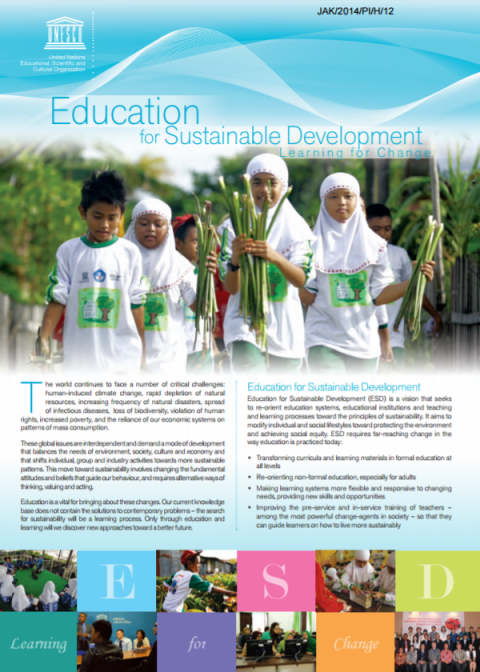 Education for Sustainable Development: Leaning for Change Year of publication: 2014 Corporate author: UNESCO Jakarta Education for Sustainable Development: Leaning for Change
  Sub-Regional Study on Transforming TVET in Ensuring Learning and Skills to Support School-to Work Transitions in Southeast Asian Countries Year of publication: 2023 Author: Jann Hidajat Tjakraatmadja | Hary Febriansyah | Yorga Permana | Lala Nurfitria | Farenza Fadil Corporate author: UNESCO Jakarta Technical and Vocational Education and Training (TVET) and the transition from school to work are critical for young individuals to be prepared for entering the job market. The school-to-work transition signifies the transition from education to professional work and involves stages such as finding a job, applying theoretical knowledge and adapting to work expectations. In line with SDG-4, there is a need to improve the relevance of TVET systems, equipping individuals with the necessary skills for employment, entrepreneurship and lifelong learning. Three strategic priorities include promoting lifelong learning opportunities, fostering skills for an inclusive and sustainable economy, and ensuring inclusive and resilient communities. UNESCO supports Member States to address current and future challenges in the field of TVET, including the transition from school to work. Recognising the significant role of TVET in achieving SDG-4, UNESCO works closely with countries like Brunei Darussalam, Indonesia, Malaysia, the Philippines, and Timor-Leste to enhance the relevance and effectiveness of their TVET systems. These countries have demonstrated a strong commitment to improving the quality of education and equipping individuals with the necessary skills for employment, entrepreneurship, and lifelong learning. In the discussion of innovations and trends in TVET systems, there is a need to respond to rapidly changing labour markets through leveraging labour market data, tracer studies, and employer insights, expanding work-based learning to support the transition from school to work, modernising TVET curricula with new skills and competencies, strengthening TVET through private sector and community engagement. TVET is important for the transition from school to work in the sub-region of Southeast Asia, in line with SDG-4. Standardised practices are needed for better employability and mobility. Challenges include labour market mismatches and negative perceptions, but there are opportunities to partner with industry, update curricula, promote inclusivity and gender equality, and adapt to changing labour markets. Using labour market data, expanding work-based learning, and engaging the private sector and local communities are critical. TVET can transform individuals and contribute to sustainable development in the subregion of South-East Asia, creating prosperous and inclusive societies.
  Sub-regional Policy Review on Teachers, Teaching and the Teaching Profession to Accelerate Achieving SDG4 in Southeast Asian Countries Year of publication: 2022 Author: Azlina Abdul Aziz | Kamisah Osman | Khairul Farhah Khairuddin | Meeyoung Choi Corporate author: UNESCO Jakarta The objectives of this report are to analyse existing national policies related to Teachers, Teaching and the Teaching Profession and examine their implementation in the five UNESCO cluster countries, namely Brunei, Indonesia, Malaysia, the Philippines and Timor-Leste. Eight themes have emerged from the systematic review of literature and they are i) Teacher Standard Competence, ii) Teacher professional Development, iii) Teacher Support, iv) Teaching Quality, v) Formative and Summative Assessment Framework on Teaching, vi) Showcasing and Rewarding Best Teaching Practices, vii) Teacher Professionalism and finally viii) Teacher Career Development.
 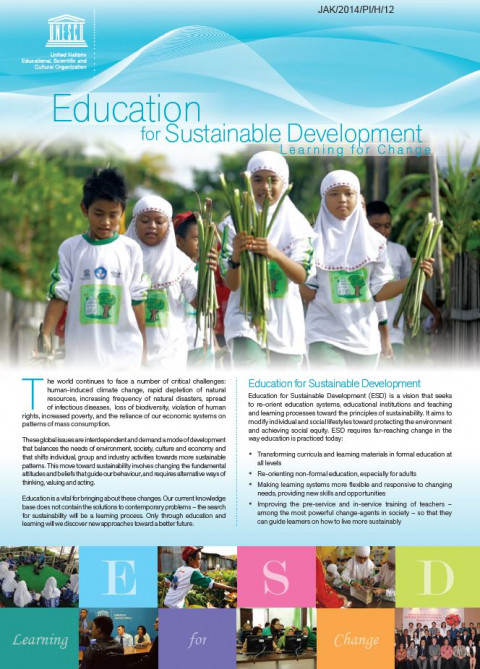 Education for Sustainable Development: Learning for Change Year of publication: 2014 Corporate author: UNESCO Jakarta The world continues to face a number of critical challenges: human-induced climate change, rapid depletion of natural resources, increasing frequency of natural disasters, spread of infectious diseases, loss of biodiversity, violation of human rights, increased poverty, and the reliance of our economic systems on patterns of mass consumption. These global issues are interdependent and demand a mode of development that balances the needs of environment, society, culture and economy and that shifts individual, group and industry activities towards more sustainable patterns. This move toward sustainability involves changing the fundamental attitudes and beliefs that guide our behaviour, and requires alternative ways of thinking, valuing and acting. Education is a vital for bringing about these changes. Our current knowledge base does not contain the solutions to contemporary problems – the search for sustainability will be a learning process. Only through education and learning will we discover new approaches toward a better future. Fostering safer and resilient communities: a natural disaster preparedness and climate change education program Year of publication: 2009 Corporate author: UNESCO Jakarta The Asia and the Pacific region is vulnerable to many natural disaster and expected impacts from climate change. In 2006, 74% of people killed by natural disasters were in Asia, with Afghanistan, India, Indonesia, Pakistan, the Philippines, and Vietnam among the countries most badly affected. Natural disasters such as windstorms, floods, droughts, earthquakes in combination with human-induced conditions such as deforestation, pollution, soil erosion collectively contribute to serious challenges for communities and governments. Climate change impacts are imminent and inevitable. The consensus among natural and social scientists, economists, and policymakers is that climate change is the most important challenge that this planet faces. It is pervasive, touching on every facet of the environment and human life including the environment, economy, transportation, communication, food production, and health. The temporal and geographic scale is wide. The projected economic, health, and societal costs put forth by experts are extraordinary. For example, the total economic cost of climate change threats could be an annual loss of 6-7% of Southeast Asian countries’ GDP by the end of the century, and the Pacific sub-region will see a sea-level rise of 0.19-0.58 meter by 2100 severely changing the lives of more than 50% of the people that live within 1.5 km of the shoreline leading to relocation, water and power shortages, and submerged infrastructure. Climate change impacts in Asia and the Pacific is particularly serious because of the fact that: 1) over 60% of the global population reside in Asia and the Pacific; 2) it has the most extensive coastline of any geographic region; and, 3) many of the world’s largest cities are located along Asian coasts. The impact of climate change in sea level rise would impact small island states such as the Maldives and Kiribati, and many of Asia’s largest coastal cities, such as Jakarta, Bangkok, Manila, Shanghai, and Ho Chi Minh City. Tens of millions of people in Asia may have to be resettled. Further, the expected greater intensity of cyclones and typhoons could have a larger impact than before on Bangladesh, China, India, Vietnam, and the Philippines, whose coastal areas already encounter among the world’s worst weather-related disasters year after year. Parts of many countries in Asia, including Northwestern India, Western China, and almost all of Pakistan, are already suffering from shortages of water, as well as land degradation and desertification, which will be further exacerbated by climate change. The World Conference on Disaster Reduction held in January 2005 in Kobe, Japan, adopted the Framework for Action 2005-2015: Building the Resilience of Nations and Communities to Disasters (referred as the “Hyogo Framework for Action” – HFA). The framework emphasizes the need to understand the linkages between disaster risk reduction and climate change adaptation, and that stakeholders work toward reducing disaster vulnerabilities of communities by helping them build their capacity to deal with disasters. Favoriser des collectivités sûres et solides: un programme d'éducation à la préparation aux catastrophes naturelles et le changement climatique Year of publication: 2009 Corporate author: UNESCO Jakarta L'Asie et la région du Pacifique est vulnérable à de nombreuses catastrophes naturelles et les impacts attendus du changement climatique. En 2006, 74% des personnes tuées par des catastrophes naturelles ont été en Asie, avec l'Afghanistan, l'Inde, l'Indonésie, le Pakistan, les Philippines et le Vietnam parmi les pays les plus durement touchés. Les catastrophes naturelles telles que les tempêtes, les inondations, les sécheresses, les tremblements de terre en combinaison avec des conditions d'origine humaine telles que la déforestation, la pollution, l'érosion des sols contribuent collectivement aux défis graves pour les communautés et les gouvernements. les impacts du changement climatique sont imminente et inévitable. Le consensus entre les sciences naturelles et sociales, les économistes et les décideurs est que le changement climatique est le défi le plus important que cette planète est confrontée. Il est omniprésent, touchant à toutes les facettes de l'environnement et de la vie humaine, y compris l'environnement, l'économie, le transport, la communication, la production de l'alimentation et de la santé. L'échelle temporelle et géographique est large. La projection économique, la santé et les coûts sociaux mis en avant par les experts sont extraordinaires. Par exemple, le coût économique total des menaces du changement climatique pourrait être une perte annuelle de 6-7% du PIB des pays d'Asie du Sud-Est de la fin du siècle, et la sous-région du Pacifique verra une élévation du niveau de la mer de 0.19- 0,58 mètre d'ici 2100 modifiant gravement la vie de plus de 50% des personnes qui vivent à moins de 1,5 km de la côte menant à des pénuries de réinstallation, de l'eau et d'énergie, et l'infrastructure submergée. les impacts du changement climatique en Asie et dans le Pacifique est particulièrement grave en raison du fait que: 1) plus de 60% de la population mondiale réside en Asie et dans le Pacifique; 2) il a le littoral le plus étendu de toute région géographique; et 3) plusieurs des plus grandes villes du monde sont situés le long des côtes d'Asie. L'impact du changement climatique en élévation du niveau marin aurait un impact sur les petits États insulaires comme les Maldives et Kiribati, et bon nombre des plus grandes villes côtières d'Asie, telles que Jakarta, Bangkok, Manille, Shanghai, et Ho Chi Minh-Ville. Des dizaines de millions de personnes en Asie peuvent être réinstallés. En outre, la plus grande intensité attendue des cyclones et typhons pourrait avoir un impact plus important que jamais sur le Bangladesh, la Chine, l'Inde, le Vietnam et les Philippines, dont les zones côtières déjà rencontrer parmi les plus liés aux conditions météorologiques catastrophes année du monde après année. Pièces de nombreux pays d'Asie, y compris le Nord-Ouest de l'Inde, la Chine occidentale, et la quasi-totalité du Pakistan, souffrent déjà d'une pénurie d'eau, ainsi que la dégradation des terres et la désertification, qui sera encore aggravé par le changement climatique. La conférence mondiale sur la prévention des catastrophes, tenue en Janvier 2005 à Kobe, au Japon, a adopté le Cadre d'action 2005-2015: Renforcer la résilience des nations et des collectivités face aux catastrophes (dénommé le «Cadre d'action de Hyogo» - HFA). Le cadre met l'aCECnt sur la nécessité de comprendre les liens entre la réduction des risques et adaptation au changement climatique, et que les parties prenantes travaillent en vue de réduire la vulnérabilité aux catastrophes des communautés en les aidant à renforcer leur capacité à faire face aux catastrophes. Education for sustainable development country guidelines for changing the climate of teacher education to address sustainability: putting transformative education into practice Year of publication: 2011 Corporate author: UNESCO Jakarta This document on ESD Country Guidelines for TEIs is the result of the Regional Training Workshop Programme, titled “Developing Capacities of Teacher Education Institutions (TEIs) of Brunei Darussalam, Indonesia, Malaysia, Philippines and Timor-Leste in Reorienting Teacher Education to Address Sustainability” and has been developed by the five cluster countries of the UNESCO Office, Jakarta. The developed guidelines ultimately aim to reorient each country's curriculum, policies, standard practices and programmes to address sustainability and implement it in a tangible way. Although many idealistic descriptions of sustainability and sustainability education exist, faculties of education must decide which themes should receive particular focus and create their own guidelines and design criteria on this specific area. Therefore, these ESD Country Guidelines are significant initial steps to ensuring teacher education programmes fit the environmental, social, cultural and economic conditions and goals of each country's communities, regions and nations.