
Resources
Explore a wide range of valuable resources on GCED to deepen your understanding and enhance your research, advocacy, teaching, and learning.
23 Results found
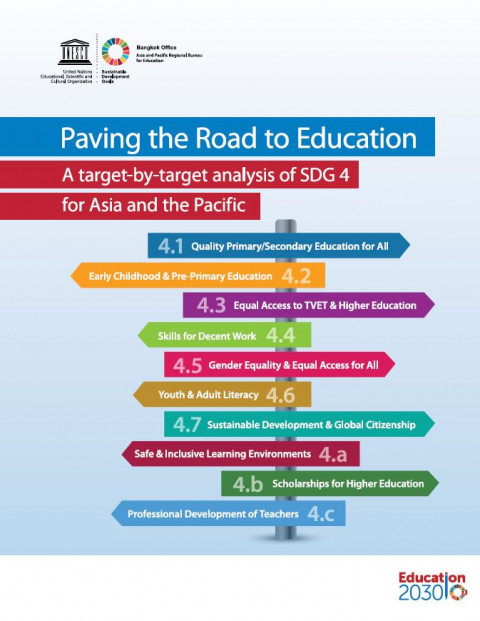 Paving the Road to Education: A Target-by-Target Analysis of SDG 4 for Asia and the Pacific Year of publication: 2018 Corporate author: UNESCO Office Bangkok and Regional Bureau for Education in Asia and the Pacific The globally adopted development agenda “Transforming our World: the 2030 Agenda for Sustainable Development” has established ambitious intentions that build on the past Millennium Development Goals but also expand on their achievements.The Sustainable Development Goal 4 on education propels forward the vision of ensuring inclusive and equitable quality education and to promote lifelong learning opportunities for all through a holistic, aspirational and systematic education agenda. Education monitoring is an integral part in this process.This publication delivers a data-rich snapshot of Sustainable Development Goal 4, its targets and their monitoring indicators while analyzing available data through a lens of inequality.Assessing the progress which countries have made in the recent past as well as where countries currently stand, this publication sets a baseline against which Member States from Asia and the Pacic are able to monitor progress in achieving the Goal 4 over time but at latest by 2030.Finally, after discussing emerging opportunities and remaining challenges in the region, this publication seeks to assist Member States in identifying what steps can be taken to ensure that the region will achieve the new education agenda.
  Envisioning education beyond 2015: Asia-Pacific regional perspectives; final report Year of publication: 2014 Corporate author: UNESCO Office Bangkok and Regional Bureau for Education in Asia and the Pacific This report provides a thorough account of the discussions and deliberations that led to the construction of the Asia-Pacific Statement on Education Beyond 2015 (Bangkok Statement), the outcome document of this historic event. Participants reviewed in fine detail EFA progress across the Asia-Pacific region and debated key thematic areas of basic education, skills and competencies, global citizenship education, education for sustainable development, teachers, governance and finance. Participants also looked into implementation strategies, and education ministers from across the region shared their views on remaining challenges, future priorities and strategies for education beyond 2015.
 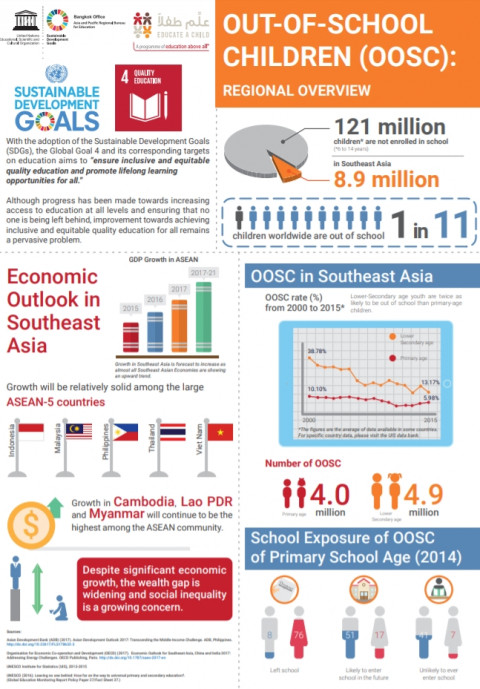 Out-of-School Children (OOSC): regional overview Year of publication: 2017 Corporate author: UNESCO Office Bangkok and Regional Bureau for Education in Asia and the Pacific This leaflet provides a regional overview of out-of-school children (OOSC) situation in Southeast Asia including school exposure of OOSC of primary school age. To provide learning opportunities for OOSC in the region, UNESCO Bangkok has launched the project titled “Strengthening Education Systems for Out of School Children” with the support of Educate a Child (EAC). Information on country activities implemented under the project is included in the leaflet.
  Online Programme and Meeting Document Situation Analysis of SDG 4 with a Gender Lens, Target 4.C Year of publication: 2018 Corporate author: UNESCO Office Bangkok and Regional Bureau for Education in Asia and the Pacific Teachers play a critical role in delivering high-quality education and learning outcomes. Indeed, the quality of an education system cannot exceed that of its teachers (OECD, 2010). Target 4.c recognizes this fact by calling on countries to increase the supply of qualified teachers. East Asia and the Pacific does not have enough trained and qualified teachers, particularly in remote and impoverished areas where children are most in need of highquality education. Moreover, the gender distribution of teachers is uneven across the education system, in teaching and administration. While integrating Target 4.c into national education policies and sector plans, governments should develop specific strategies to ensure that teachers are trained, qualified and deployed in an equitable manner.
  Situation Analysis of SDG 4 with a Gender Lens, Target 4.5 Year of publication: 2018 Corporate author: UNESCO Office Bangkok and Regional Bureau for Education in Asia and the Pacific Equity and inclusion are at the heart of the SDG 4-Education 2030 Agenda. Target 4.5 calls for monitoring equity using disaggregated parity indices for all education indicators “by income, sex, age, race, ethnicity, migratory status, disability and geographic location, or other characteristics” (UN, 2016). In East Asia and the Pacific, access to basic education has expanded in recent decades, especially for girls (UNESCO & UNICEF, 2012). Despite these gains, many girls are still denied the right to education in the sub-region, but this should not mask the fact that boys also face barriers to education. As policymakers seek to implement Target 4.5, they must address the multiple, intersecting disadvantages that all children and youth face.
 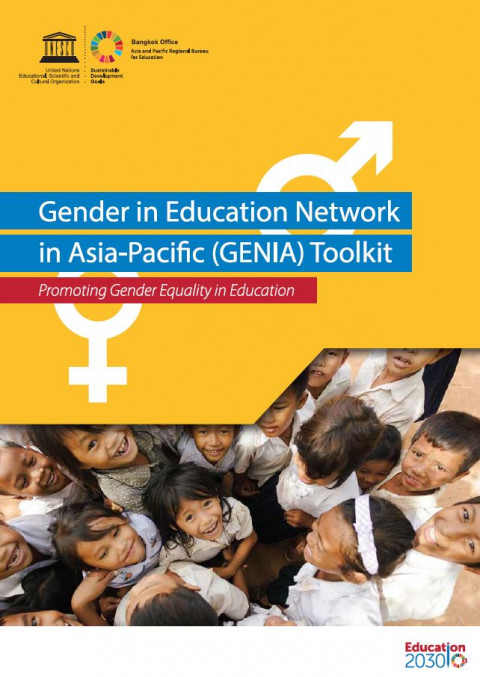 Gender in Education Network in Asia-Pacific (GENIA) Toolkit: Promoting Gender Equality in Education Year of publication: 2019 Corporate author: UNESCO Office Bangkok and Regional Bureau for Education in Asia and the Pacific The GENIA Toolkit was originally designed in 2003 when the Gender in Education Network in Asia Pacific was established. The fifth edition of the GENIA Toolkit (25 tools) is designed for use by gender focal points and education planners and implementers. It introduces key concepts and theoretical debates, and outlines practical approaches for mainstreaming gender equality throughout the education system, and within education policy.The toolkit is designed to be used selectively, depending on the user’s needs. It can be used as a self-study tool. Readers can select topics that they have identified as priority learning areas to help them improve their own understanding and practical capacity. The toolkit can also be used by trainers to facilitate training sessions. Trainers can choose tools from the kit that best match the needs of their trainees.
 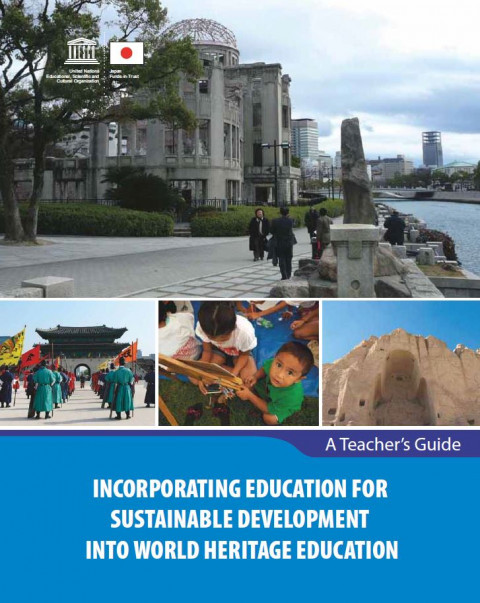 Incorporating education for sustainable development into world heritage education: a teacher's guide Year of publication: 2010 Corporate author: UNESCO Office Bangkok and Regional Bureau for Education in Asia and the Pacific This publication, A Teacher’s Guide: Incorporating Education for Sustainable Development into World Heritage Education, represents the collective efforts of workshop participants to produce a practical tool for teachers to modify available curricula and incorporate ESD concepts and principles into WHE. It has taken a long time for the guide to be available in print. Nonetheless, the content of the guide remains practical and relevant in incorporating Education for Sustainable Development into World Heritage Education.
 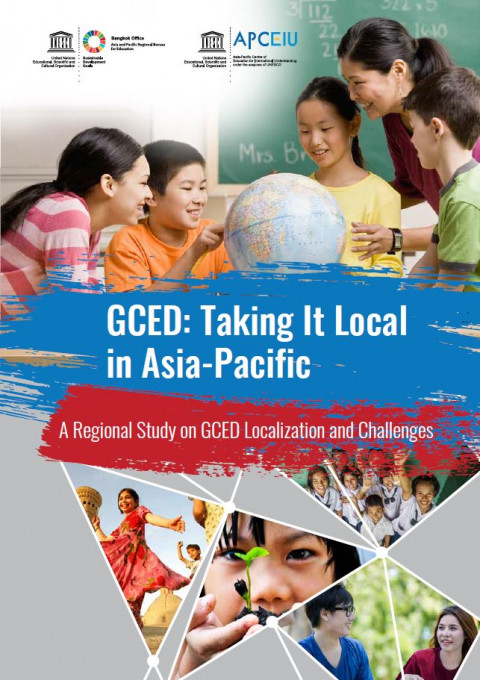 GCED: Taking It Local in Asia-Pacific; A Regional Study on GCED Localization and Challenges Year of publication: 2019 Corporate author: UNESCO Office Bangkok and Regional Bureau for Education in Asia and the Pacific Global Citizenship Education (GCED) is often interpreted in theoretical ways, which may make GCED difficult for laypeople to understand from a local perspective. However, notions of GCED are deeply rooted in the cultures of the Asia-Pacific region and are very much related to daily life experiences.In the “Asia-Pacific Regional GCED Network 2018 Jakarta Meeting Final Report”, “Contextualize GCED in Asia-Pacific while keeping in mind the global view” has been identified as one of the actions needed for facilitating GCED implementation. Thus, this study attempts to link the concept of GCED with localized ideologies by showing some examples of the way GCED is understood in different cultural contexts in the Asia and Pacific region. 2013 Asia-Pacific Education Research Institutes Network (ERI-Net) regional study on: transversal competencies in education policy and practice (Phase I): regional synthesis report Year of publication: 2015 Corporate author: UNESCO Office Bangkok and Regional Bureau for Education in Asia and the Pacific The Asia-Pacific region has been spearheading global, social, and economic development for the last several decades. Millions of people have been lifted out of poverty and basic education (primary and lower secondary) has become near universal in many countries in the region. Upper secondary and higher education enrollment rates have also increased significantly. However, while these are tremendous achievements, education quality remains a major concern among emerging economies and industrialized nations alike. While some countries in the region excel in international assessments, such as the Programme for International Student Assessment (PISA), the Trends in International Mathematics and Science Study (TIMSS), and the Progress in International Reading Literacy Study (PIRLS), other countries still attain low scores. National assessment results of countries that have not participated in international assessments reveal large knowledge and skills disparities among students of the same country. In some cases the results also indicate a very low attainment level of basic skills, even after years of schooling.At the same time, the debate surrounding what actually constitutes quality education and learning in the 21st century is ongoing. There is a growing concern that education systems are focusing too much on the accumulation of academic “cognitive” skills at the expense of the more elusive and hard-to-measure “nonacademic” skills and competencies. The accumulation of these skills and competencies, which include skills and competencies in efficient communication with others, innovative thinking, respect for diversity and the environment, conflict resolution, team work, problem solving, and so on, is not only important for students to be adequately prepared for the world of work, but is also paramount in ensuring future generations are equipped to live meaningful, sustainable, and responsible lives in a rapidly changing and interconnected world.1 The effects of the limited attention paid to such skills and competencies in education can be felt in a number of domains and include, for example: poor respect for diversity (including socio-economic, ethnic, and gender equality), neglect of environmental issues, and a lack of innovation and social entrepreneurship among students.To counter these challenges, many countries and economies in the Asia-Pacific region have introduced, or are in the process of introducing, policy and curriculum changes aimed at enhancing the cultivation of such “non-academic” skills and competencies in learners. To date, these important reforms in the Asia-Pacific region have not been widely documented, and hence, in 2013 members of the Asia-Pacific Education Research Institutes Network (ERI-Net), hosted by UNESCO Bangkok since 2009, agreed to make this their next topic of investigation. The research aims to document and consolidate reform initiatives for knowledge dissemination and policy consideration to the benefit of countries and economies in the Asia-Pacific region and beyond. In phase I, the 2013 ERI-Net research examined how different countries and economies in the region define and apply “non-academic” skills (often termed “non-cognitive skills”) in their education policies, practices, and curriculum frameworks, and identified emerging trends and challenges. This report synthesizes ten case studies and includes important information and insights gained from the discussions held during the ERI-Net annual meeting 2013.The objectives of the report are: (i) to capture the movements in the realm of “non-academic” learning in ten education systems in the Asia-Pacific region; (ii) to identify possible policy recommendations for promoting and enhancing well-rounded and holistic learning; and, (iii) to suggest further stages of investigation. Education sector responses to climate change: background paper with international examples Year of publication: 2012 Corporate author: UNESCO Office Bangkok and Regional Bureau for Education in Asia and the Pacific Through a review of academic articles and project documents, this paper explores the relationship between the education sector and climate change. It introduces how education is both impacted by and has an impact on this phenomenon, and proposes various sector responses. Different theoretical frameworks for where and how climate change education fits into the education sector are made concrete with case studies from across the globe. An essential introduction to climate change and education, this paper brings together theory, policy and practice. A useful read for those working in either the education sector or on climate change.