
Resources
Explore a wide range of valuable resources on GCED to deepen your understanding and enhance your research, advocacy, teaching, and learning.
23 Results found
 The heart of education: learning to live together; selected papers presented at the 16th UNESCO-APEID international conference Year of publication: 2014 Corporate author: UNESCO Office Bangkok and Regional Bureau for Education in Asia and the Pacific To help frame current thinking on education in a changing world, UNESCO Bangkok, the Ministry of Education in Thailand, the Asian-Pacific Network for International Education and Values (APNIEVE), Pearson Thailand and J.P. Morgan co-organized the 16th UNESCO-APEID International Conference, The Heart of Education: Learning to Live Together in November 2012 in Bangkok, Thailand. The Conference provided a forum for participants to share their knowledge and experiences, raise critical questions, provide constructive feedback and, most of all, express their commitment to imbue and translate the essence of learning to live together in their respective educational efforts. This report contains selected papers presented at the Conference to reflect the linkages between learning and social development, showcase approaches and tools, and identify enabling policies and instruments to promote learning to live together. Astrolabe: a guide to education for sustainable development coordination in Asia and the Pacific Year of publication: 2011 Corporate author: UNESCO Office Bangkok and Regional Bureau for Education in Asia and the Pacific An astrolabe is an ancient instrument used to measure the position of the sun and stars. In the past it was used for a number of purposes, such as determining the time of day or night and measuring one’s current position in relation to the north and south poles. A mariner’s astrolabe was used to determine the latitude of a ship at sea and guide its direction. Similar to the mariner’s astrolabe, the Asia-Pacific Education for Sustainable Development (ESD) Astrolabe aims to assist UNESCO Member States in determining the current position of ESD in their country and guiding education and learning in a desired direction, so as to support the advancement of sustainable development in the national context. The ESD Astrolabe is also intended to complement ongoing efforts to enhance the quality of education throughout the Asia-Pacific region.
 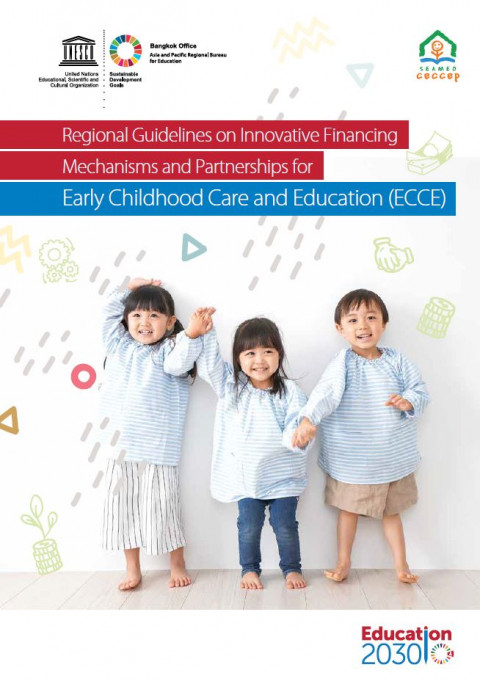 Regional Guidelines on Innovative Financing Mechanisms and Partnerships for Early Childhood Care and Education (ECCE) Year of publication: 2019 Corporate author: UNESCO Office Bangkok and Regional Bureau for Education in Asia and the Pacific | SEAMEO. Regional Centre for Early Childhood Care Education and Parenting (CECCEP) The development of the Regional Guidelines on Innovative Financing Mechanisms and Partnerships for Early Childhood Care and Education (ECCE) was a joint initiative of the UNESCO Asia-Pacific Regional Bureau for Education (UNESCO Bangkok) and the Southeast Asian Ministers of Education Organization Regional Centre for Early Childhood Care Education and Parenting (SEAMEO CECCEP). The Guidelines are part of UNESCO Bangkok’s “Exploring innovative financing and mechanisms for ensuring free inclusive and equitable quality pre-primary education for all in Asia-Pacific” project, which is supported by the Ministry of Economy and Finance Republic of Korea.