
Resources
Explore a wide range of valuable resources on GCED to deepen your understanding and enhance your research, advocacy, teaching, and learning.
52 Results found
 Teachers' guide for education for sustainable development in the Caribbean Year of publication: 2008 Author: Gillian Cambers | Grace Chapman | Paul Diamond | Lorna Down | Anthony D. Griffith | Winthrop Wiltshire Corporate author: UNESCO Santiago The publication “Teachers’ Guide for Education for Sustainable Development in the Caribbean” is geared towards regional teacher-trainers and teachers active at every level of education. Its purpose is two-fold: contribute to the integration of education for sustainable development into teaching practices through education initiatives, originally implemented in the Caribbean that may be feasible to replicate in the various classrooms, schools and communities; promote reflection, discussion and creation of innovative practices that involve all teachers in Decade activities and contribute to the making of sustainable societies. This document illustrates how different wills can come together moved by a desire to materialise common projects. Thus, this effort represents the work of regional specialists working in close cooperation with UNESCO Regional Bureau for Education in Latin America and the Caribbean, as well as the financial support of the Government of Japan. Guide pédagogique pour l'éducation pour le développement durable dans les Caraïbes Year of publication: 2008 Author: Gillian Cambers | Grace Chapman | Paul Diamond | Lorna Down | Anthony D. Griffith | Winthrop Wiltshire Corporate author: UNESCO Santiago La publication «Guide des enseignants pour l'éducation pour le développement durable dans les Caraïbes» s'adresse aux formateurs et enseignants régionaux actifs à tous les niveaux de l'enseignement. Son objectif est double: contribuer à l'intégration de l'éducation pour le développement durable dans les pratiques d'enseignement à travers des initiatives éducatives, initialement mises en œuvre dans les Caraïbes, qui peuvent être répliquées dans les différentes classes, écoles et communautés; Promouvoir la réflexion, le débat et la création de pratiques novatrices qui impliquent tous les enseignants dans les activités de la Décennie et contribuent à la création de sociétés durables. Ce document illustre la façon dont des volontés différentes peuvent se rencontrer par le désir de concrétiser des projets communs. Cet effort représente donc le travail de spécialistes régionaux travaillant en étroite coopération avec le Bureau régional de l'UNESCO pour l'éducation en Amérique latine et dans les Caraïbes, ainsi que le soutien financier du Gouvernement japonais.
 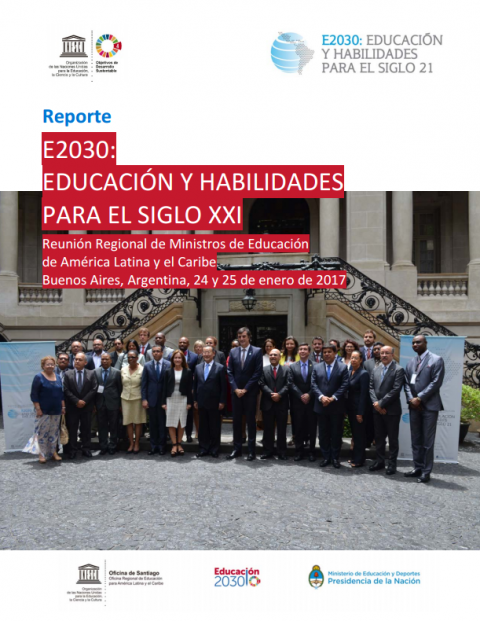 E2030: education and skills for the 21st century: Regional Meeting Year of publication: 2017 Corporate author: UNESCO Santiago This report provides a systematization of the discussions at the Regional Meeting of Ministers of Education of Latin America and the Caribbean “E2030: Education and skills for the 21st century” held 24‐25 January 2017 in Buenos Aires, Argentina. The objectives of the meeting were to: • adopt a Ministerial Declaration on a joint approach to achieve the SDG4-E2030 Agenda in the region, including means of implementation, technical instruments of support and follow-up mechanisms. • agree on a roadmap for the implementation of E2030, including a contextualized followup mechanism that responds to the region’s educational challenges and expectations. Reporte: Educación y habilidades para el siglo XXI; Reunión Regional de Ministros de Educación de América Latina y el Caribe, Buenos Aires, Argentina, 24 y 25 de enero 2017 Year of publication: 2017 Corporate author: UNESCO Santiago This report provides a systematization of the discussions at the Regional Meeting of Ministers of Education of Latin America and the Caribbean “E2030: Education and skills for the 21st century” held 24‐25 January 2017 in Buenos Aires, Argentina. The objectives of the meeting were to: • adopt a Ministerial Declaration on a joint approach to achieve the SDG4-E2030 Agenda in the region, including means of implementation, technical instruments of support and follow-up mechanisms. • agree on a roadmap for the implementation of E2030, including a contextualized followup mechanism that responds to the region’s educational challenges and expectations.
  Educación Integral de la Sexualidad: Conceptos, Enfoques y Competencias Year of publication: 2014 Corporate author: UNESCO Santiago El objetivo de este documento es comprender que la sexualidad es parte integral de la vida de las personas (en sus diferentes etapas o edades, y en toda su diversidad), y que contribuye al desarrollo de su identidad y por lo tanto, a su desarrollo social. Se trata de capacidades más que de contenidos, las que deben desarrollarse en forma interdisciplinaria y de manera progresiva para que las personas actúen de forma responsable respecto a ellas mismas y con los demás. El documento explica que la educación de la sexualidad está íntimamente relacionada con la comprensión, la reflexión y el discernimiento, y fortalece las bases para el aprendizaje a lo largo de la vida, preparando a los jóvenes para la vida adulta. Es así que el enfoque se centra en alcanzar un desarrollo y bienestar humano sostenible.
 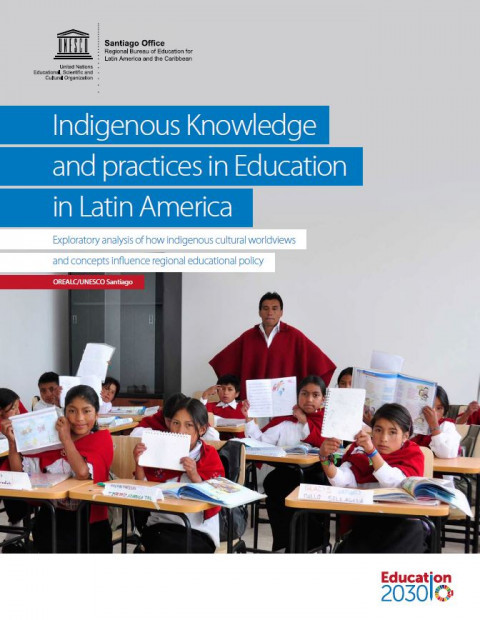 Indigenous Knowledge and practices in Education in Latin America: Exploratory Analysis of How Indigenous Cultural Worldviews and Concepts Influence Regional Educational Policy Year of publication: 2017 Corporate author: UNESCO Santiago This study presents a preliminary exploration of the approaches, processes and tools through which indigenous worldviews and concepts of knowledge and well-being can and have influenced education policies in Latin America. First, it addresses the principal theoretical approaches used in the area of indigenous knowledge and education policies, taking into account the persistence of an “epistemic otherness” and the need for a dialogue between the predominant approaches. Second, it addresses the normative framework and intercultural educational policies, emphasizing how and to what extent the countries in the region take indigenous knowledge into consideration and include it in their education policies and practices. Third, it presents a number of “relevant practices” in terms of dialogue with indigenous knowledge in education policies, taking into account the factors that favour the relevance of education to indigenous views and cultural practices, facilitating their replicability and sustainability. Furthermore, these practices respond to key criteria like recognizing learners as ‘carriers’ and producers of culture, valuing the use of schools as centres of social and cultural activities and favouring the inclusive learning of indigenous and non-indigenous students. Finally, the study unveils challenges for the advancement of the dialogue between indigenous knowledge and education policies, at the same time proposing key concepts to be approached in depth. Conocimiento Indígena y Políticas Educativas en América Latina: Análisis exploratorio de cómo las cosmovisiones y conceptos culturales indígenas de conocimiento inciden, y pueden incidir, en la política educativa en la región Year of publication: 2017 Corporate author: UNESCO Santiago El presente estudio explora la idea de una ‘alternativa epistémica’, construyendo desde el conocimiento y los valores que sustentan las prácticas sociales y educacionales indígenas de la región. En particular, explora cómo estos valores y formas de conocimiento han sido adoptados en las políticas educacionales de tres países de la región andina: Bolivia, Ecuador y Perú, que hace poco atravesaron reformas políticas y constitucionales con el fin de reconocer la composición de sus poblaciones multiculturales, multiétnicas y multilingüísticas. Esta publicación es una invitación a considerar el conocimiento indígena como una fuente legítima de inspiración para las políticas educacionales que puedan contribuir al bienestar de todos y a la sostenibilidad del planeta. Integral Education of Sexuality: Concepts, Approaches and Competencies Year of publication: 2014 Corporate author: UNESCO Santiago The objective of this document is to understand that sexuality is an integral part of people's lives (in their different stages or ages, and in all their diversity), and that it contributes to the development of their identity and, therefore, to their development Social. It is about capacities rather than content, which must be developed in an interdisciplinary way and progressively so that people act responsibly towards themselves and with others. The document explains that the education of sexuality is closely related to understanding, reflection and discernment, and strengthens the bases for lifelong learning, preparing young people for adult life. Thus, the focus is on achieving sustainable human development and well-being.
  IX and X Days of Educational Cooperation with Iberoamerica on Special Education and Educational Inclusion Year of publication: 2015 Corporate author: UNESCO Santiago This publication includes the main presentations made by experts in educational inclusion presented at the IX and X Conference on Educational Cooperation with Ibero-America on special education and educational inclusion, held in Cartagena de Indias, Colombia (2012) and Santa Cruz, Bolivia ( 2013), respectively. The workshops have been organized by the Ministry of Education of Spain with the support of the Regional Office of Education for Latin America and the Caribbean (OREALC / UNESCO Santiago). We hope that this publication will contribute to the dissemination of the reflections that RIINEE has developed on critical issues in the field of the educational inclusion of people with disabilities and / or special educational needs, and in this way, constitute a contribution to advance in the guarantee of the rights indicated in the Convention on the Rights of Persons with Disabilities, approved in 2006 by the Member States of the United Nations Organization. IX y X Jornadas de Cooperación Educativa con Iberoamérica sobre Educación Especial e Inclusión Educativa Year of publication: 2015 Corporate author: UNESCO Santiago En esta publicación se incluyen las principales ponencias realizadas por personas expertas en inclusión educativa presentadas en las IX y X Jornadas de Cooperación Educativa con Iberoamérica sobre educación especial e inclusión educativa, realizadas en Cartagena de Indias, Colombia (2012) y Santa Cruz, Bolivia (2013), respectivamente. Las jornadas han sido organizadas por el Ministerio de Educación de España con el apoyo de la Oficina Regional de Educación para América Latina y el Caribe (OREALC/UNESCO Santiago). Esperamos que con esta publicación se contribuya a la difusión de las reflexiones que la RIINEE ha desarrollado sobre nudos críticos en el ámbito de la inclusión educativa de personas con discapacidades y/o necesidades educativas especiales, y de esta forma, constituya un aporte para avanzar en la garantía de los derechos señalados en la Convención sobre los Derechos de las Personas con Discapacidad, aprobada el año 2006 por los Estados Miembro de la Organización de las Naciones Unidas.