
Resources
Explore a wide range of valuable resources on GCED to deepen your understanding and enhance your research, advocacy, teaching, and learning.
204 Results found
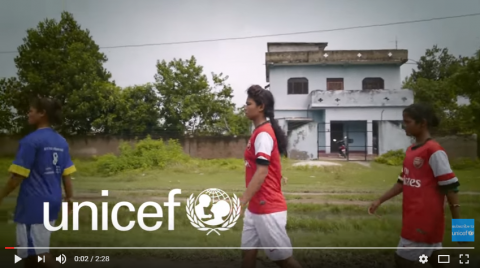 From the football field to the classrooms of Nepal Year of publication: 2015 Corporate author: United Nations Children's Fund (UNICEF) “Before, we didn’t know how to study. We were not motivated. I am transformed because of sports. And my studies have also improved,” Kalita says. In Solakhpur, Nepal, football is improving the life of 16-year-old Kalita and those of other adolescent girls through a sports programme meant to get more children into school and boost their academic success.
 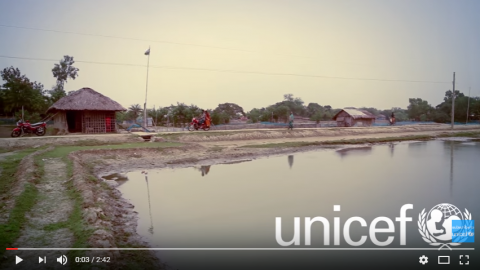 Bridging the education gap in Bangladesh Year of publication: 2015 Corporate author: United Nations Children's Fund (UNICEF) “If this school didn’t exist, I wouldn’t be here… I would be forced to work,” Mohammed, 13, says. Mohammed attends an ability-based learning school in Shyamnagar, Bangladesh supported by UNICEF’s Let Us Learn initiative. Many children in Bangladesh are out of school because they never enrolled or dropped out, largely due to poverty and child labour.
 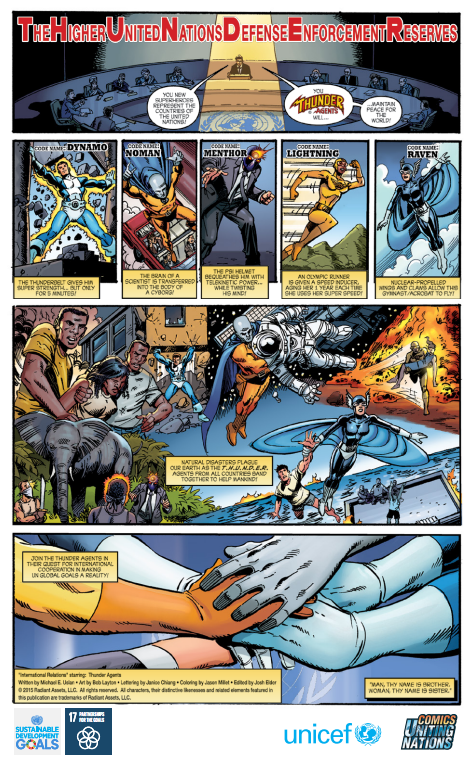 T.H.U.N.D.E.R. Agents Year of publication: 2015 Author: Michael E. Ulsan | Bob Layton | Janic Chiang | Jason Millet | Josh Elder Corporate author: Radiant Assets | LLC | United Nations Children's Fund (UNICEF) T.H.U.N.D.E.R. -- The Higher United Nations Defense Enforcement Reserves -- are UN Superheroes tasked with promoting global cooperation to make the world a better place. The T.H.U.N.D.E.R. Agentswas a comic originally created in the 1960s and is set to be made into a major motion picture in 2018.
 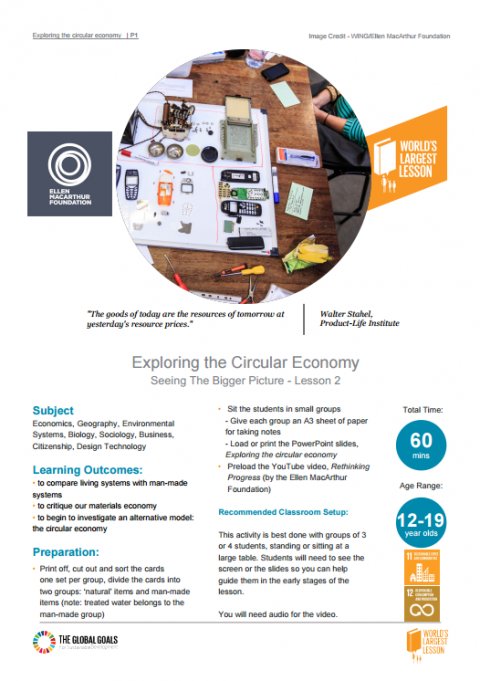 Exploring the Circular Economy: Seeing The Bigger Picture - Lesson 2 Corporate author: United Nations Children's Fund (UNICEF) World’s Largest Lesson is a collaborative education project to support the announcement of the United Nations Global Goals for Sustainable Development. Learning outcomes of the project: • to compare living systems with man-made systems • to critique our materials economy • to begin to investigate an alternative model: the circular economy
 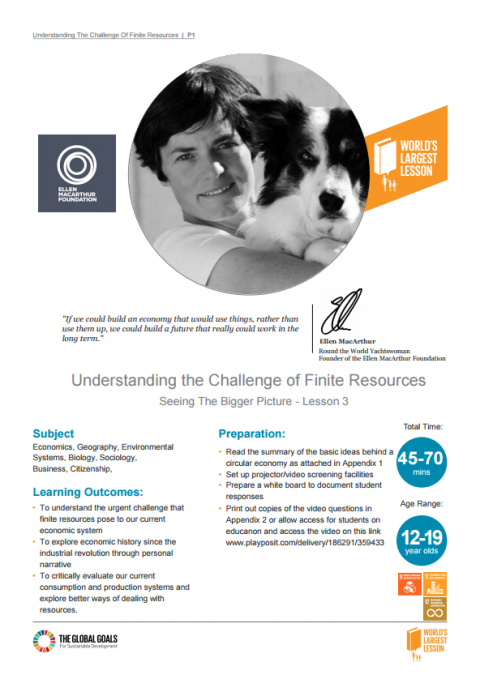 Understanding the Challenge of Finite Resources: Seeing The Bigger Picture - Lesson 3 Corporate author: United Nations Children's Fund (UNICEF) World’s Largest Lesson is a collaborative education project to support the announcement of the United Nations Global Goals for Sustainable Development. Learning outcomes of the project: • To understand and the urgent challenge that finite resources pose to our current economic system • To explore economic history since the industrial revolution through personal narrative • To critically evaluate our current consumption and production systems and explore better ways of dealing with resources.
  Designing for a Circular Economy: Seeing The Bigger Picture - Lesson 4 Corporate author: United Nations Children's Fund (UNICEF) World’s Largest Lesson is a collaborative education project to support the announcement of the United Nations Global Goals for Sustainable Development. Learning outcomes of the project: • To learn about companies that have adopted the circular economy framework • To design a product or service based on the circular economy
 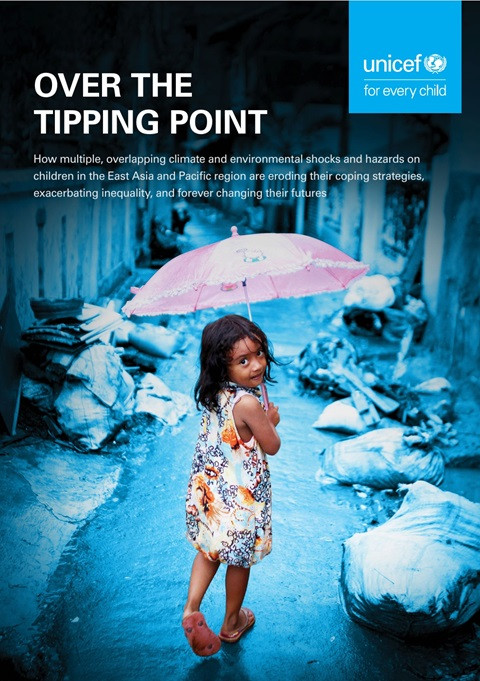 Over the Tipping Point: How Multiple, Overlapping Climate and Environmental Shocks and Hazards on Children in the East Asia and Pacific Region are Eroding their Coping Strategies, Exacerbating Inequality, and Forever Changing Their Futures Year of publication: 2023 Corporate author: United Nations Children's Fund (UNICEF) This report unveils the intensifying frequency and compounding effects of climate-related hazards intertwined with non-climate shocks like the COVID-19 pandemic and socio-economic challenges. Given that children are already facing the impacts of climate change, adaptation and resilience measures are needed now to reduce the full force of impacts. This report recommends three areas to do so: Children have continued access to the key services they need: This requires investing in climate-smart and disaster-resilient education, health, and water, sanitation and hygiene (WASH) services for children, so that children can access these services despite the shocks they face; Child protection and social protection systems are in place and are climate-responsive; and There is understanding of what to expect and how to adjust as necessary, establishing and utilizing strong early warning, risk management and disaster preparedness systems. In all of this, children and young people must be at the forefront of our actions. Urgency demands that they take action themselves, leading the way with innovative solutions for both mitigation and adaptation. We must support their efforts, providing them with the necessary skills and resources to amplify their work. Above all, we owe them every opportunity for success as we work together to secure a better world for generations to come.
 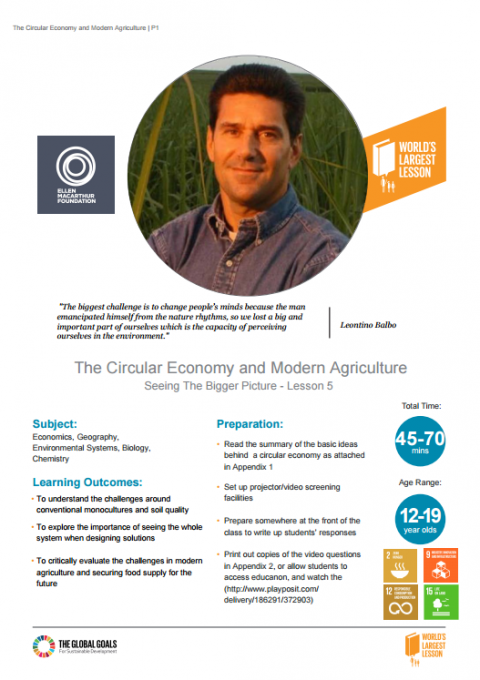 The Circular Economy and Modern Agriculture: Seeing The Bigger Picture - Lesson 5 Corporate author: United Nations Children's Fund (UNICEF) World’s Largest Lesson is a collaborative education project to support the announcement of the United Nations Global Goals for Sustainable Development. Learning outcomes of the project: • To understand the challenges around conventional monocultures and soil quality • To explore the importance of seeing the whole system when designing solutions • To critically evaluate the challenges in modern agriculture and securing food supply for the future
 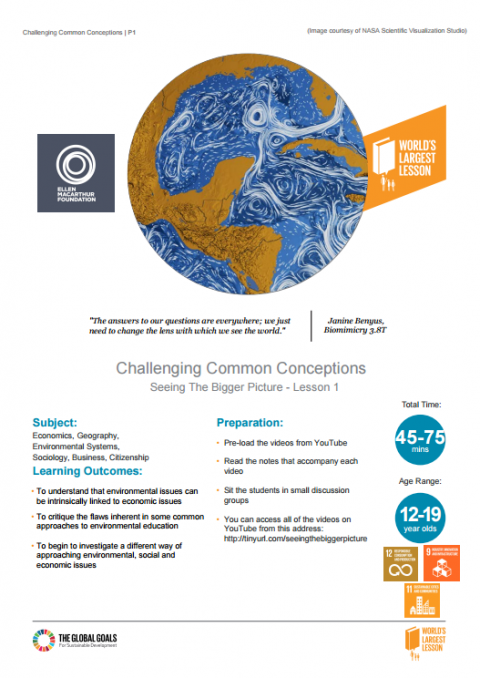 Challenging Common Conceptions: Seeing The Bigger Picture - Lesson 1 Corporate author: United Nations Children's Fund (UNICEF) World’s Largest Lesson is a collaborative education project to support the announcement of the United Nations Global Goals for Sustainable Development. Learning outcomes of the project: • To understand that environmental issues can be intrinsically linked to economic issues • To critique the flaws inherent in some common approaches to environmental education • To begin to investigate a different way of approaching environmental, social and economic issues
 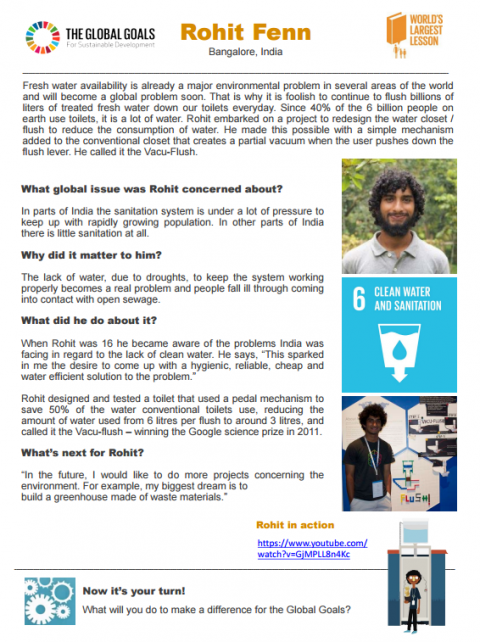 Rohit Fenn Corporate author: United Nations Children's Fund (UNICEF) Fresh water availability is already a major environmental problem in several areas of the world and will become a global problem soon. That is why it is foolish to continue to flush billions of liters of treated fresh water down our toilets everyday. Since 40% of the 6 billion people on earth use toilets, it is a lot of water. Rohit embarked on a project to redesign the water closet / flush to reduce the consumption of water. He made this possible with a simple mechanism added to the conventional closet that creates a partial vacuum when the user pushes down the flush lever. He called it the Vacu-Flush.