
Resources
Explore a wide range of valuable resources on GCED to deepen your understanding and enhance your research, advocacy, teaching, and learning.
51 Results found
 Emerging Horizons: Youth Insights on Climate Change and Breakthrough Solutions; 2024 Leading Minds on Climate Action Year of publication: 2024 Corporate author: UNICEF Innocenti | United Nations Development Programme (UNDP) This paper shares insights from a participatory foresight workshop designed and facilitated by UNICEF Innocenti in the framework of the Youth4Climate: Sparking Solutions event co-hosted by UNDP and the Government of Italy. This convened 100 youth-led solutions in the areas of climate education, energy, food and agriculture, and urban sustainability. By using the Three Horizons foresight approach, a dialogue was created that delineated the patterns of change young people envisaged, their shared visions for the future, and the high potential innovations they felt could be leveraged to bring that future about. The paper identifies research and policy questions to be further explored by young climate leaders, UNDP, UNICEF, and their partners.
  Leveraging Artificial Intelligence to Enhance Early Action towards the Kunming-Montreal Global Biodiversity Framework Year of publication: 2024 Author: Nicole DeSantis | Lea Phillips | Christina Supples | Julien Pigot | Jamison Ervin | Doley Tshering | Juan Calles Lopez | Dharshani Seneviratne | Enrique Paniagua | Monica Mora Corporate author: United Nations Development Programme (UNDP) This publication releases the methodology behind the National Biodiversity Strategies and Action Plans (NBSAP) Target Similarity Assessments and identifies key lessons learned and opportunities for future applications.
  Guidelines for Contributing to the United Nations Sustainable Development Goals Year of publication: 2024 Corporate author: International Organization for Standardization (ISO) | United Nations Development Programme (UNDP) The International Organization for Standardization (ISO) and United Nations Development Programme (UNDP) Guidelines for contributing to the Sustainable Development Goals (SDGs) offer a practical guidance on how organizations and businesses can manage and enhance their contributions to the SDGs. The guidelines draw on global expertise and best practices, complementing existing sustainability standards for aligning organizational strategies and operations with the SDGs as a whole. While other standards may address specific aspects of sustainable development, these guidelines emphasize a holistic approach and provide practical tools to enhance business performance, while at the same time optimizing the impact of all organizational activities on both people and the planet.
  Stepping Forward: Parliaments in the Fight Against Hate Speech Year of publication: 2023 Author: Kevin Deveaux | Tim Baker | Mary O’Hagan | David Ennis Corporate author: United Nations Development Programme (UNDP) This brief provides an overview of the background, drivers, enablers and the impact of hate speech and identifies strategies to counter it, with a focus on the role of parliaments as a positive force for change. Of particular relevance are the concrete actions parliaments can take to address and mitigate the prevalence and impact of hate speech on those who are most vulnerable in society, including women, minorities and other underrepresented groups. The objective of this brief is to provide meaningful and practical guidance for parliaments and parliamentarians, as well as those who programmatically support them, on steps they can take to reduce and counter hate speech while fostering peace, constructive dialogue and trust.
  A Gender-Responsive Communication Guide; Rethinking Communication Year of publication: 2021 Author: Gökçe Bayrakçeken Tüzel | İdil Safiye Soyseçkin Ceylan | Deniz Şilliler Tapan | Kıvanç Özvardar Corporate author: United Nations Development Programme (UNDP) Language is a mechanism, a tool, that influences thoughts, shapes gender roles and therefore carries a great potential for establishing gender equality in societies. It shows how we perceive life and also determines it. Language plays an important role in the formation of our thoughts and behaviors, hence the construction of our reality about gender. As UNDP Turkey, we ground on gender equality and women’s empowerment principles in all of our programs and interventions, within the institution and in all forms of communication with our partners. The reason we prepared this guide is to determine the ways to have a gender responsive approach when communicating both in the office and with the institutions, organizations, and individuals we work with.The language we use begins to take shape from the moment we are born. It is kneaded within the norms, thoughts, and actions of the society we live in and becomes a set of rules that we unconsciously internalize. Therefore, we often use a sexist language even without realizing and thus reproduce it at every turn.Based on the idea that transformation begins with awareness, this guide offers a stimulating path to the limits of our language, demonstrates how it reproduces gender inequality, and offers ways for changing this.We believe that gender responsive communication is a sign of commitment to gender equality for any country, community or institution. Therefore, we invite you to become the transformation itself by following this sign.We would like to thank you in advance for your interest and dedication to using a gender responsive language and hope that this guide will help us on the way to become a gender-equal society.
 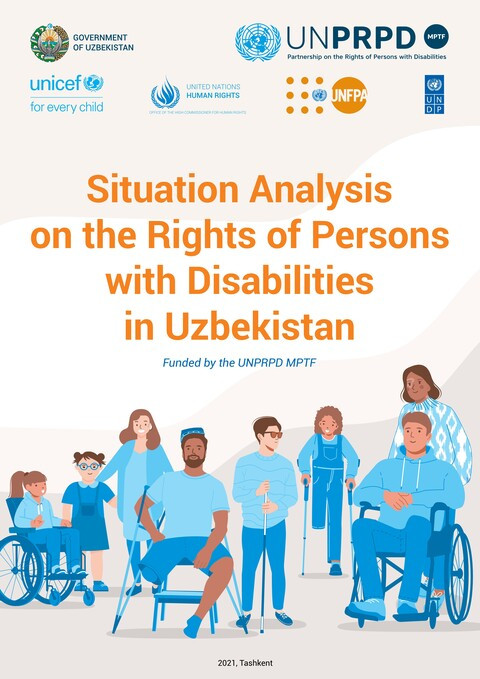 Situation Analysis on the Rights of Persons with Disabilities in Uzbekistan Year of publication: 2021 Corporate author: UNICEF Uzbekistan | United Nations Population Fund (UNFPA) | United Nations Development Programme (UNDP) | UN. Office of the United Nations High Commissioner for Human Rights (UN. OHCHR) This study is based on the results of a situation analysis of children and adults with disabilities conducted in 2019. The ambition of this Situation Analysis is not merely to point at problems but to lay ground for solutions by identifying the opportunities and catalytic forces emerging today. The report looks at the necessary preconditions for realisation of human rights of persons with disabilities, particularly women, girls, and boys with disabilities, such as a robust equality and non-discrimination framework, availability of inclusive and accessible services in the community, disability inclusive financial and coordination mechanisms, transparent monitoring and accountability systems and meaningful participation of persons with disabilities. Анализ ситуации по обеспечению прав лиц с инвалидностью в Узбекистане Year of publication: 2021 Corporate author: UNICEF Uzbekistan | United Nations Population Fund (UNFPA) | United Nations Development Programme (UNDP) | UN. Office of the United Nations High Commissioner for Human Rights (UN. OHCHR) Данное исследование основывается на результатах ситуационного анализа детей и взрослых с инвалидностью, проведенного в 2019 г. Цель данного анализа – не в том, чтобы указать на проблемы, а в том, чтобы заложить основу для их решения путем выявления возможностей и сил содействия, возникающих сегодня. В отчете рассматриваются необходимые предпосылки для реализации прав человека людей с инвалидностью, особенно женщин, девочек и мальчиков с инвалидностью, такие как надежная система обеспечения равенства и недискриминации, наличие инклюзивных и доступных услуг в сообществе, финансовые и координационные механизмы, учитывающие интересы людей с инвалидностью, прозрачные системы мониторинга и отчетности, а также значимое участие людей с инвалидностью.
  Connections that Matter: How the Quality of Governance Boosts Climate Action; A Systematic Scoping Review of the Literature Year of publication: 2024 Corporate author: United Nations Development Programme (UNDP) | German Institute of Development and Sustainability (IDOS) This report reflects the findings of a systematic literature review jointly undertaken by the UNDP Global Policy Centre for Governance and the German Institute of Development and Sustainability. The report offers aggregated empirical insight from across the globe about how inclusive, effective and accountable governance systems produces positive effects on climate action. The report aims to galvanize development actors and stakeholders to invest in SDG 16 and the strengthening of governance systems, and to better identify pathways that raise the ambition and effectiveness of climate action.
  [Executive Summary] Connections that Matter: How the Quality of Governance Boosts Climate Action Year of publication: 2024 Corporate author: United Nations Development Programme (UNDP) | German Institute of Development and Sustainability (IDOS) This is the executive summary of the Connections that Matter: How the Quality of Governance Boosts Climate Action prepared by the UNDP Global Policy Centre for Governance and the German Institute of Development and Sustainability.
 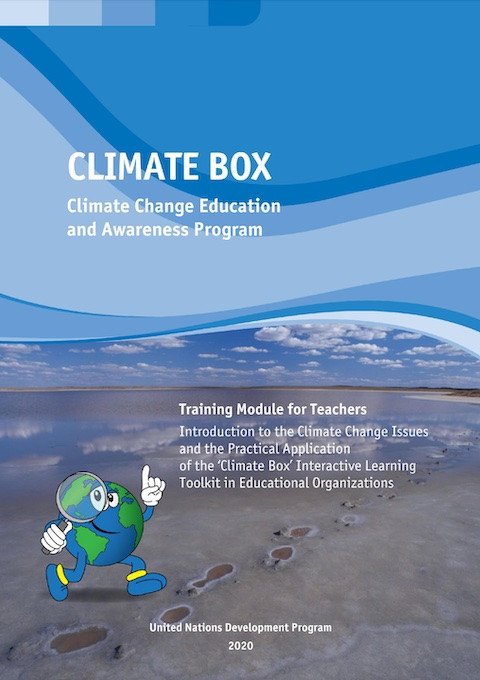 Climate Box: Climate Change Education and Awareness Program; Training Module for Teachers Year of publication: 2020 Corporate author: United Nations Development Programme (UNDP) The module contains materials for teachers, educators, tutors, educational program developers, and a wide range of people interested in climate change education. It is designed to build the capacity of teachers or education experts in climate education, as part of the formal qualification system.The objectives of the training module are:Raising climate awareness among school teachers to facilitate the introduction of climate education in primary, secondary, and high schools.Assisting teachers in the practical application of the Climate Box toolkit by facilitating the incorporation of the climate change topics into the school curriculum, extracurricular activities, and further education.Encouraging innovative pedagogical approaches to integrating climate change education into school education and raising awareness of climate change. The training module for teachers presents numerous examples on approaches to climate education, climate adaptation projects, and practices to reduce the individual carbon footprint from participating countries in the climate Box program. Its recommendations on the application of the training module consider the peculiarities of national education systems in different countries.