
Resources
Explore a wide range of valuable resources on GCED to deepen your understanding and enhance your research, advocacy, teaching, and learning.
70 Results found
 Progress on the Sustainable Development Goals: The Gender Snapshot 2021 Year of publication: 2021 Corporate author: United Nations Entity for Gender Equality and the Empowerment of Women (UN Women) | UN. Department of Economic and Social Affairs (UN. DESA) The pandemic has tested and even reversed progress in expanding women’s rights and opportunities. Women have not recovered lost jobs and income, hunger is on the rise, and school closures threaten girls’ educational gains. Women’s participation in government, research and resource management remains far from equal. Vulnerable groups of women, including migrants, those with disabilities and those affected by conflict, are frequently left behind. Disparities between rich and poor countries are preventing equal access to lifesaving COVID-19 vaccines and treatments, putting women in poorer countries at disproportionate risk. Moreover, despite women’s central roles in responding to COVID-19, including as front-line health workers, they do not have the leadership positions they deserve. Building forward differently and better will require placing women and girls at the centre of all aspects of response and recovery, including through gender- responsive laws, policies and budgeting.Progress on the Sustainable Development Goals: The Gender Snapshot 2021 presents the latest evidence on gender equality across all 17 Sustainable Development Goals, highlighting the progress made since 2015 but also the continued alarm over the COVID-19 pandemic, its immediate effect on women’s well-being and the threat it poses to future generations. Progrès vers la réalisation des objectifs de développement durable: Gros plan sur l’égalité des sexes 2021 Year of publication: 2021 Corporate author: United Nations Entity for Gender Equality and the Empowerment of Women (UN Women) | UN. Department of Economic and Social Affairs (UN. DESA) La pandémie a mis à l’épreuve et même inversé les progrès dans l’élargissement des droits et des opportunités des femmes. Les femmes n’ont pas récupéré les emplois et les revenus perdus, la faim augmente et les fermetures d’écoles menacent les progrès scolaires des filles. La participation des femmes au gouvernement, à la recherche et à la gestion des ressources est loin d’être égale. Les groupes de femmes vulnérables, y compris les migrants, les personnes handicapées et celles touchées par les conflits, sont souvent laissés pour compte. Les disparités entre les pays riches et les pays pauvres empêchent l’égalité d’accès aux vaccins et aux traitements vitaux contre la COVID-19, ce qui expose les femmes des pays les plus pauvres à un risque disproportionné. De plus, malgré le rôle central des femmes dans la réponse à la COVID-19, y compris en tant que professionnelles de santé de première ligne, elles n’ont pas les postes de direction qu’elles méritent. Pour aller de l’avant différemment et mieux, il faudra placer les femmes et les filles au centre de tous les aspects de la réponse et de la relance, notamment par le biais de lois, de politiques et d’une budgétisation sensibles au genre. Le rapport Progrès vers la réalisation des objectifs de développement durable : Gros plan sur l’égalité des sexes, 2021 présente les dernières données probantes sur l’égalité des sexes dans l’ensemble des 17 Objectifs de développement durable, soulignant les progrès réalisés depuis 2015, mais aussi l’inquiétude continue liée la pandémie de COVID-19, son effet immédiat sur le bien-être des femmes et la menace qu’elle représente pour les générations futures. El progreso en el cumplimiento de los Objetivos de Desarrollo Sostenible: Panorama de género 2021 Year of publication: 2021 Corporate author: United Nations Entity for Gender Equality and the Empowerment of Women (UN Women) | UN. Department of Economic and Social Affairs (UN. DESA) La pandemia puso a prueba e incluso revirtió el progreso alcanzado en la expansión de los derechos y las oportunidades de las mujeres. Las mujeres no han recuperado el empleo y los ingresos perdidos, el hambre ha aumentado, y el cierre de las escuelas supone una amenaza para los logros de las niñas en la esfera educativa. La participación de las mujeres en el Gobierno, la investigación y la gestión de los recursos sigue lejos de ser igualitaria. Los grupos vulnerables de mujeres, incluidas las migrantes, aquellas con discapacidad, y las afectadas por los conflictos, con frecuencia quedan rezagadas. Las disparidades entre países ricos y pobres impiden el acceso a los tratamientos y vacunas tan vitales contra el COVID-19, lo que pone a los países más pobres frente a un riesgo desproporcionado. Por otra parte, pese al papel central de las mujeres en la respuesta al COVID-19, incluidas las trabajadoras sanitarias de la primera línea, estas no ocupan los puestos de liderazgo que merecen. En adelante, una reconstrucción mejor y diferente exigirá colocar a las mujeres y las niñas en el centro de todos los aspectos de la respuesta y la reconstrucción, entre otras cosas, a través de leyes, políticas y presupuestos con perspectiva de género. En El progreso en el cumplimiento de los Objetivos de Desarrollo Sostenible: Panorama de Género 2021 se presenta la evidencia más reciente sobre igualdad de género en la totalidad de los 17 Objetivos de Desarrollo Sostenible. Se destaca el progreso alcanzado desde 2015, así como la alarma continua de la pandemia del COVID-19, sus efectos inmediatos en el bienestar de las mujeres y la amenaza que supone para las generaciones futuras.
  Rapid Gender Assessment: For the COVID-19 Situation in the Republic of Kazakhstan Year of publication: 2020 Corporate author: The Center for Social and Political Studies "Strategy" | United Nations Population Fund (UNFPA) | United Nations Entity for Gender Equality and the Empowerment of Women (UN Women) The Rapid Gender Assessment on COVID-19 in the Republic of Kazakhstan was prepared by the CFSPI "Strategy" for UN Women and the UN Population Fund. It provides important information about gender roles and responsibilities, opportunities and vulnerabilities that have emerged in society in light of the COVID-19 outbreak. Быстрая гендерная оценка (бго): В отношении COVID-19 в республике Казахстан Year of publication: 2020 Author: The Center for Social and Political Studies "Strategy" Corporate author: The Center for Social and Political Studies "Strategy" | United Nations Population Fund (UNFPA) | United Nations Entity for Gender Equality and the Empowerment of Women (UN Women) Быстрая Гендерная Оценка в отношении COVID-19 в Республике Казахстан подготовлена ОФ ЦСПИ «Стратегия» для Структуры «ООН- женщины» и Фонда ООН в области народонаселения. Он предоставляет важную информацию о гендерных ролях и обязанностях, возможностях и уязвимостях, которые появились в обществе в свете вспышки COVID-19.
  Handbook on Gender Mainstreaming for Gender Equality Results Year of publication: 2022 Corporate author: United Nations Entity for Gender Equality and the Empowerment of Women (UN Women) This handbook identifies the key concepts, principles, and approaches underlying gender mainstreaming. It outlines opportunities to apply gender analyses across different contexts and manage for gender equality results. It also illustrates how to identify opportunities for organizational change, enhance financing for gender equality, and strengthen monitoring and evaluation for the oversight of the results of gender mainstreaming.While the Handbook is focused specifically on the more traditional areas of development policy and practice, the discussions, findings, and recommendations are equally applicable in the context of humanitarian responses and programmes in conflict and peace-building contexts.
  Women’s Meaningful Participation in Transitional Justice: Advancing Gender Equality and Building Sustainable Peace Year of publication: 2022 Author: Lorena Mellado | Emily Kenney | Hariwa Adil Corporate author: United Nations Entity for Gender Equality and the Empowerment of Women (UN Women) | United Nations Development Programme (UNDP) This detailed research paper explores what women’s meaningful participation in transitional justice means and “looks like” in policy and practice. It focuses specifically on women and addressing the unique barriers to women’s meaningful participation in transitional justice processes as a result of gender-based discrimination.This publication reviews the current policy framework and assertions for women’s meaningful participation in transitional justice and highlights critical gaps between policy and practice. The research paper suggests a definition for women’s meaningful participation in transitional justice, as well as typologies of women stakeholders and roles that women play within transitional justice.
 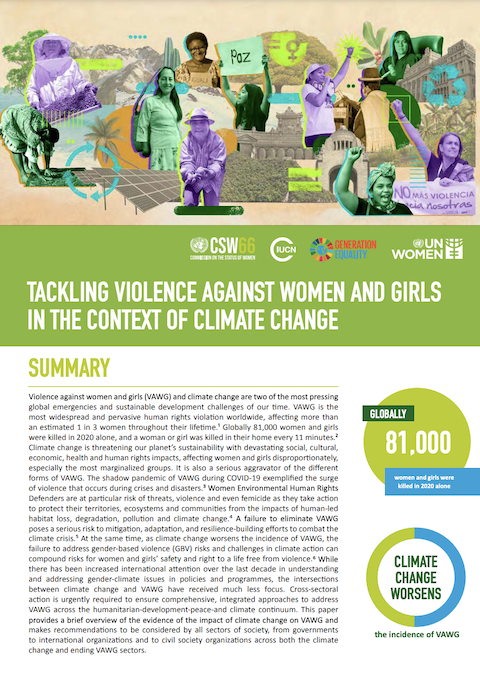 Tackling Violence Against Women and Girls in the Context of Climate Change Year of publication: 2022 Corporate author: United Nations Entity for Gender Equality and the Empowerment of Women (UN Women) | International Union for Conservation of Nature (IUCN) Violence against women and girls (VAWG) and climate change are two of the most pressing global emergencies and sustainable development challenges of our time.This paper provides a brief overview of the evidence of the impact of climate change on VAWG and makes recommendations to be considered by all sectors of society, from governments to international organizations and to civil society organizations across both the climate change and ending VAWG sectors.
  A World History of Women’s Rights in 3 Minutes Year of publication: 2020 Corporate author: United Nations Entity for Gender Equality and the Empowerment of Women (UN Women) How far have we advanced in the global fight for equal rights and how much remains to be done? From suffrage campaigns around the world to the rise of the #MeToo movement and digital activism, we've made little progress. However, the fight for gender equality is far from over. Meet remarkable women and discover the grassroots movements and historic milestones that have helped change the world for women and girls. Una historia mundial de los derechos de las mujeres en 3 munutos Year of publication: 2020 Corporate author: United Nations Entity for Gender Equality and the Empowerment of Women (UN Women) ¿Cuánto hemos avanzado en la lucha mundial por lograr la igualdad de derechos y cuánto queda por hacer? Desde las campañas sufragistas en todo el mundo al surgimiento del movimiento #MeToo y el activismo digital, hemos progresado poco a poco. Sin embargo, la lucha por la igualdad de género está lejos de haber acabado. Conoce a mujeres notables y descubre los movimientos de base y los hitos históricos que han contribuido a cambiar el mundo para las mujeres y las niñas.