
Resources
Explore a wide range of valuable resources on GCED to deepen your understanding and enhance your research, advocacy, teaching, and learning.
5 Results found
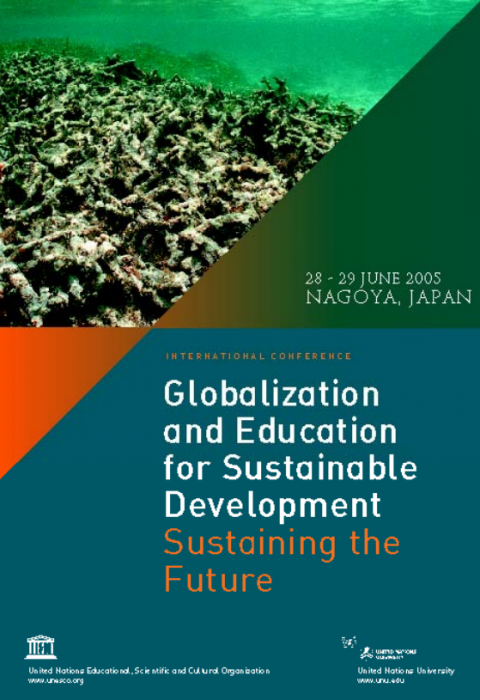 Globalization and education for sustainable development: sustaining the future Year of publication: 2006 Author: Laura Wong Corporate author: United Nations University This publication presents the contributions and outcomes of the stimulating two day gathering in Nagoya, where representatives of governments, academia and civil society gathered to share their experiences and develop their ideas about how to ensure ESD within the context of globalizing societies. La mondialisation et l'éducation pour le développement durable: le maintien de l'avenir Year of publication: 2006 Author: Laura Wong Corporate author: United Nations University Cette publication présente les contributions et les résultats de la stimulation de la collecte de deux jours à Nagoya, où les représentants des gouvernements, des universités et de la société civile se sont réunis pour partager leurs expériences et de développer leurs idées sur la façon d'assurer l'EDD dans le contexte des sociétés de mondialisation.
 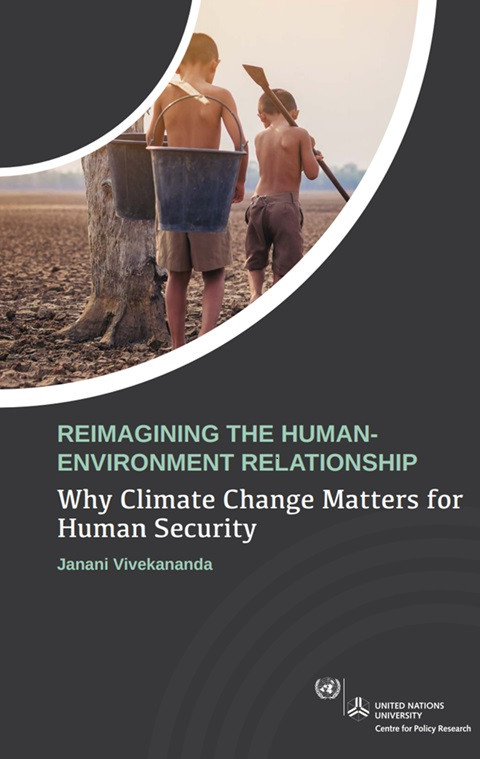 Why Climate Change Matters for Human Security Year of publication: 2022 Author: Janani Vivekananda Corporate author: United Nations University | United Nations Environment Programme (UNEP) This paper outlines the state of knowledge regarding security risks related to climate change, synthesizing the existing scientific evidence to set out five broad pathways of risk. Climate change itself is rarely a direct cause of conflict. Yet, there is ample evidence that its effects exacerbate important drivers and contextual factors of conflict and fragility, thereby challenging the stability of states and societies. Climate change impacts such as coral bleaching, diversity loss, and erratic rainfall can stress livelihoods and drive displacement, increase resource conflicts, and challenge the security and stability of people and states worldwide. Managing these security risks requires action across the entire impact chain: work to mitigate climate change; reducing its consequences on ecosystems; adapting socioeconomic systems; better management of climate-induced heightened resource competition; and strengthening governance and conflict management institutions. And every dimension of the response must be conflict-sensitive and climate proof. Without the right responses, climate change will mean more fragility, less peace and less security. But this paper sets out illustrative examples of how, with a greater understanding of how climate change interacts with social, political, economic and environmental drivers of conflict and fragility, we will be better placed to make the kind of risk-informed decisions is integral to achieving international peace and security.
  Disinformation and Peacebuilding in Sub-saharan Africa: Security Implications of AI-Altered Information Environments; Research Report Year of publication: 2024 Author: Eduardo Albrecht | Eleonore Fournier-Tombs | Rebecca Brubaker Corporate author: United Nations University | Interpeace This report aims to further explore the way in which AI technologies as they currently stand impact peace and conflict, and what methods might be used to mitigate their adverse effects - through the development of better tools and the inclusion of peace and conflict considerations in AI governance frameworks. The report proposes the following recommendations: 1. More funding and support should be provided to civil society organization efforts to expand media literacy and fact-checking initiatives using AI tools to enhance capabilities. 2. Governments need to work with civil society to develop and implement comprehensive, transparent legal frameworks combating disinformation. These legislative measures need to support digital and media literacy campaigns and fact-checking organizations. 3. Social media companies need to expand investment and research into understanding local information environments, so they can better identify and respond to instances of disinformation in all contexts in which they operate and enhance transparency. 4. Peacebuilding organizations need to carefully consider local media ecosystems and information environments when conducting conflict analyses, and factor these dynamics into their projects' frameworks.
  Disinformation and Peacebuilding in Sub-Saharan Africa : Security Implications of AI-Altered Information Environments : Research Report Year of publication: 2024 Author: Eduardo Albrecht | Eleonore Fournier-Tombs | Rebecca Brubake Corporate author: United Nations University This report aims to further explore the way in which AI technologies as they currently stand impact peace and conflict, and what methods might be used to mitigate their adverse effects - through the development of better tools and the inclusion of peace and conflict considerations in AI governance frameworks. The report proposes the following recommendations: 1. More funding and support should be provided to civil society organization efforts to expand media literacy and fact-checking initiatives using AI tools to enhance capabilities. 2. Governments need to work with civil society to develop and implement comprehensive, transparent legal frameworks combating disinformation. These legislative measures need to support digital and media literacy campaigns and fact-checking organizations. 3. Social media companies need to expand investment and research into understanding local information environments, so they can better identify and respond to instances of disinformation in all contexts in which they operate and enhance transparency. 4. Peacebuilding organizations need to carefully consider local media ecosystems and information environments when conducting conflict analyses, and factor these dynamics into their projects' frameworks.