
Resources
Explore a wide range of valuable resources on GCED to deepen your understanding and enhance your research, advocacy, teaching, and learning.
51 Results found
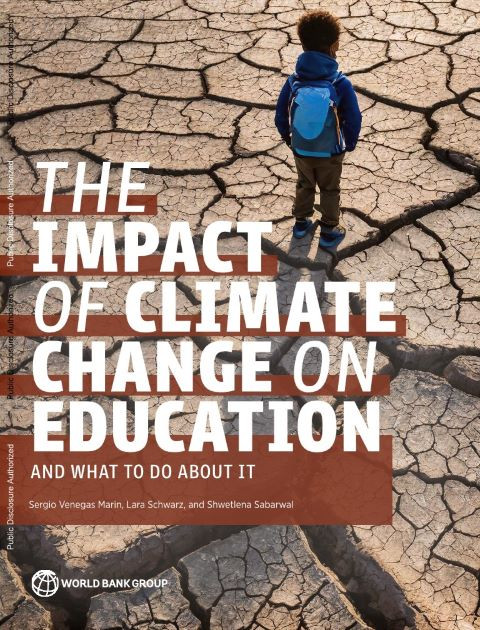 The Impact of Climate Change on Education and What to Do about It Year of publication: 2024 Author: Sergio Venegas Marin | Lara Schwarz | Shwetlena Sabarwal Corporate author: International Bank for Reconstruction and Development | World Bank Education can be the key to ending poverty in a livable planet, but governments must act now to protect it. Climate change is increasing the frequency and intensity of extreme weather events such as cyclones, floods, droughts, heatwaves and wildfires. These extreme weather events are in turn disrupting schooling; precipitating learning losses, dropouts, and long-term impacts. Even if the most drastic climate mitigation strategies were implemented, extreme weather events will continue to have detrimental impacts on education outcomes.
  LEARNING to Realize Education’s Promise Corporate author: World Bank The World Development Report 2018 (WDR 2018)—LEARNING to Realize Education’s Promise—is the first ever devoted entirely to education. And the timing is excellent: education has long been critical to human welfare, but it is even more so in a time of rapid economic and social change. The best way to equip children and youth for the future is to place their learning at the center. The 2018 WDR explores four main themes: 1) education’s promise; 2) the need to shine a light on learning; 3) how to make schools work for learners; and 4) how to make systems work for learning.
 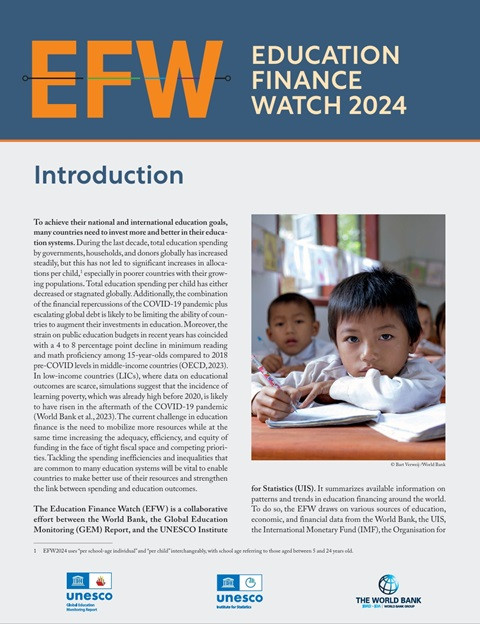 Education Finance Watch 2024 Year of publication: 2024 Corporate author: Global Education Monitoring Report Team | UNESCO Institute for Statistics (UIS) | World Bank The Education Finance Watch (EFW) is a collaborative effort between the World Bank, the GEM Report, and the UNESCO Institute for Statistics (UIS). The EFW aims to provide an analysis of trends, patterns, and issues in education financing around the world. The EFW uses various sources of education, economic, and financial data from the World Bank, UIS, the International Monetary Fund, and the Organization of Economic Co-operation and Development (OECD).
  Guidance Note on Uzbekistan Green Taxonomy Year of publication: 2023 Corporate author: World Bank This Guidance Note serves to support the government of Uzbekistan in the design of a national Green Taxonomy. A green taxonomy sets out rules for classifying environmentally sustainable activities and can be instrumental inthe transition to a Green Economy by guiding policies and public resource flows, and influencing the private sector’s investment response. The Guidance Note discusses methodological choices for the taxonomy and their policy implications, reviews existing international practices, and recommends a model taxonomy and roadmap for further development of the taxonomy. A key message in the note is the importance of setting clear strategic goals that will inform the selection of the taxonomy’s environmental objectives and its other features. Also discussed are theinstitutional arrangements to coordinate the actions and inputs of multiple stakeholders during the development process of the taxonomy, and the importance of strong oversight and consistent enforcement of taxonomy rules by a competent regulatory body. Методические рекомендации по «зеленой» таксономии для Узбекистана Year of publication: 2023 Corporate author: World Bank Настоящие Методические рекомендации призваны оказать содействие правительству Узбекистана в разработке национальной «зеленой» таксономии. «Зеленая» таксономия устанавливает правила классификации экологически устойчивых видов деятельности и может сыграть важную роль в переходе к «зеленой» экономике, определяя политику и потоки государственных ресурсов, а также влияя на инвестиционную активность частного сектора. В Методических рекомендациях обсуждаются методологические варианты таксономии и их политические последствия, рассматривается существующая международная практика, а также даются рекомендации по модельной таксономии и «дорожной карте» ее дальнейшей разработки. Одним из ключевыхтезисов Рекомендаций является важность постановки четких стратегических целей, на основе которых будут определяться экологические цели таксономии и другие ее характеристики. Кроме того, рассматриваются институциональные механизмы координации действий и участия многочисленных заинтересованных сторон в процессе разработки таксономии, а также отмечается важность обеспечения компетентным регулирующиморганом надежного надзора и последовательного соблюдения правил таксономии.
  Foundations for Building Forward Better: An Education Reform Path for Lebanon Year of publication: 2021 Corporate author: World Bank Human capital development is a critical determinant of economic growth, equity, and prosperity, but outcomes in this domain are worryingly low inLebanon, risking the future of generations of children. Lebanese children lag behind their peers in human capital development—measured accordingto the World Bank (2020c) Human Capital Index—suggesting that the future productivity of the labor force and the country’s trajectory for equitablegrowth is at risk (World Bank 2020b). The Human Capital Index indicates that children born in Lebanon today will reach, on average, only 52 percentof their potential productivity when they grow up. This is lower than the average estimates for the Middle East and North Africa (MENA) region(57 percent) and upper-middle-income countries (56 percent). Lebanon’s poor performance on the Human Capital Index is largely attributed to theeducation outcomes calculated for the index. If actual years of schooling, which average approximately 10.2 years in Lebanon, are adjusted for actual learning, effective years of schooling are 40 percent less—on average, only 6.3 years of actual learning (World Bank 2020b). The most recent school closures were due to the COVID-19 pandemic, with schools being closed over 75 percent of the school year between January 2020 and February 2021.1 This will likely lead to a further and significant decrease in learning: effectively, students are facing a lost year of learning (Azevedo et al. 2021).
  Advancing Arabic Language Teaching and Learning: A Path to Reducing Learning Poverty in the Middle East and North Africa Year of publication: 2021 Author: Laura Gregory | Hanada Taha Thomure | Amira Kazem | Anna Boni | Mahmoud Abduh A. Elsayed | Nadia Taibah Corporate author: World Bank The purpose of the present report is to identify and explore the evidence on factors that are leading to high rates of learning poverty in MENA countries. In addition, the report proposes a path for countries of the region to make the teaching and learning of the Arabic language—which are critical foundations for children in Arabic-speaking countries—more effective. The intended audience of the report is education stakeholders in the MENA region, including officials in ministries of education across the region, those responsible for education decision-making, teachers, academics, education administrators, parents, and nongovernmental organizations, as well as World Bank and partner organization staff tasked with supporting countries in their efforts to raise learning and human capital.The intention of the report is not to provide an Arabic literacy strategy for each country since countries of the region differ and each would need to have their own national dialogue. Instead, the report collates the relevant literature from the region and beyond, as well as local and regional initiatives, and offers guidance to countries to advance the teaching and learning of MSA. As such, the report does not focus on the broader issues of language use within each country. As part of the process of developing the report, a summary of the emerging evidence and recommendations was shared with a small group of teachers from two countries across the region in advance of a focus group discussion to explore local views. Unanimous agreement on the key findings and recommendations were expressed by these teachers. Further discussions on the topics raised in this report are expected to take place during the dissemination of this report and in the months and years to come, leading to greater consensus across stakeholders on the best ways to advance Arabic language teaching and learning.The report is structured in a way that first explores the incidence of learning poverty in the MENA region, followed by international evidence on the science of learning to read, and factors that are influencing Arabic language learning outcomes. The report then looks at some of the national strategies, policies, and initiatives already in place for Arabic language education, and proposes a path for advancing Arabic language teaching and learning, along with suggestions for regional collaboration efforts that could further support MENA countries.
  Achieving SDG4 Through a Human Rights Based Approach to Education: World Development Report 2018 Background Paper Year of publication: 2018 Author: Kate Moriarty Corporate author: World Bank Quality education is a critical dimension for the achievement of sustainable development. The renewed political commitment set out in sustainable development goal 4 (SDG4) is an opportunity to ensure strong coherence between education policy and the right to education first articulated more than 70 years ago. This paper presents the results of a desk-based study on a human rights-based approach to education (HRBAE) in the context of SDG4. It explores the ways in which such an approach can guide policy, planning, and the delivery of education in observance with agreed international frameworks providing for the right to education. The paper argues that the human rights conventions on the right to education are not passive instruments designed to remain only at the level of discourse but, as legal obligations, require action from the state and should be central in the development of education services, including in the context of large scale displacement and crisis. This paper outlines the legally binding commitments of the right to education. It considers how these can be applied practically through a HRBA-E to address the continuing barriers to access and completion of quality education and learning.
  Loud and Clear: Effective Language of Instruction Policies for Learning Year of publication: 2021 Corporate author: World Bank This paper describes the new World Bank policy approach on language of instruction(LoI), as part of the operationalization of the literacy policy package in support of the Bank’s new learning target. This new approach aims to support progress on language of instruction(LoI) Policies and interventions, as loi-based challenges are identified and addressed in light of each country’s context. Haut et fort: Politiques efficaces de Langue d’Enseignement Pour l’Apprentissage Year of publication: 2021 Corporate author: World Bank Ce document décrit la nouvelle approche de la politique de la Banque mondiale en matière de langue d’enseignement, en tant que composante dans l’opérationnalisation du paquet de politique de littératie en appui au nouvel objectif d’apprentissage de la banque. Cette nouvelle approche vise à soutenir les progrès dans le domaine des politiques et des interventions en matière de LE (Langue d'Enseignement), dans la mesure où les défis liés à la PLE(Politique de Langue d'Enseignement) sont identifiés et traités à la lumière du contexte de chaque pays.