
Resources
Explore a wide range of valuable resources on GCED to deepen your understanding and enhance your research, advocacy, teaching, and learning.
51 Results found
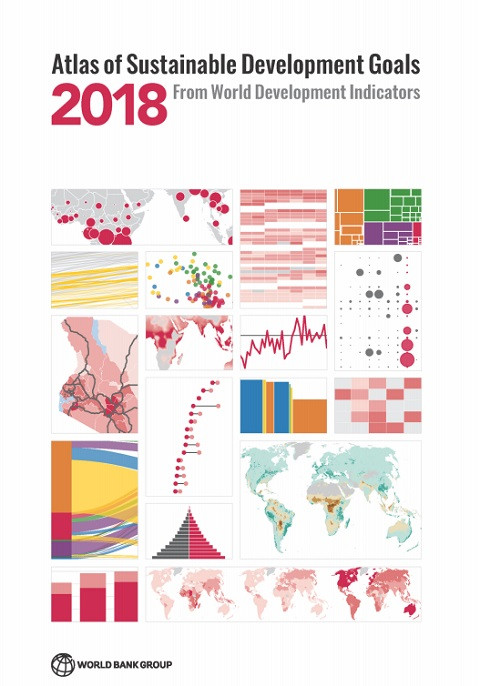 Atlas of Sustainable Development Goals 2018: From World Development Indicators Year of publication: 2018 Corporate author: World Bank The Atlas of Sustainable Development Goals 2018 is a visual guide to the trends, challenges and measurement issues related to each of the 17 Sustainable Development Goals. The Atlas features maps and data visualizations, primarily drawn from World Development Indicators (WDI) - the World Bank’s compilation of internationally comparable statistics about global development and the quality of people’s lives. Given the breadth and scope of the SDGs, the editors have been selective, emphasizing issues considered important by experts in the World Bank’s Global Practices and Cross Cutting Solution Areas. Nevertheless, The Atlas aims to reflect the breadth of the Goals themselves and presents national and regional trends and snapshots of progress towards the UN’s seventeen Sustainable Development Goals related to: poverty, hunger, health, education, gender, water, energy, jobs, infrastructure, inequalities, cities, consumption, climate, oceans, the environment, peace, institutions, and partnerships. Atlas de los Objetivos de Desarrollo Sostenible 2018: Basado en los Indicadores del Desarrollo Mundial Year of publication: 2018 Corporate author: World Bank El Atlas de los Objetivos de Desarrollo Sostenible 2018 se basa en los Indicadores del Desarrollo Mundial, la compilación de estadísticas del Banco Mundial de más de 200 economías sobre el desarrollo mundial y la calidad de vida de las personas. Para cada uno de los 17 Objetivos de Desarrollo Sostenible, se han identificado y visualizado indicadores seleccionados para analizar tendencias y desafíos, y para catalizar la discusión sobre temas de medición. Atlas des Objectifs de développement durable 2018: Des Indicateurs du développement dans le monde Year of publication: 2018 Corporate author: World Bank L’Atlas 2018 des Objectifs de développement durable s’articule autour des Indicateurs du développement dans le monde – Il s’agit de la compilation par la Banque mondiale de statistiques tirées de plus de 200 économies sur le développement mondial et la qualité de vie des populations. Pour chacun des 17 Objectifs de développement durable, une sélection d’indicateurs ont été identifiés et visualisés, afin d’analyser les tendances et les défis, et de susciter la discussion sur les questions liées aux mesures.
  Step by Step: Social and Emotional Learning Program; Teacher’s Guide (Grade 1 - 11) Year of publication: 2016 Author: José Fernando Mejía | Gloria Inés Rodríguez | Nancy Guerra | Andrea Bustamante | María Paula Chaparro | Melisa Castellanos Corporate author: World Bank This Program offers a series of practical lessons designed to be implemented in the classroom by the teacher. These lessons are based on a carefully chosen developmental perspective of middle childhood and adolescence, to fit the characteristics and needs of each age group or grade, from ages 6 through 17. The lessons are organized into three modules, six general skills and 18 specific skills. Step by Step focuses on six core life skills: self-awareness, self-regulation, social awareness, positive communication, determination, and responsible decision-making. Paso a Paso: Programa de Educación Socioemocional; Guía del docente (Grados 1 - 11) Year of publication: 2016 Author: José Fernando Mejía | Gloria Inés Rodríguez | Nancy Guerra | Andrea Bustamante | María Paula Chaparro | Melisa Castellanos Corporate author: World Bank Este programa ofrece una serie de sesiones prácticas diseñadas para ser implementadas por un decente en el aula. Estas sesiones tienen como base una perspectiva del desarrollo de la niñez y la adolescencia cuidadosamente elegida, para responder a las características y necesidades de cada grado o grupo de edad, desde los 6 hasta los 17 años. Las sesiones están organizadas en tres módulos, seis habilidades generales y 18 habilidades específicas. Paso a Paso se enfoca en seis habilidades centrales para la vida: autoconciencia, autoregulación, conciencia social, comunicación positiva, determinación y toma responsable de decisiones.
  Step by Step: Social and Emotional Learning Program; Student Workbook (Grade 1 - 11) Year of publication: 2016 Author: José Fernando Mejía | Gloria Inés Rodríguez | Nancy Guerra | Andrea Bustamante | María Paula Chaparro | Melisa Castellanos Corporate author: World Bank This Program offers a series of practical lessons designed to be implemented in the classroom by the teacher. These lessons are based on a carefully chosen developmental perspective of middle childhood and adolescence, to fit the characteristics and needs of each age group or grade, from ages 6 through 17. The lessons are organized into three modules, six general skills and 18 specific skills. Step by Step focuses on six core life skills: self-awareness, self-regulation, social awareness, positive communication, determination, and responsible decision-making. Paso a Paso: Programa de Educación Socioemocional; Cuaderno para estudiante (Grados 1 - 11) Year of publication: 2016 Author: José Fernando Mejía | Gloria Inés Rodríguez | Nancy Guerra | Andrea Bustamante | María Paula Chaparro | Melisa Castellanos Corporate author: World Bank Cuaderno de trabajo para el estudiante del Programa Paso a Paso para el grado undécimo. Este programa ofrece una serie de sesiones prácticas diseñadas para ser implementadas por un decente en el aula. Estas sesiones tienen como base una perspectiva del desarrollo de la niñez y la adolescencia cuidadosamente elegida, para responder a las características y necesidades de cada grado o grupo de edad, desde los 6 hasta los 17 años. Las sesiones están organizadas en tres módulos, seis habilidades generales y 18 habilidades específicas. Paso a Paso se enfoca en seis habilidades centrales para la vida: autoconciencia, autoregulación, conciencia social, comunicación positiva, determinación y toma responsable de decisiones.
 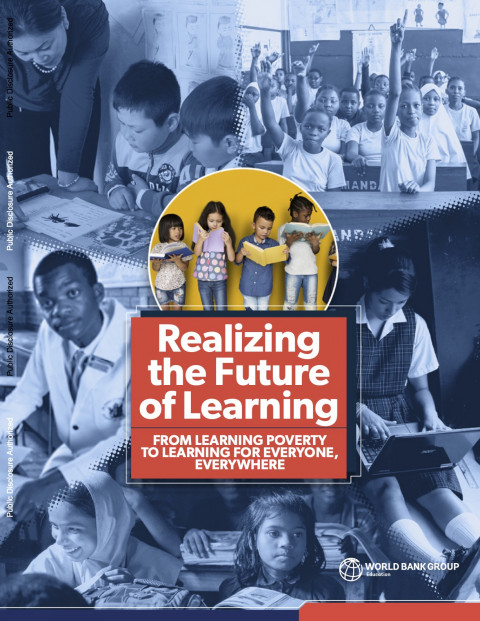 Realizing the Future of Learning: From Learning Poverty to Learning for Everyone, Everywhere Year of publication: 2020 Author: Jaime Saavedra | Cristian Aedo | Omar Arias | Adelle Pushparatnam | Halsey Rogers | Marcela Gutierrez Bernal | Sanna Ellinore Ahlgren | Maria Qureshi Corporate author: World Bank This report describes the World Bank’s vision for the future of learning and a strategic approach that lays out the lines of actions needed for education systems to move forward in accelerating learning improvement. To guide its policy advisory and operational support to countries, the report discusses policy actions that are needed to accelerate learning and that characterize the way many successful systems operate. These are presented within five interrelated pillars of a well-functioning education system that underpin the World Bank’s strategic education policy approach: learners, teachers, learning resources, schools, and system management.This report also reviews the current learning crisis, including the extent to which COVID-19 has exacerbated it, and then lays out a vision, policy priorities and some principles for education policy reform.
  Internationalization of Tertiary Education in the Middle East and North Africa Year of publication: 2020 Author: Giulia Marchesini | Lise Barbotte | Paul Cahu | Aurelia Hoffmann | Holly Johnstone | Mirna Mehrez | Marco Pasqualini | Francisco Marmolejo Corporate author: World Bank This report draws on available data to respond to both a real need for regional analysis and a direct demand from stakeholders, including tertiary education institutions in MENA. Encouraging internationalization to be mainstreamed throughout MENA is the objective that this report seeks to achieve by way of stimulating regional policy dialogue on the subject. The report presents some global trends in internationalization and details its main benefits, before providing an overview of the current status of internationalization in the MENA region, including an in-depth analysis of student mobility. In its reflections on the way forward for the region, the report situates its recommendations in the context of COVID-19, within which, despite serious challenges due to a lack of attractiveness of the region, MENA may find a key opportunity. It suggests that adapting to the “new normal” through the deeper implementation of internationalization “at home” – a dimension that does not require physical mobility and, being implemented within domestic environments, has a much wider reach – may help enable the region to make strides towards catching up on the internationalization agenda. Internationalisation de l’enseignement supérieur dans la région Moyen-Orient Afrique du Nord Year of publication: 2020 Author: Giulia Marchesini | Lise Barbotte | Paul Cahu | Aurelia Hoffmann | Holly Johnstone | Mirna Mehrez | Marco Pasqualini | Francisco Marmolejo Corporate author: World Bank Ce rapport s'appuie sur les données disponibles pour répondre à la fois à un réel besoin d'analyse régionale et à une demande directe des parties prenantes, y compris des établissements d'enseignement supérieur de la région MENA. Encourager le développement de l’internationalisation à travers la région MENA est l'objectif que ce rapport cherche à atteindre, en stimulant un dialogue régional sur les politiques publiques autour de ce sujet. Le rapport présente quelques tendances mondiales de l'internationalisation et détaille ses principaux avantages, avant de donner un aperçu de l'état actuel de l'internationalisation dans la région MENA, y compris une analyse approfondie de la mobilité étudiante. Parmi les recommandations proposées pour le développement de l’internationalisation, le contexte de la COVID-19 est vu, pour la région MENA, comme une fenêtre d’opportunité pour pallier au manque d'attractivité de la région dans ce domaine. Mettre l’accent sur l'internationalisation « à domicile » - une dimension qui ne nécessite pas de mobilité physique et qui se développe dans le cadre domestique, et a donc une portée plus large - pour s’adapter à la « nouvelle normalité » peut aider la région à rattraper son retard sur le plan de l’internationalisation.