
Resources
Explore a wide range of valuable resources on GCED to deepen your understanding and enhance your research, advocacy, teaching, and learning.
51 Results found
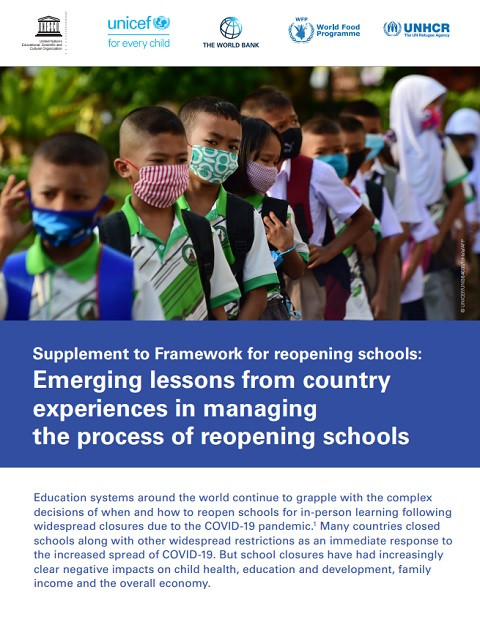 Supplement to Framework for Reopening Schools: Emerging Lessons From Country Experiences in Managing the Process of Reopening Schools Year of publication: 2020 Corporate author: UNESCO | United Nations Children's Fund (UNICEF) | World Bank | World Food Programme | UN. Office of the United Nations High Commissioner for Refugees (UNHCR) Education systems around the world continue to grapple with the complex decisions of when and how to reopen schools for in-person learning following widespread closures due to the COVID 19 pandemic. This supplement to the Framework for reopening schools, originally published jointly by UNICEF, UNESCO, the World Bank, the World Food Programme, and the UN Refugee Agency (UNHCR) in April 2020, summarizes emerging lessons learnt over the past months.The supplement follows the four main dimensions of the Framework (safe operations, focus on learning, wellbeing & protection, and reaching the most marginalized) and highlighting a number of country examples.
  Education 2030: Incheon declaration and framework for action towards inclusive and equitable quality education and lifelong learning for all Year of publication: 2015 Corporate author: UNESCO | United Nations Development Programme (UNDP) | United Nations Population Fund (UNFPA) | UN. Office of the United Nations High Commissioner for Refugees (UNHCR) | United Nations Children's Fund (UNICEF) | United Nations Entity for Gender Equality and the Empowerment of Women (UN Women) | World Bank This framework — painstakingly drafted over many months with input from governments, international agencies, civil society and experts — provides guidance for implementing the education commitments made in the 2030 Agenda for Sustainable Development at a national, regional and global level. In particular: it aims at mobilizing all countries and partners around Sustainable Education Goal 4 and its targets;it proposes ways of implementing, coordinating, financing and monitoring the new commitments; andit proposes indicative strategies which countries may wish to draw upon in developing their plans, taking into account different national realities, capacities and levels of development and respecting national policies and priorities. 교육 2030 인천선언과 실행계획: 포용적이고 공평한 양질의 교육과 모두를 위한 평생학습을 향해 Year of publication: 2015 Corporate author: 유네스코 | United Nations Development Programme (UNDP) | United Nations Population Fund (UNFPA) | UN. Office of the United Nations High Commissioner for Refugees (UNHCR) | United Nations Children's Fund (UNICEF) | United Nations Entity for Gender Equality and the Empowerment of Women (UN Women) | World Bank 정부, 국제기구, 시민사회와 전문가의 조언을 받아 몇 달 동안 많은 노력을 기울여 초안이 작성된 이 실행계획은 지속가능한 발전을 위한 2030 아젠다의 국가적, 지역적, 세계적 단계에서의 실현을 위한 교육의 역할에 대한 실천 가이드를 제공한다. 이는 모든 국가와 지속가능목표 4와 그 대상을 둘러싼 파트너들을 움직이도록 하는 데에 그 목적을 둔다.이 실행계획은 새로운 역할에 대한 실천, 협력, 자금조달과 관찰 방안을 제안한다.이 실행계획은 각 국가들이 서로 다른 국가적 상황과 역량, 발전 단계 및 각국의 정책과 우선순위를 존중한 계획을 세울 수 있도록 전략을 보여준다.
  Education 2030: Déclaration d'Incheon et Cadre d'action: vers une éducation inclusive et équitable de qualité et un apprentissage tout au long de la vie pour tous Year of publication: 2016 Corporate author: Organisation des Nations Unies pour l'éducation, la science et la culture (UNESCO) | United Nations Development Programme (UNDP) | United Nations Children's Fund (UNICEF) | United Nations Entity for Gender Equality and the Empowerment of Women (UN Women) | World Bank | United Nations Population Fund (UNFPA) | UN. Office of the United Nations High Commissioner for Refugees (UNHCR) This framework — painstakingly drafted over many months with input from governments, international agencies, civil society and experts — provides guidance for implementing the education commitments made in the 2030 Agenda for Sustainable Development at a national, regional and global level. In particular: it aims at mobilizing all countries and partners around Sustainable Education Goal 4 and its targets; it proposes ways of implementing, coordinating, financing and monitoring the new commitments; and it proposes indicative strategies which countries may wish to draw upon in developing their plans, taking into account different national realities, capacities and levels of development and respecting national policies and priorities.
 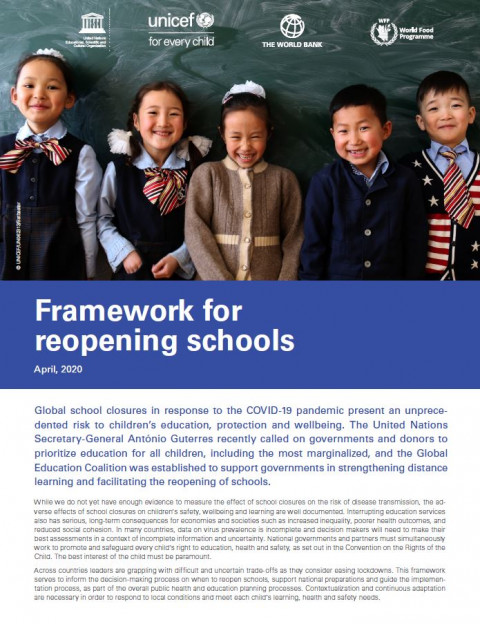 Framework for Reopening Schools; April, 2020 Year of publication: 2020 Corporate author: UNESCO | United Nations Children's Fund (UNICEF) | World Bank | World Food Programme By late April, nationwide school closures were still disrupting the learning of more than 73 per cent of students, or more than 1.2 billion children and youth. When deciding whether to reopen schools, authorities should look at the benefits and risks across education, public health and socio-economic factors, in the local context, using the best available evidence. The best interest of every child should be paramount.The guidelines aim to inform the decision-making process regarding school reopening, support national preparations and guide the implementation process, as part of overall public health and education planning processes. It is designed to be a flexible tool that can be adapted to each context and updated as the situation changes. The guidelines outline six key priorities to assess the readiness of those schools and inform planning.
 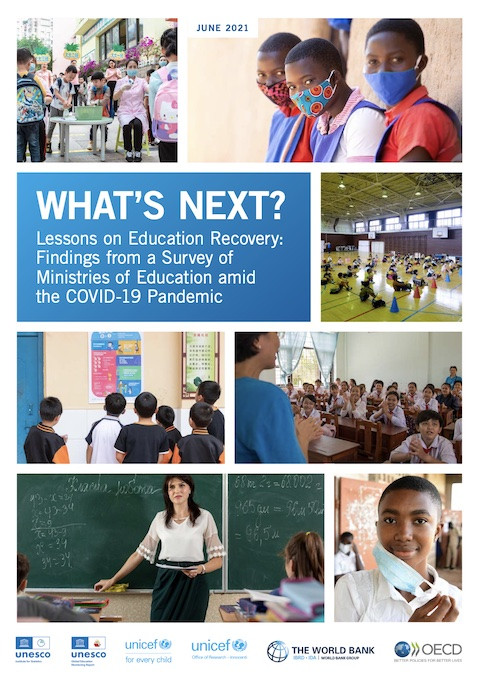 What’s Next? Lessons on Education Recovery: Findings From a Survey of Ministries of Education Amid the COVID-19 Pandemic Year of publication: 2021 Corporate author: UNESCO | United Nations Children's Fund (UNICEF) | World Bank | Organisation for Economic Co-operation and Development (OECD) United Nations Educational, Scientific and Cultural Organization (UNESCO), the United Nations Children’s Fund (UNICEF), the World Bank and the Organisation for Economic Co-operation and Development (OECD) have collaborated in the third round of the Survey on National Education Responses to COVID-19 School Closures, administered by the UNESCO Institute for Statistics (UIS) and OECD to Ministry of Education officials. The questions covered four levels of education: preprimary, primary, lower secondary and upper secondary. While the first two rounds of the survey were implemented during the periods May–June and July–October 2020, respectively, the third round was implemented during the period February–June 2021. In total, 143 countries responded to the questionnaire. Thirty-one countries submitted responses to the OECD (“OECD survey”) and 112 countries responded to the UIS (“UIS survey”). Seven countries responded to both surveys. In these instances, the more complete set responses were used in analysis.
 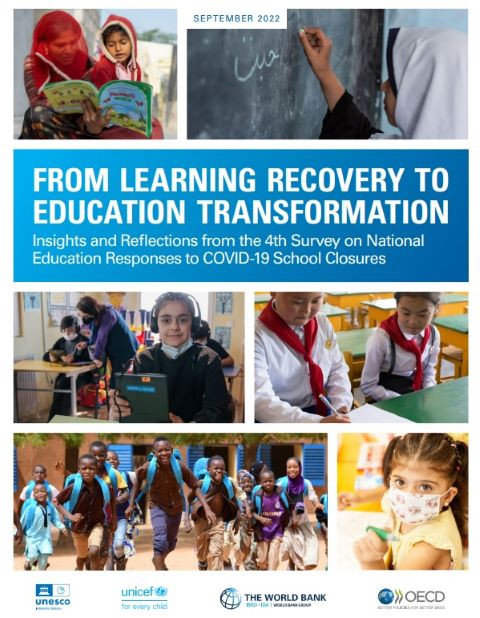 From Learning Recovery to Education Transformation: Insights and Reflections from the 4th Survey on National Education Responses to COVID-19 School Closures Year of publication: 2022 Corporate author: UNESCO | UNESCO Institute for Statistics (UIS) | United Nations Children's Fund (UNICEF) | World Bank | Organisation for Economic Co-operation and Development (OECD) From Learning Recovery to Education Transformation, a new joint report by UNESCO, UNESCO Institute for Statistics (UIS), UNICEF, The World Bank and The OECD, presents findings from the fourth round of the Survey on National Education Responses to COVID-19 School Closures, administered between April–July 2022 with responses from Ministries of Education in 93 countries. It explores how countries are progressing in the RAPID actions to recover learning: Reach every child and keep them in school; Assess learning levels regularly; Prioritize teaching the fundamentals; Increase the efficiency of instruction; and Develop psychosocial health and wellbeing.
  Technical Note on the Implementation of the Convention on the Rights of Persons with Disabilities in Uzbekistan Year of publication: 2023 Corporate author: World Bank This compilation of technical briefs lays out the key problems faced by persons with disabilities in Uzbekistan under all areas of life and formulates detailed recommendations, providing the evidence base for a Strategic Note that aims to guide Uzbekistan's next five-year National Action Plan (NAP) for implementing the United Nations Convention on the Rights of Persons with Disabilities (CRPD). Технические справки по имплементации Конвенции о правах инвалидов Year of publication: 2023 Corporate author: World Bank В этом сборнике девяти отраслевых технических справок очень подробно анализируются проблемы, с которыми сталкиваются лица с инвалидностью в Узбекистане во всех сферах жизни, и формулируются подробные рекомендации, обеспечивающие доказательную базу для Стратегической записки, которая призвана служить ориентиром для следующего пятилетнего Национального плана действий Узбекистана (НПД) по имплементации Конвенции Организации Объединенных Наций о правах инвалидов (КПИ) в стране.
 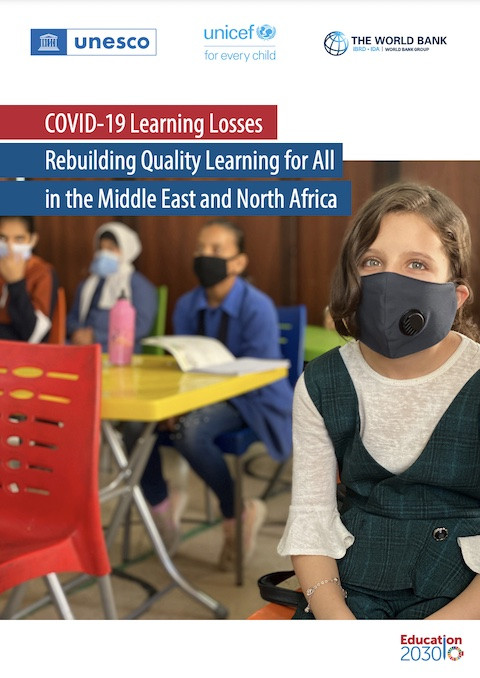 COVID-19 Learning Losses: Rebuilding Quality Learning for All in the Middle East and North Africa Year of publication: 2021 Author: Hana Yoshimoto | Jeannette Vogelaar | Brenda Haiplik Corporate author: UNESCO | United Nations Children's Fund (UNICEF) | World Bank An entire generation of children in the Middle East and North Africa (MENA) is estimated to be affected by the education crisis determined by the COVID-19 pandemic, with potential impacts that are going beyond the immediate/short term and also well beyond the education domain itself, with consequences on children’s socialisation, mental well-being, and future perspective of being active members of their society, including in the labor market. More information on the impact of the crisis would help countries to put in place strategies to mitigate the impacts. Timely investment and action to prevent extreme impacts of this crisis on education are of paramount importance in MENA, which already tackling a learning crisis before the COVID-19 outbreak.This publication delineates the overall education status in MENA after the breakout of COVID-19 pandemic, by presenting the education responses in MENA, and assessing the potential learning loss through a simulation analysis, recommendations are provided on how to build back better and enhance access and quality learning for all.