
Resources
Explore a wide range of valuable resources on GCED to deepen your understanding and enhance your research, advocacy, teaching, and learning.
21 Results found
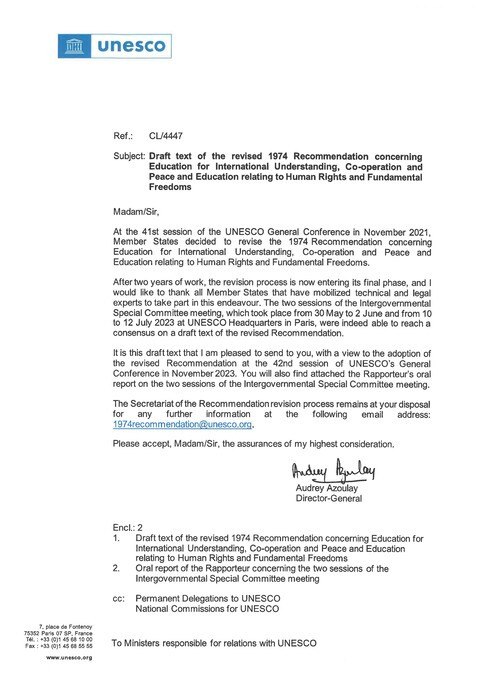 Draft Text of the Revised 1974 Recommendation Concerning Education for International Understanding, Co-Operation and Peace and Education Relating to Human Rights and Fundamental Freedoms Year of publication: 2023 Corporate author: UNESCO In accordance with the UNESCO Constitution and the Rules of Procedure concerning Recommendations to Member States and international conventions covered by the terms of Article IV, paragraph 4, of the Constitution, the draft text of the revised Recommendation concerning education for international understanding, co-operation and peace and education relating to human rights and fundamental freedoms, and the related preliminary report, were sent to UNESCO Member States through the circular letter CL/4401 (September 2022) for their written commentsand observations. On the basis of their comments, a second draft of the text was prepared. In circular letter CL/4433 (April 2023), the second draft together with the Definitive Report were submitted to Member States. The Special Committee meeting of experts designated by Member States took place from 30 May to 2 June 2023, as per the circular letter CL/4417 (November 2022), and from 10 to 12 July 2023, as per circular letter CL/4442 (June 2023).
 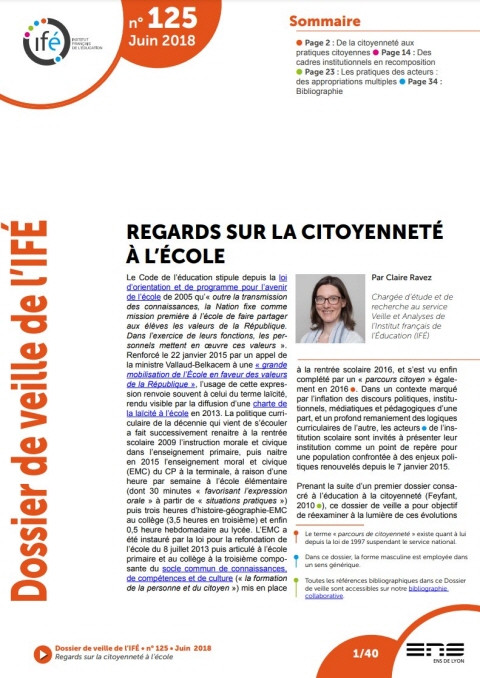 Perspectives on Citizenship in School (IFE Monitoring Report; (vol. 125, no.6) Year of publication: 2018 Corporate author: École normale supérieure de Lyon.L’Institut français de l’Éducation Prenant la suite d’un premier dossier consacré à l’éducation à la citoyenneté (Feyfant, 2010 l), ce dossier de veille a pour objectifde réexaminer à la lumière de ces évolutions récentes la question des liens entre école et citoyenneté. Following up on an initial report dedicated to citizenship education (Feyfant, 2010 I), this monitoring report aims to re-examine the relationship between school and citizenship in light of recent developments. Regards sur la citoyenneté à l’école(Dossier de veille de l’IFÉ; (vol.125, n°6) Year of publication: 2018 Corporate author: École normale supérieure de Lyon.L’Institut français de l’Éducation Prenant la suite d’un premier dossier consacré à l’éducation à la citoyenneté (Feyfant, 2010 l), ce dossier de veille a pour objectifde réexaminer à la lumière de ces évolutions récentes la question des liens entre école et citoyenneté. Following up on an initial report dedicated to citizenship education (Feyfant, 2010 I), this monitoring report aims to re-examine the relationship between school and citizenship in light of recent developments.
 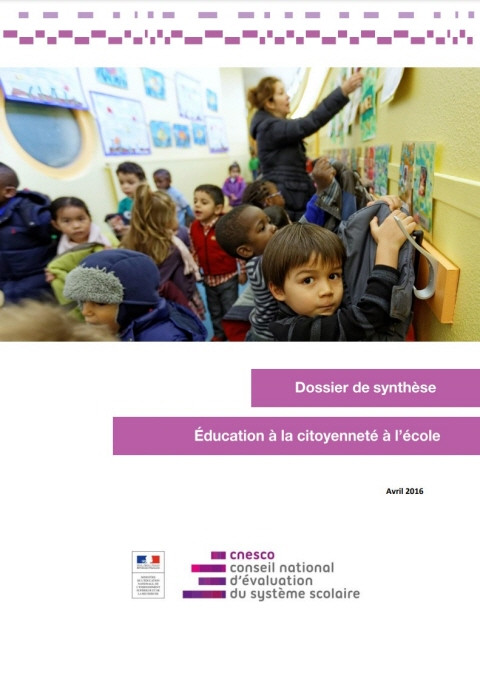 Citizenship Education in Schools: Summary Report Year of publication: 2016 Corporate author: National Center for the Study of School Systems (CNESCO) This report explores the evolution of citizenship education in French schools in response to contemporary challenges. It highlights the key principles of this education and its impact on students, supported by recent research and surveys. The report also compares international practices and presents innovative examples, offering insights to enhance citizenship teaching in France. Éducation à la citoyenneté à l'école : Dossier de synthèse Year of publication: 2016 Corporate author: National Center for the Study of School Systems (CNESCO) Ce dossier explore l'évolution de l'éducation à la citoyenneté dans les écoles françaises face aux défis contemporains. Il met en avant les principes clés de cette éducation et son impact sur les élèves, soutenu par des recherches et des sondages récents. Le rapport compare les pratiques internationales et présente des exemples innovants, offrant des perspectives pour améliorer l'enseignement de la citoyenneté en France.
 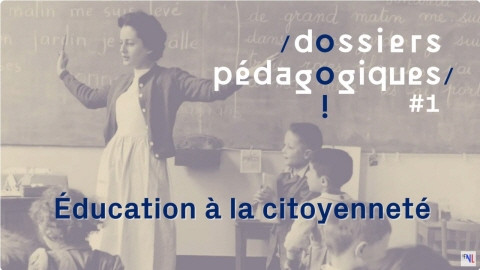 Educational Pack: Claire Ravez, research analyst focused on monitoring and analysis, IFE Year of publication: 2021 Corporate author: French Institute of Netherlands As a professor of history and geography, Claire Ravez joined the Monitoring and Analysis team of the French Institute of Education within the École normale supérieure de Lyon in 2017.Pedagogical file #1 is dedicated to civic education, with contributions from Claire Ravez, Dominique Schnapper, FEi, and the National Library of France. Dossier pédagogique : Claire Ravez, chargée d'étude Veille et Analyses, IFE Year of publication: 2021 Corporate author: French Institute of Netherlands Professeure d’histoire-géographie, Claire Ravez a rejoint l’équipe Veille et Analyses de l’Institut français de l’éducation au sein de l’École normale supérieure de Lyon en 2017.Dossier pédagogique #1 consacré à l’éducation à la citoyenneté, avec les contributions de Claire Ravez, Dominique Schnapper, FEi et la BnF.
 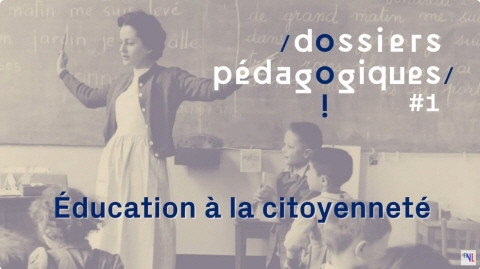 Education Pack: Dominique Schnapper, sociologue Year of publication: 2023 Corporate author: French Institute of Netherlands Member of the Constitutional Council from 2001 to 2010, Dominique Schnapper is a French sociologist and political scientist. pedagogical file #1 is dedicated to civic education, with contributions from Claire Ravez, Dominique Schnapper, FEi and the BnF. Dossiers pédagogiques : Dominique Schnapper, sociologue Year of publication: 2023 Corporate author: French Institute of Netherlands Membre du Conseil constitutionnel de 2001 à 2010, Dominique Schnapper est une sociologue et politologue française.Dossier pédagogique #1 consacré à l’éducation à la citoyenneté, avec les contributions de Claire Ravez, Dominique Schnapper, FEi et la BnF.
 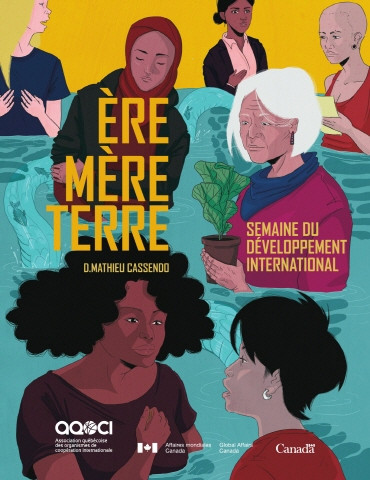 Ère, Terre, Mer: Semaine du développement international Year of publication: 2020 Author: Dimani Mathieu Cassendo Corporate author: Quebec Association of International Cooperation Organizations (AQOCI) La Semaine du développement international (SDI) permet chaque année de souligner un enjeu international qui interpelle les sociétés. Au Québec, c’est l’Association québécoise des organismes de coopération internationale (AQOCI) qui organise cette semaine de sensibilisation auprès du public. Le CRÉDIL participe activement à cette campagne et a participé à la production de bandes dessinées comme outil pédagogique comme “Ère, Terre, Mer” en 2021 qui traite de l'impact de la crise de l'environnement sur les différentes populations.