
Resources
Explore a wide range of valuable resources on GCED to deepen your understanding and enhance your research, advocacy, teaching, and learning.
18 Results found
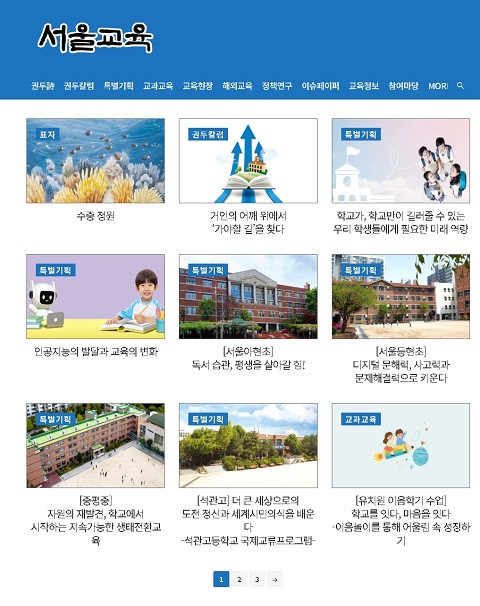 서울교육 2024년 여름호 (제66권 통권 255호) Year of publication: 2024 Corporate author: 서울특별시교육청 교육연구정보원 권두칼럼: 거인의 어깨 위에서 ‘가야할 길’을 찾다 특별기획:- 학교가, 학교만이 길러줄 수 있는 우리 학생들에게 필요한 미래 역량- 인공지능의 발달과 교육의 변화- [서울아현초] 독서 습관, 평생을 살아갈 힘!- [서울등현초] 디지털 문해력, 사고력과 문제해결력으로 키운다- [중평중] 자원의 재발견, 학교에서 시작하는 지속가능한 생태전환교육- [석관고] 더 큰 세상으로의 도전 정신과 세계시민의식을 배운다: 석관고등학교 국제교류프로그램 교과교육:- [유치원 이음학기 수업] 학교를 잇다, 마음을 잇다: 이음놀이를 통해 어울림 속 성장하기- [특수학급 국제 공동 수업] 바다를 넘고 장애를 넘는 특별한 우정 프로젝트- [초등학교 생태전환교육 수업] 기후 위기? 예술로 공존!- [중학교 역지사지 공존형 토론 수업] 경쟁이 아닌 공존을 위한 토론!교과교육- [고등학교 인공지능 활용 수업] 인공지능과 함께 성장하는 수학수업- [학급운영 현장보기] 육개장 사발면반 제자들과의 시간- [체험·문화·예술활동 Ⅰ] 예술의 언어로 소통하며 공동체를 이루다: 중학교 맞춤형 예술 교육- [체험·문화·예술활동 Ⅱ] 나를 발견하게 하고, 나를 표현하게 하는 “예술교육”: 고등학교 협력종합예술활동- [학교현장 미리보기] AI 디지털교과서를 통한 미래교육 엿보기 정책연구: 학교수업 내 에듀테크 활용 정도가 중학생의 교육적 성장에 미치는 영향 분석 정책연구 교육정보:- 2024년 강화된 교육활동 보호 정책, 이것만큼은 꼭 알아두세요- 돌봄과 배움이 공존하는 서울형 늘봄학교- 수업-평가의 연계성 강화를 위한 초 · 중등학교 정보공시(교수학습 및 평가계획 관련) 개정 안내- 메타버스는 정말 끝났을까? 참여마당:- [웹툰] 알찬 여름방학 보내기- [수기] 뮤지컬 배우가 꿈이었던 교사, 학교에서 뮤지컬을 꿈꾸다- [서평] 쉬운 공공의 언어는 인권이다: 이건범 『언어는 인권이다』를 읽고- [후기] 모니터단 2024 ‘봄호’ 후기 갤러리: “어린이·청소년의 미래역량 신장을 위해 노력합니다!”
 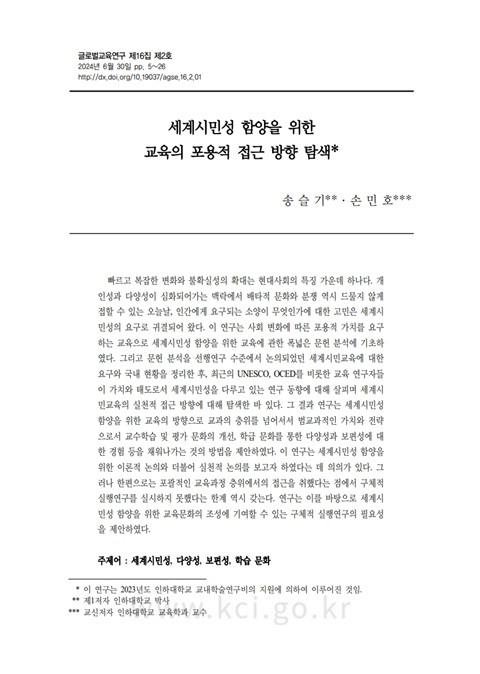 세계시민성 함양을 위한 교육의 포용적 접근 방향 탐색 (글로벌교육연구; Vol. 16, No.2) Year of publication: 2024 Author: 송슬기 | 손민호 Corporate author: 글로벌교육연구학회 빠르고 복잡한 변화와 불확실성의 확대는 현대사회의 특징 가운데 하나다. 개인성과 다양성이 심화되어가는 맥락에서 배타적 문화와 분쟁 역시 드물지 않게 접할 수 있는 오늘날, 인간에게 요구되는 소양이 무엇인가에 대한 고민은 세계시민성의 요구로 귀결되어 왔다. 이 연구는 사회 변화에 따른 포용적 가치를 요구하는 교육으로 세계시민성 함양을 위한 교육에 관한 폭넓은 문헌 분석에 기초하였다. 그리고 문헌 분석을 선행연구 수준에서 논의되었던 세계시민교육에 대한 요구와 국내 현황을 정리한 후, 최근의 UNESCO, OCED를 비롯한 교육 연구자들이 가치와 태도로서 세계시민성을 다루고 있는 연구 동향에 대해 살피며 세계시민교육의 실천적 접근 방향에 대해 탐색한 바 있다. 그 결과 연구는 세계시민성 함양을 위한 교육의 방향으로 교과의 층위를 넘어서서 범교과적인 가치와 전략으로서 교수학습 및 평가 문화의 개선, 학급 문화를 통한 다양성과 보편성에 대한 경험 등을 채워나가는 것의 방법을 제안하였다. 이 연구는 세계시민성 함양을 위한 이론적 논의와 더불어 실천적 논의를 보고자 하였다는 데 의의가 있다. 그러나 한편으로는 포괄적인 교육과정 층위에서의 접근을 취했다는 점에서 구체적 실행연구를 실시하지 못했다는 한계 역시 갖는다. 연구는 이를 바탕으로 세계시민성 함양을 위한 교육문화의 조성에 기여할 수 있는 구체적 실행연구의 필요성을 제안하였다.
 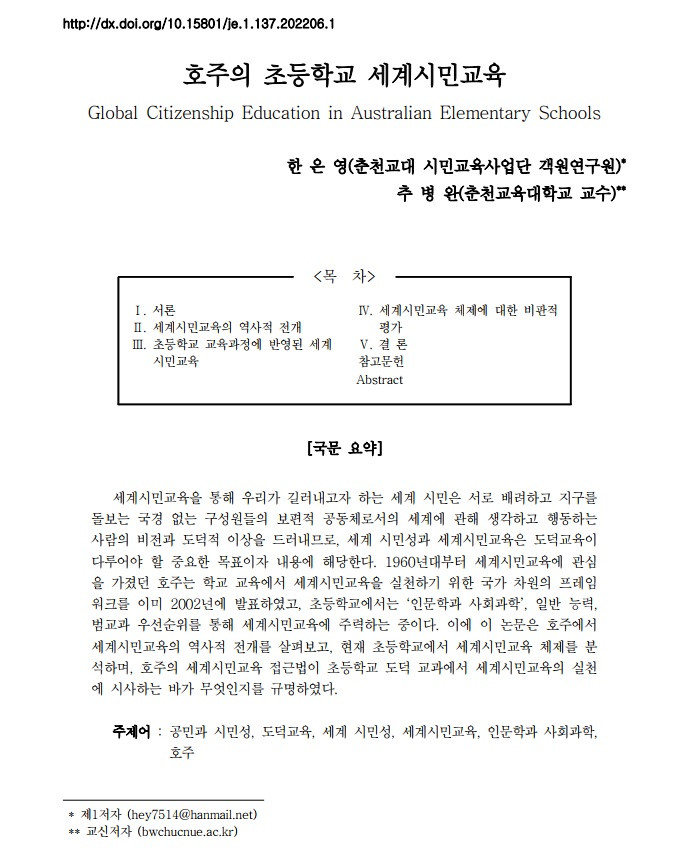 Global Citizenship Education in Australian Elementary Schools(Journal of Ethics; Vol. 137, No 1) Year of publication: 2022 Author: 한은영 | 추병완 Corporate author: 한국윤리학회 Global citizens think and act about the world as a universal community of borderless members who care for each other and are dedicated to taking care of the earth. Considering these visions and moral ideals, global citizenship education is an important goal and content of moral education. However, at present, we do not have a framework for dealing with global citizenship education in moral education. In this regard, Australia is the country we should pay attention to. Australia declared a national statement for global citizenship education in 2002. Since 2009, it has been reflected in the Australian curriculum. This article examines the historical development of global citizenship education in Australia, analyzes the current systems of global citizenship education system in primary schools, and investigates what Australia's approach to global citizenship education suggests for elementary moral education in Korea. In conclusion, we proposed three things. First, we must develop and apply a framework for the practice of global civic education in moral education. Second, we should emphasize the aspects of knowledge and understanding, skills and processing, behavior and participation as well as values and attitudes. Third, we must seek a balance between moderate global citizenship education and critical global citizenship education. 호주의 초등학교 세계시민교육(윤리연구; Vol. 137, No 1) Year of publication: 2022 Author: 한은영 | 추병완 Corporate author: 한국윤리학회 세계시민교육을 통해 우리가 길러내고자 하는 세계 시민은 서로 배려하고 지구를 돌보는 국경 없는 구성원들의 보편적 공동체로서의 세계에 관해 생각하고 행동하는 사람의 비전과 도덕적 이상을 드러내므로, 세계 시민성과 세계시민교육은 도덕교육이 다루어야 할 중요한 목표이자 내용에 해당한다. 1960년대부터 세계시민교육에 관심을 가졌던 호주는 학교 교육에서 세계시민교육을 실천하기 위한 국가 차원의 프레임워크를 이미 2002년에 발표하였고, 초등학교에서는 ‘인문학과 사회과학’, 일반 능력, 범교과 우선순위를 통해 세계시민교육에 주력하는 중이다. 이에 이 논문은 호주에서 세계시민교육의 역사적 전개를 살펴보고, 현재 초등학교에서 세계시민교육 체제를 분석하며, 호주의 세계시민교육 접근법이 초등학교 도덕 교과에서 세계시민교육의 실천에 시사하는 바가 무엇인지를 규명하였다.
 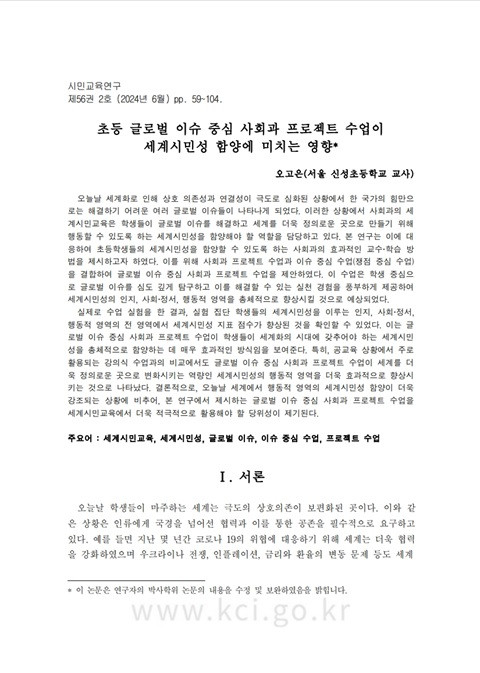 초등 글로벌 이슈 중심 사회과 프로젝트 수업이 세계시민성 함양에 미치는 영향 (시민교육연구; Vol. 56, No. 2) Year of publication: 2024 Author: 오고은 Corporate author: 한국사회과교육학회 오늘날 세계화로 인해 상호 의존성과 연결성이 극도로 심화된 상황에서 한 국가의 힘만으로는 해결하기 어려운 여러 글로벌 이슈들이 나타나게 되었다. 이러한 상황에서 사회과의 세계시민교육은 학생들이 글로벌 이슈를 해결하고 세계를 더욱 정의로운 곳으로 만들기 위해 행동할 수 있도록 하는 세계시민성을 함양해야 할 역할을 담당하고 있다. 본 연구는 이에 대응하여 초등학생들의 세계시민성을 함양할 수 있도록 하는 사회과의 효과적인 교수-학습 방법을 제시하고자 하였다. 이를 위해 사회과 프로젝트 수업과 이슈 중심 수업(쟁점 중심 수업)을 결합하여 글로벌 이슈 중심 사회과 프로젝트 수업을 제안하였다. 이 수업은 학생 중심으로 글로벌 이슈를 심도 깊게 탐구하고 이를 해결할 수 있는 실천 경험을 풍부하게 제공하여 세계시민성의 인지, 사회-정서, 행동적 영역을 총체적으로 향상시킬 것으로 예상되었다. 실제로 수업 실험을 한 결과, 실험 집단 학생들의 세계시민성을 이루는 인지, 사회-정서, 행동적 영역의 전 영역에서 세계시민성 지표 점수가 향상된 것을 확인할 수 있었다. 이는 글로벌 이슈 중심 사회과 프로젝트 수업이 학생들이 세계화의 시대에 갖추어야 하는 세계시민성을 총체적으로 함양하는 데 매우 효과적인 방식임을 보여준다. 특히, 공교육 상황에서 주로 활용되는 강의식 수업과의 비교에서도 글로벌 이슈 중심 사회과 프로젝트 수업이 세계를 더욱 정의로운 곳으로 변화시키는 역량인 세계시민성의 행동적 영역을 더욱 효과적으로 향상시키는 것으로 나타났다. 결론적으로, 오늘날 세계에서 행동적 영역의 세계시민성 함양이 더욱 강조되는 상황에 비추어, 본 연구에서 제시하는 글로벌 이슈 중심 사회과 프로젝트 수업을 세계시민교육에서 더욱 적극적으로 활용해야 할 당위성이 제기된다.
 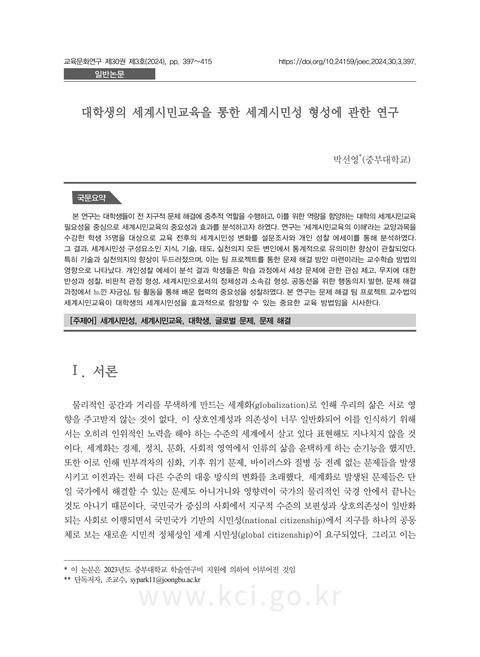 대학생의 세계시민교육을 통한 세계시민성 형성에 관한 연구 (교육문화연구; Vol. 30, No. 3) Year of publication: 2024 Author: 박선영 Corporate author: 인하대학교 교육연구소 본 연구는 대학생들이 전 지구적 문제 해결에 중추적 역할을 수행하고, 이를 위한 역량을 함양하는 대학의 세계시민교육필요성을 중심으로 세계시민교육의 중요성과 효과를 분석하고자 하였다. 연구는 '세계시민교육의 이해'라는 교양과목을수강한 학생 35명을 대상으로 교육 전후의 세계시민성 변화를 설문조사와 개인 성찰 에세이를 통해 분석하였다. 그 결과, 세계시민성 구성요소인 지식, 기술, 태도, 실천의지 모든 변인에서 통계적으로 유의미한 향상이 관찰되었다. 특히 기술과 실천의지의 향상이 두드러졌으며, 이는 팀 프로젝트를 통한 문제 해결 방안 마련이라는 교수학습 방법의영향으로 나타났다. 개인성찰 에세이 분석 결과 학생들은 학습 과정에서 세상 문제에 관한 관심 제고, 무지에 대한반성과 성찰, 비판적 관점 형성, 세계시민으로서의 정체성과 소속감 형성, 공동선을 위한 행동의지 발현, 문제 해결과정에서 느낀 자긍심, 팀 활동을 통해 배운 협력의 중요성을 성찰하였다. 본 연구는 문제 해결 팀 프로젝트 교수법의세계시민교육이 대학생의 세계시민성을 효과적으로 함양할 수 있는 중요한 교육 방법임을 시사한다.
 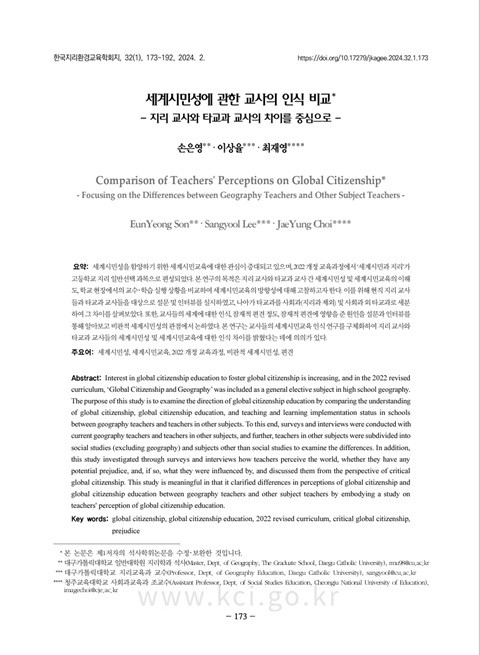 세계시민성에 관한 교사의 인식 비교: 지리 교사와 타교과 교사의 차이를 중심으로 (한국지리환경교육학회지; Vol. 32, No. 1) Year of publication: 2024 Author: 손은영 | 이상율 | 최재영 Corporate author: 한국지리환경교육학회 세계시민성을 함양하기 위한 세계시민교육에 대한 관심이 증대되고 있으며, 2022 개정 교육과정에서 ‘세계시민과 지리’가고등학교 지리 일반선택 과목으로 편성되었다. 본 연구의 목적은 지리 교사와 타교과 교사 간 세계시민성 및 세계시민교육의 이해도, 학교 현장에서의 교수・학습 실행 상황을 비교하여 세계시민교육의 방향성에 대해 고찰하고자 한다. 이를 위해 현직 지리 교사들과 타교과 교사들을 대상으로 설문 및 인터뷰를 실시하였고, 나아가 타교과를 사회과(지리과 제외) 및 사회과 외 타교과로 세분하여 그 차이를 살펴보았다. 또한, 교사들의 세계에 대한 인식, 잠재적 편견 정도, 잠재적 편견에 영향을 준 원인을 설문과 인터뷰를통해 알아보고 비판적 세계시민성의 관점에서 논하였다. 본 연구는 교사들의 세계시민교육 인식 연구를 구체화하여 지리 교사와타교과 교사들의 세계시민성 및 세계시민교육에 대한 인식 차이를 밝혔다는 데에 의의가 있다.
  2022 세계시민교육 국내 모니터링 체제 구축 연구 Year of publication: 2022 Author: 박환보 | 박경희 | 최원석 | 길혜지 | 조대훈 | 엄정민 Corporate author: 유네스코 아시아태평양 국제이해교육원 본 연구는 유네스코 아시아태평양 국제이해교육원(이하 유네스코 아태교육원)이 지속가능발전목표4.7(SDG4.7) 의 국내 이행 노력을 효과적으로 모니터링하기 위해 다년간 실시해온 연구의 일환으로, 국내 모니터링 체제 구축 방안 모색을 목적으로 한다. 특히 본 연구에서는 SDG4.7 목표 이행과 모니터링의 초점을 세계시민교육을 통한 학습자의 변화와 성장에 두고, 세계시민교육 정책, 교사의 세계시민교육 역량, 학습자의 세계시민역량의 세 가지 측면에서 모니터링 방안을 모색하였다. 이를 위해 우선 유네스코 아태교육원이 본 모니터링 연구 의 연속선상에서 수행해 온 선행연구에서 제안한 세계시민교육 주제영역과 개념틀을 활용하여 시·도교육청의 세계시민교육 이행 실태와 변화 추이를 분석하고, 정책의 주류화라는 관점에서 모니터링 방안에 관해 논의하였다. 그리고 기존 투입 중심의 연구 한계를 극복하기 위해, 세계시민교육의 이행 과정과 산출이라는 관점에서 교사의 세계시민교육 역량과 학습자의 세계시민성 수준을 측정하기 위한 문항을 개발하였다.
  Asia-Pacific Living Heritage Lesson Plan 2023 Year of publication: 2023 Corporate author: APCEIU | UNESCO Bangkok | International Information and Networking Centre for Intangible Cultural Heritage in the Asia-Pacific Region (ICHCAP) In partnership with UNESCO Bangkok and ICHCAP (International Information and Networking Centre for Intangible Cultural Heritage in the Asia-Pacific Region), APCEIU (Asia-Pacific Centre of Education for International Understanding) carried out “Bringing Living Heritage to the Classroom in the Asia-Pacific” since 2020. As a part of this multi-year project, the UNESCO Asia-Pacific Living Heritage Lesson Plan Contest 2023, co-organized by UNESCO Bangkok, APCEIU, and ICHCAP was launched and 18 lesson plans from 10 countries – Bhutan, China, India, Indonesia, the Republic of Korea, Malaysia, Nepal, The Philippines, Singapore, and Viet Nam - were selected as follows. - Saykha Offering (Subject: English), Tsirangtoe Central School, Bhutan- Setting Up a Herbarium, Learning about Medicinal Herbs and their Cultural and Traditional Uses in the Community (Subject: Science/Grades 7–9), Zilukha Middle Secondary School, Bhutan- Shamanistic Worship and Propitiation to the Spirits (Subject: Bhutan History and Civics and Citizenship Education/Grade 8), Bajothang Higher Secondary School, Bhutan- Beauty of Intangible Cultural Heritage (Subject: Foundations of College Art Education/ Freshman Year), Anhui Medical University, China- The Folk Custom of Building the Peace Kiln for the Mid-Autumn Festival in Jingdezhen (Subject: Mathematics/Grade 7), Jingdezhen No.13 Secondary School, China - When Xiabu Meets Batik (Subject: Art/Grade 5–6), ChongQing Shuren Primary School, China- Agricultural Practices (Subject: Biology/Grade 8), Paramita Heritage School, India- Living Heritage – Quilting in the Kalbelia Community of Rajasthan (Subject: Social Science/Grade 9), St. Stephen's Senior Secondary School, India- My City: Varanasi (Subject: Environmental Studies/Grade 2), Sunbeam School Lahartara, India - Bringing Back the Javanese Saka Calendar through Ethnomathematics (Subject: Mathematics/Grade 7–12), Binus School Bekasi, Indonesia- Song, Play, and Dance (Subject: Interdisciplinary for Indonesian Language, Balinese Culture, Music and Physical Education/Grade 3), Green School Bali, Indonesia- Teaching Sound Wave with Sundanese Traditional Instruments (Subject: Physics/Grade 8), Binus School Bekasi, Indonesia- Wau – The Malays Traditional Kite: Introduction, Wau Bulan Appreciation, Wau Making and Flying Workshop and Wau Corner (Subject: Traditional Games/Grades 4–5), SMU (A) Tarbiah Islamiah (SABK), Malaysia- Himalayan Aromatic Incense-Making and Meditation Workshop (Subject: Economics and Social Studies/ Grades 8–9, 11–12), Pragati Pathshala, Nepal- Influence of Biodiversity on the Stability of Ecosystems (Subject: Science/Grade 10), Philippine Normal University Mindanao, The Philippines- Understanding the Nature of Religion: From the Perspective of the Tripeople (Christians, Muslims, & Lumads) of Kidapawan City, North Cotabato (Subject: Humanities and Social Sciences/Grade 12), Kidapawan City National High School, The Philippines- Bongsan Talchum that Helps the Community Become More Sustainable (Subject: Korean Language and Literature, Social Studies, P.E., Arts/Grade 6), Kimje Buk Elementary School, Republic of Korea- Exploring Community Gardens – How and why are they so precious to humans? (Subject: Geography/Grade 9), Admiralty Secondary School, Singapore 무형유산을 통해 키우는 세계시민성: 2023 아태지역 무형유산 교수학습계획안 Year of publication: 2023 Corporate author: 유네스코 아시아태평양 국제이해교육원 | UNESCO Bangkok | 유네스코아태무형유산센터 유네스코 아태교육원은 2020년부터 유네스코 방콕사무소와 유네스코아태무형유산센터(ICHCAP)와 협력하여 「아시아태평양 교실에서 만나는 무형유산 사업」을 수행하였다. 이 사업의 일환으로, <2023 아태지역 무형유산 교수학습계획안 공모전 >을 개최하였으며, 총 10개국(네팔, 말레이시아, 베트남, 부탄, 싱가포르, 인도, 인도네시아, 중국, 필리핀, 한국)의 18개 교수학습계획안을 모범사례로 최종 선정하였다. 다음은 수상작 목록이다. - Saykha Offering (Subject: English), Tsirangtoe Central School, Bhutan- Setting Up a Herbarium, Learning about Medicinal Herbs and their Cultural and Traditional Uses in the Community (Subject: Science/Grades 7–9), Zilukha Middle Secondary School, Bhutan- Shamanistic Worship and Propitiation to the Spirits (Subject: Bhutan History and Civics and Citizenship Education/Grade 8), Bajothang Higher Secondary School, Bhutan- Beauty of Intangible Cultural Heritage (Subject: Foundations of College Art Education/ Freshman Year), Anhui Medical University, China- The Folk Custom of Building the Peace Kiln for the Mid-Autumn Festival in Jingdezhen (Subject: Mathematics/Grade 7), Jingdezhen No.13 Secondary School, China - When Xiabu Meets Batik (Subject: Art/Grade 5–6), ChongQing Shuren Primary School, China- Agricultural Practices (Subject: Biology/Grade 8), Paramita Heritage School, India- Living Heritage – Quilting in the Kalbelia Community of Rajasthan (Subject: Social Science/Grade 9), St. Stephen's Senior Secondary School, India- My City: Varanasi (Subject: Environmental Studies/Grade 2), Sunbeam School Lahartara, India - Bringing Back the Javanese Saka Calendar through Ethnomathematics (Subject: Mathematics/Grade 7–12), Binus School Bekasi, Indonesia- Song, Play, and Dance (Subject: Interdisciplinary for Indonesian Language, Balinese Culture, Music and Physical Education/Grade 3), Green School Bali, Indonesia- Teaching Sound Wave with Sundanese Traditional Instruments (Subject: Physics/Grade 8), Binus School Bekasi, Indonesia- Wau – The Malays Traditional Kite: Introduction, Wau Bulan Appreciation, Wau Making and Flying Workshop and Wau Corner (Subject: Traditional Games/Grades 4–5), SMU (A) Tarbiah Islamiah (SABK), Malaysia- Himalayan Aromatic Incense-Making and Meditation Workshop (Subject: Economics and Social Studies/ Grades 8–9, 11–12), Pragati Pathshala, Nepal- Influence of Biodiversity on the Stability of Ecosystems (Subject: Science/Grade 10), Philippine Normal University Mindanao, The Philippines- Understanding the Nature of Religion: From the Perspective of the Tripeople (Christians, Muslims, & Lumads) of Kidapawan City, North Cotabato (Subject: Humanities and Social Sciences/Grade 12), Kidapawan City National High School, The Philippines- Bongsan Talchum that Helps the Community Become More Sustainable (Subject: Korean Language and Literature, Social Studies, P.E., Arts/Grade 6), Kimje Buk Elementary School, Republic of Korea- Exploring Community Gardens – How and why are they so precious to humans? (Subject: Geography/Grade 9), Admiralty Secondary School, Singapore