
Resources
Explore a wide range of valuable resources on GCED to deepen your understanding and enhance your research, advocacy, teaching, and learning.
28 Results found
 Reopening Schools in Latin America and the Caribbean: Keys, Challenges, and Dilemmas to Plan for a Safe Return to in-Person Classes Year of publication: 2021 Author: Alejandro Vera | Martín Scasso | Alejandro Morduchowicz | Cecilia Berlanga Alessio Robles Corporate author: UNESCO Santiago | Inter-American Development Bank The suspension of in-person classes as a consequence of the COVID-19 pandemic profoundly affected the education systems in Latin America and the Caribbean (LAC) and compromised the achievements reached around the goals established in the SDG4-Education 2030 Agenda. The most vulnerable people have been the most affected by this situation, which widened the preexisting gaps. The countries of the region have carried out great efforts to guarantee the continuity of learning. However, these have been limited by the challenges that this unprecedented crisis brought, aggravated by unequal conditions in access to infrastructure and other resources that affect broad sectors of the population.This report analyzes the possibilities, restrictions and needs that the countries of the region will face during the process of returning to in-person classes, considering five dimensions: (i) safe schools (school infrastructure, access to water and sanitation); (ii) human resources (principals and teachers); (iii) access to ITC and connectivity; (iv) education financing and (v) information and planning. Reabrir las escuelas en América Latina y el Caribe: Claves, desafíos y dilemas para planificar el retorono seguro a las clases presenciales; Reporte Year of publication: 2021 Author: Alejandro Vera | Martín Scasso | Alejandro Morduchowicz | Cecilia Berlanga Alessio Robles Corporate author: UNESCO La suspensión de clases presenciales como consecuencia de la pandemia de COVID-19 afectó profundamente los sistemas educativos de América Latina y el Caribe, y puso en riesgo los avances alcanzados en torno al cumplimiento de las metas establecidas en la Agenda ODS 4-Educación 2030. Las poblaciones más vulnerables se han visto más afectadas por esta situación, lo cual acrecentó las brechas preexistentes. Los países de la región llevaron a cabo enormes esfuerzos para garantizar la continuidad de los aprendizajes. Sin embargo, se ven limitados por los desafíos que presenta este contexto inédito de crisis y agravados por las desiguales condiciones de acceso a infraestructura y otros recursos que afectan a vastos sectores de la población.El reporte analiza las posibilidades, restricciones y necesidades que enfrentarán los países de la región durante el proceso del regreso a las clases presenciales, considerando cinco dimensiones: (i) escuelas seguras (infraestructura escolar, acceso al agua y saneamiento); (ii) recursos humanos (directores y docentes); (iii) acceso a TIC y conectividad, (iv) financiamiento de la educación y (v) información y planificación.
  In Solidarity With Girls: Gender and Education in Crisis (Policy Brief Series) Year of publication: 2020 Corporate author: United Nations Girls' Education Initiative (UNGEI) The In Solidarity With Girls: Gender and education in crisis policy brief series was developed through a series of intergenerational dialogues on gender, education and COVID-19. The contents of this paper and its recommendations belong to the young women activists featured in each brief. Drawing on the ‘build back equal’ principle, this brief contributes to policy dialogues and discussions on (1) how we can plan for and work towards more equal, gender-responsive school systems once restrictions are lifted, and (2) achieve this through meaningful partnership with youth and youth-led networks.
  Raise Your Voice With Malala: A Guide to Taking Action for Girls’ Education Year of publication: 2018 Author: Emily Laurie | Eleanor Gall Corporate author: Malala Fund This guide gives young activists the tools to raise their voices and make change happen. Girls around the world are standing up in support of their out-of-school sisters and fighting to see every girl complete 12 years of free, safe, quality education. By taking action in their communities, girls can contribute to the peace and prosperity of our entire world. The guide includes real stories about girls around the world working to make sure all girls have the opportunity to go to school.
 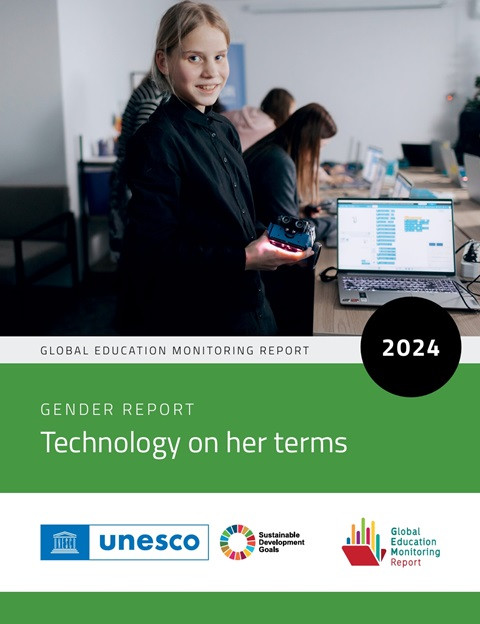 Global Education Monitoring Report 2024: Gender Report; Technology on Her Terms Year of publication: 2024 Corporate author: UNESCO | Global Education Monitoring Report Team The 2024 Gender Report tells the increasingly positive story of girls’ education access, attainment and achievement, which is helping reverse decades of discrimination. But there is much more to say on gender equality in and through education. A companion to the 2023 GEM Report, this report looks at the interaction between education and technology with a gender lens. First, it looks at the impact of technology on girls’ education opportunities and outcomes. Although many instances are seen of radio, television and mobile phones providing a learning lifeline for girls, particularly in crisis contexts, gender divides exist globally in both access to technology and in digital skills, although the latter are smaller among youth compared to among adults. Biased social and cultural norms inhibit equitable access to and engagement with technology in and outside of school, with girls always left on the wrong side of the divide. While technology offers many girls opportunities to access important education content in safe environments, for instance on comprehensive sexuality education, technology in practice often exacerbates negative gender norms or stereotypes. Social media usage impacts learners’ and particularly girls’ well-being and self-esteem. The ease with which cyberbullying can be magnified through the use of online devices in the school environment is a cause of concern, as is the biased design of artificial intelligence algorithms. Second, the report looks into the role of education on the shape of future technological development. It shows that women struggle to pursue STEM careers, which manifests from an early age in the form of anxiety in mathematics and develops into a reluctance to study STEM subjects, ultimately resulting in a lack of women in the technology workforce. Women make up only 35% STEM graduates, and hold only a quarter of science, engineering and ICT jobs. Ensuring women participate on equal terms in shaping the world’s ongoing digital transformation will ensure that technology works for everyone and takes into consideration the needs of all humanity.
 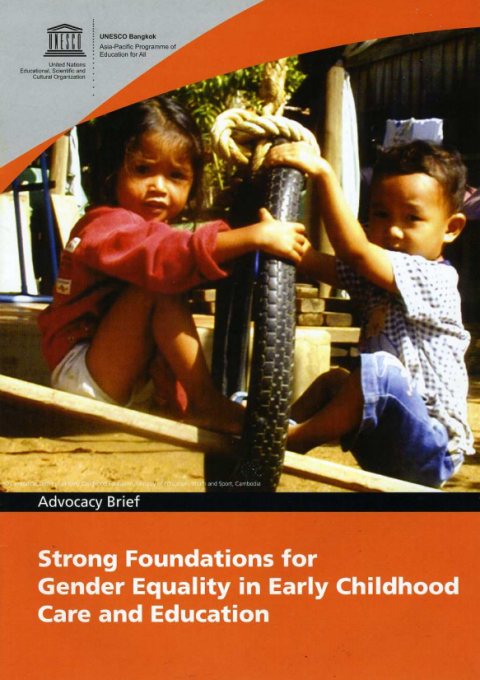 Strong foundations for gender equality in early childhood care and education: advocacy brief Year of publication: 2007 Corporate author: UNESCO The term Early Childhood Care and Education (ECCE) refers to services for children from birth to eight years of age. These include educating parents in how to care for their children and help them learn, as well as providing community-run and formal preschool programmes for pre-primary school-aged boys and girls. Given the varying needs of children from birth to eight years, educators have found it best to have different policies and strategies for children below and above three years of age. This brief focuses on the gender issues in the services provided for children who are three years of age or older in the Asia-Pacific region. Its scope is informed by UNESCO's commitment to holistic pre-primary services for this age group. The goal is to provide early childhood education that helps girls and boys succeed in primary school and in learning throughout their lives. The brief starts by looking into the growth of ECCE in the Asia-Pacific region and what is driving this growth. It explores why gender responsiveness is important in early childhood education, gives practical examples of what this looks like, and discusses the challenges of providing ECCE that equally values and benefits each girl and each boy. Flowing from this, the brief concludes with recommendations on how to make ECCE more gender responsive De solides fondations pour l'égalité des sexes dans les soins de la petite enfance et de l'éducation: le plaidoyer bref Year of publication: 2007 Corporate author: UNESCO Le terme de l’éducation et la protection de la petite enfance (EPPE) fait référence aux services pour les enfants de la naissance à huit ans. Ceux-ci incluent l'éducation des parents dans la façon de prendre soin de leurs enfants et de les aider à apprendre, ainsi que de fournir des programmes formels préscolaires gérés par la communauté et pour les garçons et les filles d'âge scolaire pré-primaire. Compte tenu des divers besoins des enfants de la naissance à huit ans, les éducateurs ont trouvé préférable d'avoir des politiques et des stratégies pour les enfants de moins et de plus de trois ans. Ce bref se concentre sur les questions de genre dans les services fournis aux enfants qui sont de trois ans ou plus dans la région Asie-Pacifique. Son champ d'application est informé par l'engagement de l'UNESCO aux services pré-primaires holistiques pour ce groupe d'âge. L'objectif est de fournir une éducation de la petite enfance qui aide les filles et les garçons à réussir à l'école primaire et dans l'apprentissage tout au long de leur vie. Les brèves commence par la recherche dans la croissance de l'EPPE dans la région Asie-Pacifique et ce qui est le moteur de cette croissance. Il explore pourquoi le genre de réaction est important dans l'éducation de la petite enfance, donne des exemples concrets de ce que cela ressemble, et examine les défis de fournir EPPE que de façon égale les valeurs et les avantages de chaque fille et chaque garçon. Découlant de cela, le mémoire se termine par des recommandations sur la façon de rendre sensible EPPE plus le sexe.
  Education in Africa: placing equity at the heart of policy; executive summary Year of publication: 2023 Corporate author: UNESCO Dakar | Union Africaine This report follows the request made by the Member States of the African Union during the 2018 Pan-African High-Level Conference on Education. It aims to support the efforts undertaken by African countries to accelerate the achievement of the targets and strategic objectives set out in the 2030 Agenda and the Continental Education Strategy for Africa (CESA). This first report highlights the need to place equity at the heart of efforts to improve access to and the quality of education, without which efforts to improve access to and the quality of education could inadvertently widen existing inequalities. L’éducation en Afrique: Placer l’équité au cœur des politiques Year of publication: 2023 Corporate author: UNESCO Dakar | Union Africaine Ce rapport fait suite à la demande formulée par les États membres de l'Union Africaine au cours de la Conférence panafricaine de haut niveau sur l’éducation de 2018. Il vise à soutenir les efforts entrepris par les pays africains afin d’accélérer la réalisation des cibles et des objectifs stratégiques fixés dans le Programme 2030 et la Stratégie continentale de l’éducation pour l’Afrique (CESA). Ce premier rapport met en lumière la nécessité d’accorder une place centrale à l’équité, sans laquelle les efforts d’amélioration de l’accès à l’éducation et de sa qualité pourraient involontairement creuser les inégalités existantes. This report follows the request made by the Member States of the African Union during the 2018 Pan-African High-Level Conference on Education. It aims to support the efforts undertaken by African countries to accelerate the achievement of the targets and strategic objectives set out in the 2030 Agenda and the Continental Education Strategy for Africa (CESA). This first report highlights the need to place equity at the heart of efforts to improve access to and the quality of education, without which efforts to improve access to and the quality of education could inadvertently widen existing inequalities. A Educação na África: colocar a igualdade no cerne da política; sumário executivo Year of publication: 2023 Corporate author: UNESCO Dakar | Union Africaine Ce rapport fait suite à la demande formulée par les États membres de l'Union Africaine au cours de la Conférence panafricaine de haut niveau sur l’éducation de 2018. Il vise à soutenir les efforts entrepris par les pays africains afin d’accélérer la réalisation des cibles et des objectifs stratégiques fixés dans le Programme 2030 et la Stratégie continentale de l’éducation pour l’Afrique (CESA). Ce premier rapport met en lumière la nécessité d’accorder une place centrale à l’équité, sans laquelle les efforts d’amélioration de l’accès à l’éducation et de sa qualité pourraient involontairement creuser les inégalités existantes. This report follows the request made by the Member States of the African Union during the 2018 Pan-African High-Level Conference on Education. It aims to support the efforts undertaken by African countries to accelerate the achievement of the targets and strategic objectives set out in the 2030 Agenda and the Continental Education Strategy for Africa (CESA). This first report highlights the need to place equity at the heart of efforts to improve access to and the quality of education, without which efforts to improve access to and the quality of education could inadvertently widen existing inequalities.