
Resources
Explore a wide range of valuable resources on GCED to deepen your understanding and enhance your research, advocacy, teaching, and learning.
90 Results found
 Challenging Systematic Prejudices: An Investigation into Bias Against Women and Girls in Large Language Models Year of publication: 2024 Author: Daniel Van Niekerk | Maria Peréz Ortiz | John Shaw-Taylor | Davor Orlic | Ivana Drobnjak | Jackie Kay | Noah Siegel | Katherine Evans | Nyalleng Moorosi | Tina Eliassi-Rad | Leone Maria Tanczer | Wayne Holmes | Marc Peter Deisenroth | Isabel Straw | Maria Fasli | Rachel Adams | Nuria Oliver | Dunja Mladenić | Urvashi Aneja | Madeleine Janicky Corporate author: UNESCO | International Research Centre on Artificial Intelligence (IRCAI) This study explores biases in three significant large language models (LLMs): OpenAI’s GPT-2 and ChatGPT, along with Meta’s Llama 2, highlighting their role in both advanced decision-making systems and as user-facing conversational agents. Across multiple studies, the brief reveals how biases emerge in the text generated by LLMs, through gendered word associations, positive or negative regard for gendered subjects, or diversity in text generated by gender and culture. The research uncovers persistent social biases within these state-of-the-art language models, despite ongoing efforts to mitigate such issues. The findings underscore the critical need for continuous research and policy intervention to address the biases that exacerbate as these technologies are integrated across diverse societal and cultural landscapes. The emphasis on GPT-2 and Llama 2 being open-source foundational models is particularly noteworthy, as their widespread adoption underlines the urgent need for scalable, objective methods to assess and correct biases, ensuring fairness in AI systems globally.
  “I Don’t Have a Gender, Consciousness, or Emotions. I’m Just a Machine Learning Model” Year of publication: 2023 Corporate author: UNESCO | International Research Centre on Artificial Intelligence (IRCAI) An introduction to a forthcoming Gender bias in Artificial Intelligence report coming out on March 8, 2024. As we stand on the precipice of a technological revolution driven by Artificial Intelligence (AI), it is imperative to ensure that this future is shaped equitably, representing all genders. With this essay we are excited to announce our forthcoming in-depth report on Gender and Artificial Intelligence in a partnership between IRCAI and UNESCO, set for release on March 8, 2024. As we prepare for this milestone event, we extend an invitation to experts, scholars, and all interested stakeholders to join us in our research.
  Reading and Writing in Digital Culture: Trends and Education Year of publication: 2023 Author: Carina Maguregui Corporate author: Educ.ar This video presents an expanded talk whose central theme or narrative thread, «Reading and writing in digital culture: trends and education», provides a contextual framework for three possible itineraries or expansions: a.) Artificial intelligence as a virtual assistant for writing and other productions; b) Ecosystem of screens and platforms, and c) The right to digital disconnection.Each expansion—itinerary or talk—is self-contained, has a presentation, development and closure. However, the three complement each other and, in some way, dialogue with each other. The most important thing is that they provide a much richer overview. Lectura y escritura en la cultura digital: tendencias y educación Year of publication: 2023 Author: Carina Maguregui Corporate author: Educ.ar Este video presenta una charla expandida cuyo tema central o hilo narrativo, «Lectura y escritura en la cultura digital: tendencias y educación», da marco contextual a tres itinerarios posibles o expansiones: a.) La inteligencia artificial como asistente virtual para la escritura y otras producciones; b) Ecosistema de pantallas y plataformas, y c) El derecho a la desconexión digital.Cada expansión —itinerario o charla— es autoconclusiva, tiene presentación, desarrollo y cierre. Sin embargo, las tres se complementan y, de algún modo, dialogan entre sí. Lo más importante es que brindan una visión de conjunto mucho más rica.
 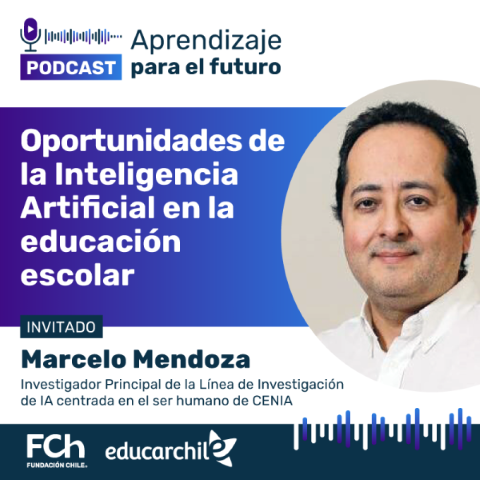 Podcast: Learning for the Future; Opportunities of Artificial Intelligence in School Education Year of publication: 2024 Author: Marcelo Mendoza Corporate author: Chile Foundation | Educarchile In this edition of the podcast: Learning for the Future, we spoke with Marcelo Mendoza, Principal Investigator of the Human-Centered AI Research Line at CENIA, with whom we developed the topic: Opportunities for Artificial Intelligence in school education. We also learned about the experience of the Bicentennial People Help People High School in Pilmaiquén using AI in various processes, together with teacher Cristóbal Morales. Podcast: Aprendizaje para el futuro; Oportunidades de la Inteligencia Artificial en la educación escolar Year of publication: 2024 Author: Marcelo Mendoza Corporate author: Chile Foundation | Educarchile En esta edición del podcast: Aprendizaje para el Futuro, conversamos con Marcelo Mendoza, Investigador Principal de la Línea de Investigación de IA centrada en el ser humano de CENIA, con quien desarrollamos el tema: Oportunidades de la Inteligencia Artificial en la educación escolar. También, conocimos la experiencia del Liceo Bicentenario People Help People de Pilmaiquén usando la IA en diversos procesos, junto al docente Cristóbal Morales.
 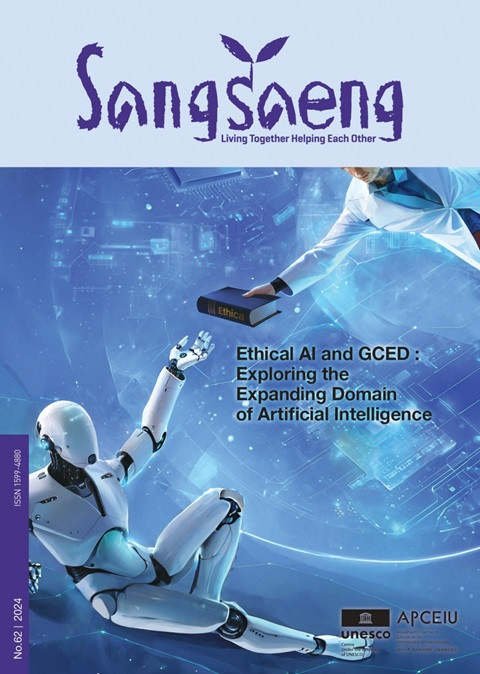 Ethical AI and GCED: Exploring the Expanding Domain of Artificial Intelligence (SangSaeng; No. 62, 2024) Year of publication: 2024 Corporate author: APCEIU The 62nd issue of SangSaeng has been published with the theme of “Ethical AI and GCED: Exploring the Expanding Domain of Artificial Intelligence.” AI has never been as pervasive and influential as it is in today’s rapidly changing world. Despite the convenience and cutting-edge technology AI has offered us, it has the potential to pose a threat to humanity. This is where ethics for AI should come forward. In this regard, this issue will lead readers to the alarming side of AI as well as its future developments, focusing on the importance of GCED and AI ethics in tackling any potential problems. Contents03 Editor's Note 04 Special ColumnEmbracing Change to Cultivate Success — Integrating Global Citizenship Education into Tertiary Education / Dendev Badarch 08 FOCUS: Ethical AI and GCED: Exploring the Expanding Domain of Artificial IntelligenceRole of Ethics in the Era of AI — Protecting and Guiding AI Processes for Humanity to Flourish / Emma Ruttkamp-BloemPaying Attention to AI Ethics — An Avenue for a New Competitive Edge in Business / Myoungshin KimDriving Innovative Education — Balancing Future Possibilities and Ethical Concerns: How GCED Can be Used to Address AI Issues / Angelique Southern 20 Special ReportEmpowering a Climate Generation — From Classrooms to Climate Frontlines: The Transformative Role of Education highlighted at COP28 / Djian Sadadou 22 Best PracticesNavigating an AI Future — Ethical AI and the Importance of Critical Thought / Hannah GrantGLACE Brings the World to a City — Empowering Youth as Global Citizens: Lessons from Navotas City’s Project GLAC / Marco D. MedurandaLowering Eco-Anxiety — Teaching Climate Change Through Media and Information Literacy / Laetitia Legrand 33 GCED YOUTH NETWORK New Wave of Youth Advocacy — Role of AI in Youth Advocacy and its Ethical Implications to Global Citizenship / Oshan M. Gunathilake and Diego Manrique 36 Understanding the Asia Pacific RegionDiscovering Auroville — Where Boundaries Fade, Nature Thrives, and Global Minds Unite / Akanksha Arya 39 Peace in My MemoryHappiness without Violence — Mindanao Peace ForumCelebrates Building a Culture of Peace / Ludivina Borja-DekitPeace Scholar Passes Away Amidst Turbulent Times / Kwang-Hyun KIM 45 Story TimeThe Right Footing — My Life Has Purpose Thanks to Football / Hajar Abulfazl 48 LetterShared Challenges of Global Citizens / Natsuki Nagata 50 APCEIU in Action
  Guía para el uso de IA generativa en educación e investigación Year of publication: 2023 Author: Fengchun Miao | Wayne Holmes Corporate author: UNESCO Esta guía apunta a apoyar la planificación de regulaciones, políticas y programas de desarrollo de capacidades humanas apropiados para garantizar que la lAGen se convierta en una herramienta que genuinamente beneficie y empodere a docentes, estudiantes e investigadores. Explica las técnicas de IA utilizadas por la lAGen y elabora una lista de modelos de GPT puestos a disposición del público, especialmente aquellos con licencias de código abierto. También abre un debate sobre el surgimiento de EdGPT: los modelos de lAGen entrenados con datos específicos para servir a fines educativos. Además, resume algunas de las controversias clave en torno a la lAGen, desde el empeoramiento de la pobreza digital a la homogeneización de opiniones, y desde los más profundos deepfakes a cuestiones de derechos de autor. Con base en una visión humanista, la guía sugiere pasos clave para la regulación de las herramientas de lAGen, que incluyen la obligación de proteger la privacidad de los datos y el establecimiento de un límite de edad para las conversaciones independientes con las plataformas de lAGen. Para guiar el uso adecuado de las herramientas en la educación y la investigación, esta guía propone un enfoque humano-agente y adecuado a la edad para los procesos de validación ética y diseño pedagógico. Orientations pour l’intelligence artificielle générative dans l’éducation et la recherche Year of publication: 2023 Author: Fengchun Miao | Wayne Holmes Corporate author: UNESCO Ces recommandations ont pour objectif de soutenir l'élaboration de réglementations, de politiques et de programmes visant à développer les capacités humaines, dans le but de garantir que l'intelligence artificielle générative (GenAI) devienne un outil qui profite réellement aux enseignants, aux apprenants et aux chercheurs et leur donne les moyens d'agir. Il explique les techniques d'IA utilisées par la GenAI et dresse une liste des modèles de GPT qui sont mis à la disposition auprès du public, en particulier ceux qui font l'objet d'une licence à source ouverte. Il ouvre également une discussion sur l'émergence de l'EdGPT - les modèles GenAI qui sont entraînés avec des données spécifiques pour se mettre au service des objectifs dans le domaine de l'éducation. En outre, il résume certaines des principales controverses formées autour de l'IA générative, de l'aggravation de la pauvreté numérique à l'homogénéisation des opinions, en passant par les trucages (deepfakes) et les questions liées aux droits d'auteur. Fondé sur une vision humaniste, le présent document propose des étapes-clefs pour la réglementation des outils de la GenAI, notamment en rendant obligatoire la protection de la confidentialité des données et en fixant une limite d'âge pour les conversations autonomes avec les plateformes de la GenAI. Pour accompagner l'utilisation pertinente des outils dans l'éducation et la recherche, ce guide propose une approche holistique et adaptée à tout âge pour les processus de validation éthique et de conception pédagogique. Руководство по использованию генеративного искусственного интеллекта в образовании и научных исследованиях Year of publication: 2023 Author: Fengchun Miao | Wayne Holmes Corporate author: UNESCO Данное руководство направлено на поддержку разработки соответствующих правил, политик и программ развития человеческого потенциала с целью обеспечения того, чтобы генеративный искусственный интеллект (ИИ) стал инструментом, действительно приносящим пользу и расширяющим возможности учителей, учащихся и исследова телей. В нем объясняются методы искусственного интеллекта, используемые в генеративном ИИ, а также приводится список моделей СРТ, которые становятся общедоступными, особенно модели с открытым исходным кодом. Руководство также открывает обсуждение о появлении ЕсІСРТ - моделей генеративного ИИ, обученных на конкретных данных для образовательных целей. Кроме того, в нем суммируются некоторые ключевые противоречия вокруг генеративного ИИ - от ухудшения цифрового неравенства до гомогенизации мнений, от более сложных дипфейков до вопросов авторского права. Исходя из гуманистического подхода, руководство предлагает ключевые шаги по регулированию инструментов генеративного ИИ, включая обязательную защиту конфиденциальности данных и установку возрастных ограничений для самостоятельного взаимодействия с платформами генеративного ИИ. Для обеспечения правильного использования инструментов в сфере образования и исследований, в руководстве затронуты вопросы этики и проектирования педагогического процесса и заложен подход, ориентированный на человека и учитывающий возрастные особенности.