
Resources
Explore a wide range of valuable resources on GCED to deepen your understanding and enhance your research, advocacy, teaching, and learning.
15 Results found
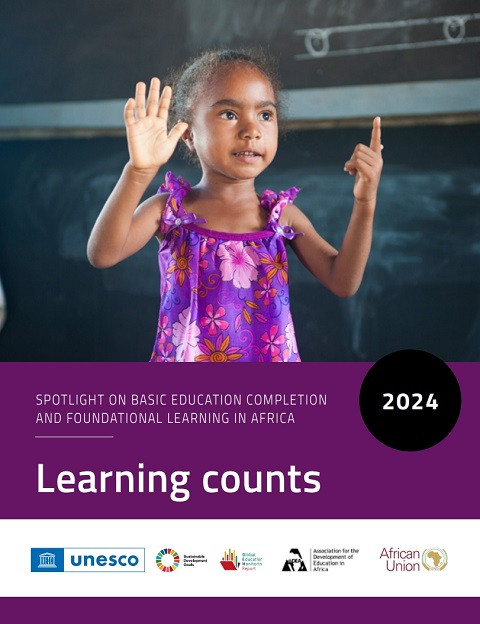 Learning Counts: Spotlight on Basic Education Completion and Foundational Learning in Africa, 2024 Year of publication: 2024 Corporate author: Global Education Monitoring Report Team | Association for the Development of Education in Africa (ADEA) | African Union The African Union’s designation of 2024 as the Year of Education highlights the critical importance of education for equipping young Africans with the skills essential for their own and for the continent’s development. It is also a recognition of the multiple challenges ahead before every child can complete primary school having acquire the foundational skills that open the door for lifelong learning. Currently the out-of-school population is rising, one in five children do not complete primary school and, of those who do, only about one in five achieve minimum proficiency in reading and mathematics. African countries have set targets on primary completion and foundational learning but to effectively translate their ambitions into results, the 2024 Spotlight continental report emphasizes the importance of coherence between their curricula, textbooks, teacher guides and assessments. It evaluates the alignment of these policy documents with each other but also with a global standard of what students are expected to know and by when. It also assesses how these key documents are used in classrooms and what the implications are for children’s opportunities to learn. This report is the second in a series of three envisaged between 2022 and 2025, each covering some 12 countries of which a selection is examined in depth, in dialogue with education ministries and national stakeholders. The focus countries for this second Spotlight report cycle were Mauritania, Niger, South Africa, Uganda, and Zambia. The statistics and analysis presented in this publication aim to feed into the policy dialogue mechanism under the auspices of the African Union and its Continental Education Strategy for Africa. In particular, the Spotlight series aims to spark debate on foundational learning among African countries and encourage them to identify areas for joined action, given that they share a lot of policy challenges.
  Assessment for Advocacy to Transform Communities, Programmes and Policies in the Global South Year of publication: 2024 Corporate author: UNESCO | Global Education Monitoring Report Team | PAL Network This paper was commissioned by the Global Education Monitoring Report as background information to assist in drafting the 2024 Spotlight Report on basic education completion and foundational learning in Africa. It has not been edited by the team. The views and opinions expressed in this paper are those of the author(s) and should not be attributed to the Global Education Monitoring Report or to UNESCO. The papers can be cited with the following reference: “Paper commissioned for the 2024 Spotlight Report on basic education completion and foundational learning in Africa”.
  Save the Children's Education Strategic Direction, 2016-2018 Year of publication: 2016 Corporate author: Save the Children This presentation outlines the overall 2016-2018 strategic direction for Save the Children’s education work. This is an articulation of the role education will play in delivering Save the Children’s global strategy and achieving our breakthroughs. The strategic direction is the product of the strategy development work that has taken place over the last 18 months and which many people across the organisation have fed into. The strategic direction provides a framework to guide all Save the Children’s education work and should be adapted to meet the specific needs of different countries and contexts.
  中国少数民族基础教育政策研究报告 Year of publication: 2010 Corporate author: UNESCO Beijing 本报告是在“提高少数民族群体的受教育程度及文化上敏感的教育”的框架下是实地调查少数民族基础教育政策研究实施情况。2010年,根据对中国政府制定、实施的少数民族基础教育政策文本分析报告,确定实地调研的目标和任务,对三个项目省十二个个案点调研报告。通过田野调查和问卷调查,六个调研组完成十二个个案点调研报告。基于十二个个案调研报告内容形成本报告,并在此基础上提出改进建议和下一步的行动计划。 Research Report on Basic Education Policies for Ethnic Minorities in China Year of publication: 2010 Corporate author: UNESCO Beijing This report is a survey of the implementation of basic education policy research towards ethnic minority in the framework of "Improving the educational level and culturally sensitive education of ethnic minority groups". In 2010, based on the text analysis report of the basic education policy which has been formulated and implemented for ethnic minorities by the Chinese government, the objectives and tasks of the field research were determined. The field research was conducted on the twelve project sites of three provinces. Through field investigations and questonnaire surveys, six research groups completed twelve case study reports. Based on the contents of the 12-case research report, this report is formed and then proposes suggestions for improving and the next action plan.
  The Contribution of the New Mexican Culture to Education for World Citizenship(Sinéctica, Revista electrónica de educación; no. 60) Year of publication: 2023 Author: Gloria Esther Briceño Alcaraz Corporate author: Sinéctica, Revista Electrónica de Educación A couple of years ago, UNESCO suggested transforming educational models based on an in-tegral and humanist paradigm in order to train new generations with a social and civic di-mension, based on human rights. In this essay we propose to analyze the work of education as a preferential instrument not only to develop traditional school skills, but also as an ac-tion to form citizens with a sense of responsibility and social self-awareness that promote a culture of peace. The citizen-subject represents an identity or discursive construction that is forged in the social framework in which it is situated, always in tension between individual freedom, autonomy and collective normative frameworks (Cerda, 2004), hence the interest in approaching from a critical perspective of discourse analysis (Van Dijk, 2014) to the pro-posal of the new educational model of Mexico called the New Mexican School (2022) and open the discussion on this pedagogical model and the formative fields that affect education for global citizenship. El aporte de la nueva cultura mexicana a la educación para la ciudadanía mundial(Sinéctica, Revista electrónica de educación; núm. 60) Year of publication: 2023 Author: Gloria Esther Briceño Alcaraz Corporate author: Sinéctica, Revista Electrónica de Educación La UNESCO sugirió hace un par de años transformar los modelos educativos con base en un paradigma integral y humanista a fin de formar a las nuevas generaciones con dimensión social y ciudadana, cuya base fueran los derechos humanos. En este ensayo nos planteamos analizar el quehacer de la educación como instrumento preferente no solo para desarrollar las capacidades escolares tradicionales, sino como acción formadora de ciudadanos con sentido de responsabilidad y autoconciencia social que promuevan una cultura de paz. El sujeto-ciudadano representa una construcción identitaria o discursiva que se va forjando en el entramado social en el que este se sitúa, siempre en tensión entre la libertad individual, la autonomía y los marcos normativos colectivos (Cerda, 2004), de ahí el interés en aproximarnos desde una perspectiva crítica del análisis del discurso (Van Dijk, 2014) a la propuesta de la llamada nueva escuela mexicana (2022) y abrir la discusión sobre este modelo pedagógico y los campos formativos que inciden en la educación para la ciudadanía mundial.
  Final Report: 2016 UNESCO/KOICA Joint Fellowship Programme Year of publication: 2016 Corporate author: APCEIU This report provides an overview of the activities carried out during the 2016 UNESCO/KOICA Joint Fellowship Programme held in Republic of Korea from 1 September - 31 October, 2016.In its 10th year of implementation, UNESCO/KOICA Joint Fellowship Programme 2016 invited 25 educators from 17 countries in Africa and the Asia-Pacific region for two months; from September 1st to October 31st. The overarching goal of the Programme was to enhance the capacities of participating educators under the themes of “Teacher Training for Basic Education,” “Use of ICT for Education (or e-Learning),” “Leadership in Global Education” and “Girls’ Education.” Composed of various segments such as lectures, workshops, hands-on activities, and seminars, which were closely interlinked with each module, the modules were designed to enable the participants to reorient their perspectives on educational development, to gain essential knowledge and skills, and furthermore to produce meaningful and relevant outputs that could be widely applied in their local contexts.For more information, please contact APCEIU's Office of Education and Training at ent@unescoapceiu.org. 2016 한-유네스코 펠로우십 프로그램 최종보고서 Year of publication: 2016 Corporate author: 유네스코 아시아태평양 국제이해교육원 본 보고서는 2016년 9월 1일부터 10월 31일까지 열린 ‘2016 한-유네스코 펠로우십 프로그램’에서이루어진 활동 내용과 성과물에 대한 요약을 담고 있다. 올해 10회를 맞이하는 본 프로그램에는 아시아태평양 및 아프리카 17개국 25명의 교육자들이 참가하였으며, 두 달간 기초교육, ICT교육(e-러닝), 세계시민교육 및 소녀교육의 4가지 주제영역에 대한 참가자들의 이해 증진과 역량강화를 위한 연수로 진행되었다. 이 보고서를 통해, 다양한 주제관련 강의, 워크숍, 현장학습활동, 교육자료 개발 프로젝트 등으로 이루어진 이 프로그램의 내용과 참가자들의 교육현장에서 의미 있게 적용될 수 있는 결과물과 실행계획 등 성과에 대한 내용을 살펴볼 수 있다. 문의: 유네스코 아태교육원 교육연수실(ent@unescoapceiu.org)
 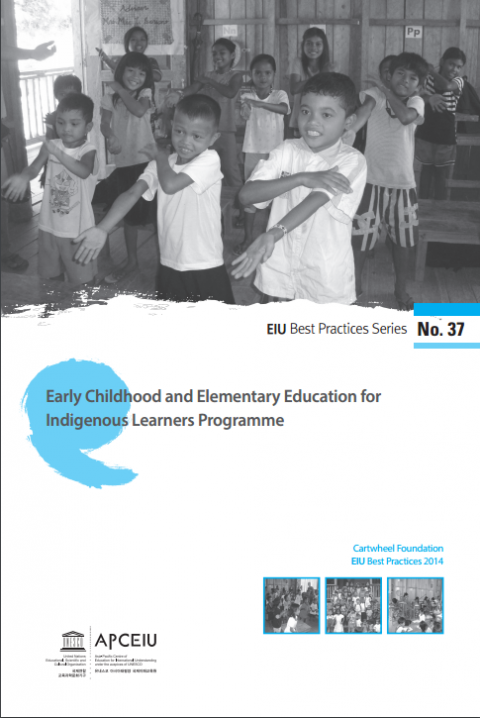 EIU Best Practices Series No. 37: Early Childhood and Elementary Education for Indigenous Learners Programme Year of publication: 2014 Author: Bricks Sabella Sintaon Corporate author: APCEIU This monograph is one of APCEIU's EIU Best Practices Series, which aims to encourage educators, scholars, and activists to implement and share local initiatives on EIU. The Series No.37 introduces the Early Childhood and Elementary Education (ECEE) for Indigenous Learners Programme initiated in the Philippines. The indigenous peoples (IP) reside in the mountainous regions, away from basic social services and struggling with poverty, malnutrition, and lack of proper education. The aim of ECEE is to facilitate access to quality and culturally-relevant early childhood and elementary education for the Higaonon indigenous children. To achieve this, activities such as curriculum indigenization and teacher training are provided in collaboration with the community members. As the program creates learning process for all through openness, sharing, and collaboration, this is an exemplary case of EIU/GCED pedagogical approach.