
Resources
Explore a wide range of valuable resources on GCED to deepen your understanding and enhance your research, advocacy, teaching, and learning.
46 Results found
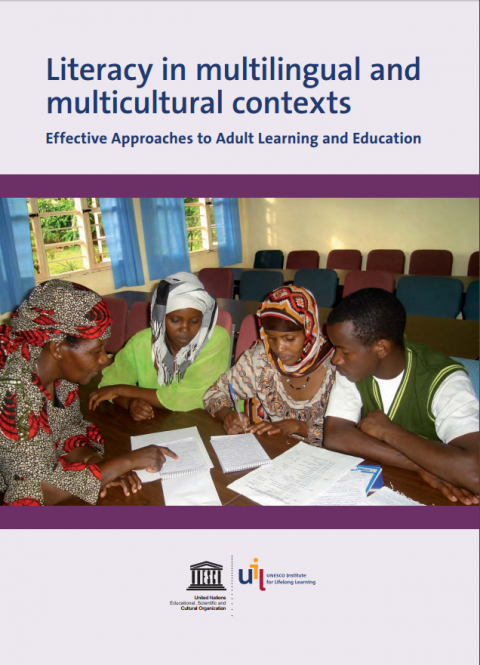 Literacy in multilingual and multicultural contexts: effective approaches to adult learning and education Year of publication: 2016 Author: Ulrike Hanemann, Cassandra Scarpino All of the literacy programmes featured in this publication offer valuable experiences and lessons on how the challenges posed by linguistic and cultural diversity can be productively addressed by harnessing the potential of language and culture as enriching resources in the process of literacy teaching and learning. A major lesson that has emerged over the years is that the use of local languages as the medium of instruction enhances the effectiveness and efficiency of the learning process in developing literacy, numeracy and (second or more) language skills. However, mother tongue-based literacy not only facilitates the learning process, but is also an important symbol of identity, unity and self-determination. It is closely intertwined with culture and local values, wisdom, worldviews and tradition. A number of the featured programmes demonstrate that language and culture in education are highly political. Respect for all languages and cultures, and their equal treatment, can play a critical role in fostering national cohesion. In some cases, this is contributing to rebuilding peace in post-conflict communities. Literacy programmes that contribute to the preservation of linguistic and cultural diversity should, also, be viewed as integral to sustainable development.
  Languages in adult literacy: policies and practices during the 15 years of EFA (2000-2015) Year of publication: 2015 Author: Clinton Robinson Linguistic diversity characterises many countries with large literacy needs. Meeting these needs will require a multilingual approach based on learning initial literacy in the learner’s mother tongue, with other languages used subsequently. This paper identifies five major challenges in implementing multilingual programmes, and traces the international policy developments over the 15 years of the EFA period. Four case studies – Mexico, Morocco, Papua New Guinea and Senegal – illustrate a range of policies, showing differing approaches and levels of commitment in providing literacy acquisition based on the mother tongue. The paper concludes with six policy orientations to guide action as part of the post- 2015 agenda.
 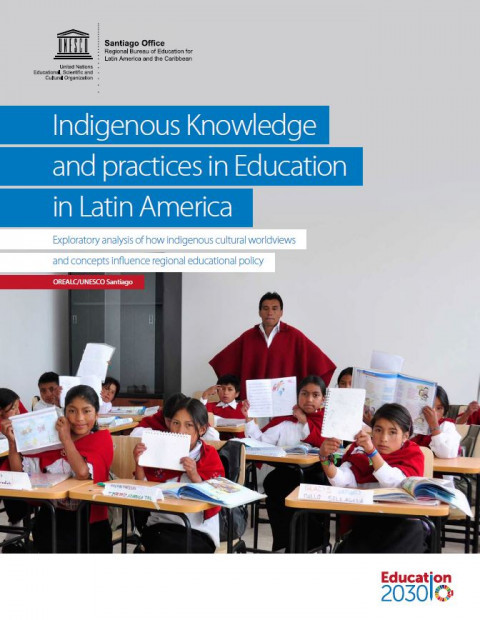 Indigenous Knowledge and practices in Education in Latin America: Exploratory Analysis of How Indigenous Cultural Worldviews and Concepts Influence Regional Educational Policy Year of publication: 2017 Corporate author: UNESCO Santiago This study presents a preliminary exploration of the approaches, processes and tools through which indigenous worldviews and concepts of knowledge and well-being can and have influenced education policies in Latin America. First, it addresses the principal theoretical approaches used in the area of indigenous knowledge and education policies, taking into account the persistence of an “epistemic otherness” and the need for a dialogue between the predominant approaches. Second, it addresses the normative framework and intercultural educational policies, emphasizing how and to what extent the countries in the region take indigenous knowledge into consideration and include it in their education policies and practices. Third, it presents a number of “relevant practices” in terms of dialogue with indigenous knowledge in education policies, taking into account the factors that favour the relevance of education to indigenous views and cultural practices, facilitating their replicability and sustainability. Furthermore, these practices respond to key criteria like recognizing learners as ‘carriers’ and producers of culture, valuing the use of schools as centres of social and cultural activities and favouring the inclusive learning of indigenous and non-indigenous students. Finally, the study unveils challenges for the advancement of the dialogue between indigenous knowledge and education policies, at the same time proposing key concepts to be approached in depth. Conocimiento Indígena y Políticas Educativas en América Latina: Análisis exploratorio de cómo las cosmovisiones y conceptos culturales indígenas de conocimiento inciden, y pueden incidir, en la política educativa en la región Year of publication: 2017 Corporate author: UNESCO Santiago El presente estudio explora la idea de una ‘alternativa epistémica’, construyendo desde el conocimiento y los valores que sustentan las prácticas sociales y educacionales indígenas de la región. En particular, explora cómo estos valores y formas de conocimiento han sido adoptados en las políticas educacionales de tres países de la región andina: Bolivia, Ecuador y Perú, que hace poco atravesaron reformas políticas y constitucionales con el fin de reconocer la composición de sus poblaciones multiculturales, multiétnicas y multilingüísticas. Esta publicación es una invitación a considerar el conocimiento indígena como una fuente legítima de inspiración para las políticas educacionales que puedan contribuir al bienestar de todos y a la sostenibilidad del planeta.
  Building Intercultural Citizenship through Education: A Human Rights Approach Year of publication: 2008 Author: Rodolfo Stavenhagen This article analyses the challenges posed by traditional ethnic and linguistic minorities in multicultural states and more specifically the problems faced by indigenous peoples and communities. Their educational and cultural needs and demands are increasingly being framed in the language of human rights, based on the expanding international legal and institutional human rights system. The United Nations World Conference on Human Rights, held in Vienna in 1993, endorsed a rights-based approach to development, human rights education is a growing field in educational practice, respect for cultural diversity is now enshrined in international and domestic laws, and the right of every person to education and to culture has become a mainstay of international human rights principles to which a majority of the world's states has subscribed.
  Toolbox in Education for Peace Year of publication: 2013 Author: Luz Marfa Chapela Corporate author: UNESCO Mexico The components of this box form a system in which each element has its own ends and all the elements, gathered and linked, seek the same shared goal: offer recreational materials that encourage introspective reflection, the best knowledge of the other and the environment, the collaborative study, the participation of different agents of the community in support of teachers, the use of mother tongues and the identification of resources, knowledge, talents and skills in local communities. This box is addressed in a special way to teachers and students of basic education, as well as to different agents of the civil society that support them. Its purpose is to favor the development of school communities that make the school a center of study, play, advice and work for all. Because the materials of the Toolbox can also be interesting to young people and adults of all ages. In this sense, the box invites the different agents of the communities to think and produce new playful-educational materials that collect and put into action some priority local contents, which, surely, will enrich the life and educational possibilities of school communities. Caja de Herramientas en Educación para la Paz Year of publication: 2013 Author: Luz Marfa Chapela Corporate author: UNESCO Mexico Los componentes de esta caja forman un sistema en el que cada elemento tiene sus propios fines y todos los elementos, reunidos y vinculados, buscan un mismo fin compartido: ofrecer materiales lúdicoeducativos que propicien la reflexión introspectiva, el mejor conocimiento del otro y del entorno, el estudio colaborativo, la participación de distintos agentes de la comunidad en apoyo a los maestros, el uso de las lenguas maternas y la identificación de recursos, saberes, talentos y habilidades en las comunidades locales. Esta caja se dirige de manera especial a maestros y estudiantes de educación básica, así como a distintos agentes de la sociedad civil que los apoyan. Tiene entre sus propósitos favorecer el desarrollo de comunidades escolares que hagan de la escuela un centro de estudio, juego, asesoría y trabajo para todos. Porque los materiales de la Caja de Herramientas también pueden resultar interesantes a jóvenes y adultos de todas las edades. En este sentido, la caja invita a los distintos agentes de las comunidades a pensar y producir nuevos materiales lúdico-educativos que recojan y pongan en acción algunos contenidos locales prioritarios, mismos que, seguramente, enriquecerán la vida y las posibilidades educativas de las comunidades escolares.
 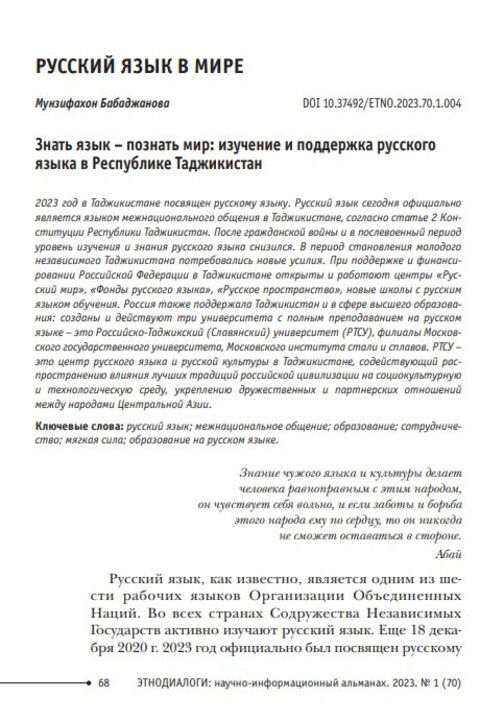 Knowing a Language Is Knowing the World: Learning and Supporting the Russian Language in the Republic of Tajikistan (Ethnodialogues; No.1, 2023) Year of publication: 2023 Author: Мунзифахон Бабаджанова The year 2023 in Tajikistan is dedicated to the Russian language. The Russian language today is officially the language of interethnic communication in Tajikistan. With the support and funding of the Russian Federation, “Russian World”, “Russian Language Foundations”, “Russian Space” centers and new Russian language schools were opened and now operate in Tajikistan. Russia has also supported Tajikistan in higher education: three universities with full Russian-language instruction have been established and are operating. Знать язык - познать мир: изучение и поддержка русского языка в республике Таджикистан (Этнодиалоги; No.1, 2023) Year of publication: 2023 Author: Мунзифахон Бабаджанова 2023 год в Таджикистане посвящен русскому языку. Русский язык сегодня официально является языком межнационального общения в Таджикистане. При поддержке и финансировании Российской Федерации в Таджикистане открыты и работают центры «Русский мир», «Фонды русского языка», «Русское пространство», новые школы с русским языком обучения. Россия также поддержала Таджикистан и в сфере высшего образования: созданы и действуют три университета с полным преподаванием на русском языке.
 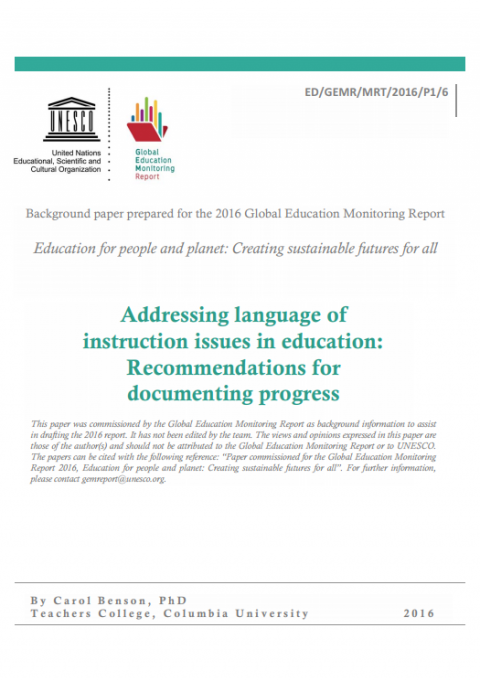 Addressing language of instruction issues in education: recommendations for documenting progress Year of publication: 2016 Author: Carol Benson Corporate author: Columbia University (USA). Teachers College This paper offers evidence-based recommendations for documenting international progress towards addressing language issues in education. The focus is on adapting the school language(s) of instruction to the home language(s) of learners. The paper begins by defining terms like L1 and explaining the concepts underlying multilingual education (MLE). Next there is a discussion of how to capture relevant linguistic and educational information from policy documents and linguistic sources, with examples from lowincome countries. This is followed by a set of questions that can and should be asked of any program to evaluate progress in addressing instructional language issues, focusing on the approach/methodology, teacher languages and skills, learner assessment, and program management, monitoring and evaluation. The paper concludes with some possible global indicators and suggestions for further research.