
Resources
Explore a wide range of valuable resources on GCED to deepen your understanding and enhance your research, advocacy, teaching, and learning.
46 Results found
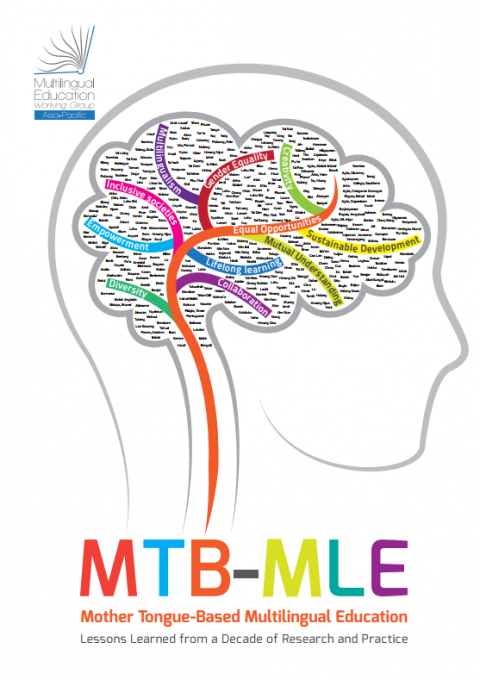 MTB-MLE: mother tongue-based multilingual education;lessons learned from a decade of research and practice Year of publication: 2014 Corporate author: Asia Multilingual Education Working Group This information is based on presentations and discussions at the 4th International Conference on Language and Education, ‘Multilingual Education for All in Asia and the Pacific: Policies, Practices and Processes’, held in Bangkok, Thailand in November 2013.
 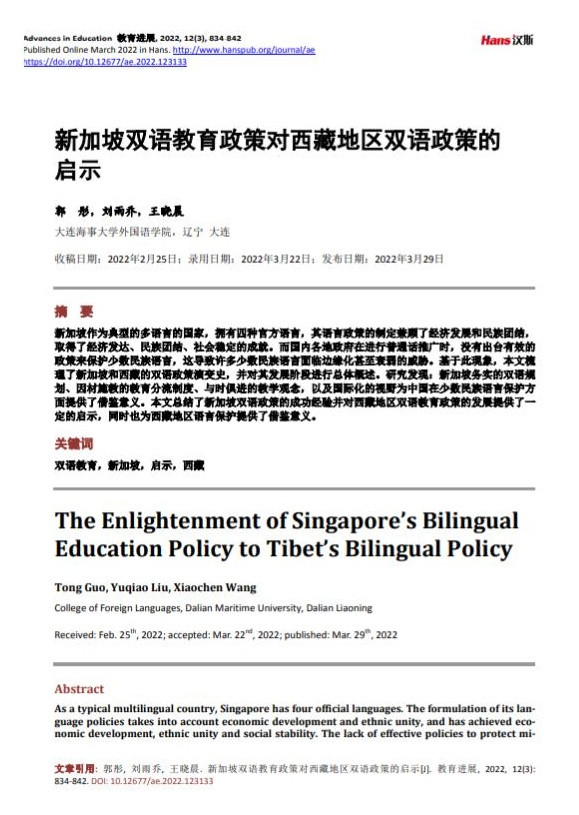 The Enlightenment of Singapore’s Bilingual Education Policy to Tibet’s Bilingual Policy Year of publication: 2022 Author: 郭彤 | 刘雨乔 | 王晓晨 This article introduces the history of Singapore's bilingual education policy and uses it as a basis to explore the implications for Tibetan bilingual education policy. 新加坡双语教育政策对西藏地区双语政策的启示 Year of publication: 2022 Author: 郭彤 | 刘雨乔 | 王晓晨 本文介绍了新加坡双语教育政策的发展历史,并以此为基础探讨对西藏双语教育政策启示和借鉴意义。
  Alternative bilingual Miskito-Spanish intercultural literacy education linked to the exercise of citizenship and community production Year of publication: 2008 Corporate author: Regional Literacy and CONFINTEA VI Preparatory Conference in Latin America and the Caribbean: From Literacy to Lifelong Learning: Towards the Challenges of the 21st Century, Mexico City, 2008 The Alternative Bilingual Intercultural Literacy Education project is carried out in five rural indigenous communities and eleven urban neighbourhoods of Bilwi (Puerto Cabezas) in the North Atlantic Autonomous Region (RAAN) of Nicaragua. In this region, illiteracy is the result of poverty, historical social exclusion and the lack of any official or State programme of adult literacy education in the Miskito language. This constitutes a negation of the right to bilingual intercultural education of the young and adult indigenous population and an obstacle to individual, social and regional development. The project provides literacy classes for young people and adults in their mother tongue Miskito and in Spanish, and deals with intercultural themes of their world view, the environment and indigenous rights. In Nicaragua, this experiment is a unique and alternative model of literacy provision in Miskito, with a Miskito-Spanish bilingual intercultural curriculum of its own. The texts have been produced by authors from the Miskito ethnic group, with contents determined on the basis of a needs analysis and the identification of fundamental features of the Miskito world view. Éducation Interculturelle bilingue Miskito-Espagnol liée à l'exercice de la citoyenneté et de la communauté production Year of publication: 2008 Corporate author: Regional Literacy and CONFINTEA VI Preparatory Conference in Latin America and the Caribbean: From Literacy to Lifelong Learning: Towards the Challenges of the 21st Century, Mexico City, 2008 Le projet de l'éducation interculturelle bilingue est réalisée dans cinq communautés autochtones rurales et onze quartiers urbains de Bilwi (Puerto Cabezas) dans la région de l'Atlantique Nord autonome (RAAN) du Nicaragua. Dans cette région, l'analphabétisme est le résultat de la pauvreté, l'exclusion sociale historique et l'absence de tout programme officiel ou de l'Etat de l'alphabétisation des adultes dans la langue Miskito. Ceci constitue une négation du droit à l'éducation interculturelle bilingue des jeunes et des adultes population indigène et un obstacle au développement individuel, social et régional. Le projet offre des cours d'alphabétisation pour les jeunes et les adultes dans leur Miskito langue maternelle et en espagnol, et traite des thèmes interculturels de leur vision du monde, l'environnement et les droits des autochtones. Au Nicaragua, cette expérience est un modèle unique et alternatif de la prestation de l'alphabétisation en Miskito, avec un bilingue Miskito-espagnol curriculum interculturel propre. Les textes ont été rédigés par des auteurs du groupe ethnique Miskito, avec des contenus déterminés sur la base d'une analyse des besoins et l'identification des caractéristiques fondamentales de la vision du monde Miskito. Global Citizenship and Lingual Identity: The Ability to Perform in Different Lingual Settings Year of publication: 2011 Author: Ann-Christin Torpsten Corporate author: SAGE Publications The aim of this article is to interpret second-language pupils’ encounter with the Swedish school regarding first- and second-language learning. An empirical context called experienced learning is investigated by interpreting student teachers’ oral and written narrated learning memories. Using a life-story approach, the interpretation focuses on lingual skills, lingual identity and citizenship. The study looks at participation in Swedish as a second language and mother tongue education when the subjects encountered the Swedish school system. Participating in those lessons is described as positive. Participating made it easier to improve skills in the second language and mother tongue. Mother tongue skills were transferred to the second-language improvement. It became much easier to continue developing the second language when skills in the mother tongue increased. Language skills were positive for continued learning, linguistic development, development of bilingualism and multilingualism. Through widened linguistic horizons it becomes possible to develop identity as multilingual persons. When skills increase in different languages such as Swedish as a second language and mother tongue, the subjects become aware of their identities as multilingual persons. They become aware of their possibilities of being active, multicultural, global citizens. Their ability to perform in different lingual settings becomes visible. Citoyenneté mondiale et Identité linguale : la capacité d'exécuter dans différents contextes linguales Year of publication: 2011 Author: Ann-Christin Torpsten Corporate author: SAGE Publications Le but de cet article est d'interpréter la rencontre des élèves de langue seconde à l'école suédoise au sujet de première et de l'apprentissage de la langue seconde. Un contexte empirique appelé apprentissage expérimenté est étudié en interprétant des souvenirs d'apprentissage orales et écrites narrés des enseignants aux étudiants. En utilisant une approche histoire de vie, l'interprétation se concentre sur les compétences linguales, l'identité et la citoyenneté lingual. L'étude se penche sur la participation en suédois comme langue seconde et éducation en langue maternelle lorsque les sujets ont rencontré le système scolaire suédois. La participation à ces leçons est décrit comme positif. La participation a rendu plus facile d'améliorer les compétences dans la langue seconde et langue maternelle. Compétences en langue maternelle ont été transférés à l'amélioration de la langue seconde. Il est devenu beaucoup plus facile de continuer à développer la deuxième langue lorsque les compétences dans la langue maternelle ont augmenté. Les compétences linguistiques ont été positifs pour l'apprentissage continu, le développement linguistique, le développement du bilinguisme et le multilinguisme. A travers élargi les horizons linguistiques, il devient possible de développer une identité en tant que personnes multilingues. Lorsque les compétences augmentent dans différentes langues comme le suédois comme langue seconde et la langue maternelle, les sujets prennent conscience de leur identité en tant que personnes multilingues. Ils prennent conscience de leurs possibilités d'être multiculturelles, des citoyens actifs. Leur capacité à effectuer dans différents contextes linguales devient visible. Intercultural Multilingual Education in Latin America: Mexico, Guatemala, Colombia, Brazil, Ecuador, Peru, Bolivia and Paraguay, and Norway Year of publication: 2011 Corporate author: Internacional de la Educación para Latinoamerica This document deals with Intercultural Bilingual Education (IBE), its current status and the concepts and processes driving it today – and in a certain way the conflicts encompassing it. It contains information on Mexico, Guatemala, Colombia, Brazil, Ecuador, Peru, Bolivia and Paraguay, and includes some data and comments on Norway. Certainly all Latin America is involved in the topic, one way or another, but for now this is the geographical scope of the paper. It seeks to give an overview of the whole and profile a few specific aspects by country. Educación Multilingüe e Intercultural en América Latina: México, Guatemala, Colombia, Brazil, Ecuador, Perú, Bolivia y Paraguay y Noruega Year of publication: 2011 Corporate author: Internacional de la Educación para Latinoamerica This document deals with Intercultural Bilingual Education (IBE), its current status and the concepts and processes driving it today – and in a certain way the conflicts encompassing it. It contains information on Mexico, Guatemala, Colombia, Brazil, Ecuador, Peru, Bolivia and Paraguay, and includes some data and comments on Norway. Certainly all Latin America is involved in the topic, one way or another, but for now this is the geographical scope of the paper. It seeks to give an overview of the whole and profile a few specific aspects by country. Multilingue et éducation interculturelle en Amérique latine: le Mexique, le Guatemala, la Colombie, le Brésil, l'Équateur, le Pérou, la Bolivie et le Paraguay et la Norvège Year of publication: 2011 Corporate author: Internacional de la Educación para Latinoamerica Ce document traite de l'éducation interculturelle bilingue (BIE), son état actuel et les concepts et les processus de conduite aujourd'hui - et d'une certaine manière les conflits englobant elle. Il contient des informations sur le Mexique, le Guatemala, la Colombie, le Brésil, l'Équateur, le Pérou, la Bolivie et le Paraguay, et comprend quelques infomations et commentaires sur la Norvège. Certes, toute l'Amérique Latine est impliqué dans le sujet, d'une façon ou d'une autre, mais pour l'instant c'est la portée géographique du papier. Il vise à donner un aperçu de l'ensemble et le profil de quelques aspects spécifiques par pays.