
Resources
Explore a wide range of valuable resources on GCED to deepen your understanding and enhance your research, advocacy, teaching, and learning.
12 Results found
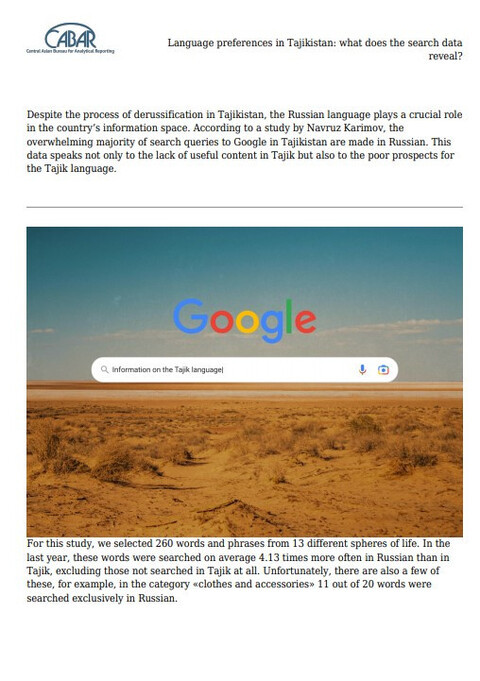 Language Preferences in Tajikistan: What Does the Search Data Reveal? Year of publication: 2023 Author: Navruz Karimov Corporate author: Central Asian Bureau for Analytical Reporting (CABAR) Despite the process of derussification in Tajikistan, the Russian language plays a crucial role in the country’s information space. According to a study by Navruz Karimov, the overwhelming majority of search queries to Google in Tajikistan are made in Russian. This data speaks not only to the lack of useful content in Tajik but also to the poor prospects for the Tajik language. Языковые предпочтения в Таджикистане: что говорят данные поисковых запросов? Year of publication: 2023 Author: Navruz Karimov Corporate author: Central Asian Bureau for Analytical Reporting (CABAR) Несмотря на процесс дерусификации в Таджикистане, русский язык продолжает играть ключевую роль в информационном пространстве страны. Согласно исследованию Навруза Каримова, подавляющее большинство поисковых запросов к Google в Таджикистане делается на русском языке. Эти данные говорят не только об отсутствии полезного контента на таджикском языке, но и о плохих перспективах таджикского языка.
  Knowing a Language Is Knowing the World: Learning and Supporting the Russian Language in the Republic of Tajikistan (Ethnodialogues; No.1, 2023) Year of publication: 2023 Author: Мунзифахон Бабаджанова The year 2023 in Tajikistan is dedicated to the Russian language. The Russian language today is officially the language of interethnic communication in Tajikistan. With the support and funding of the Russian Federation, “Russian World”, “Russian Language Foundations”, “Russian Space” centers and new Russian language schools were opened and now operate in Tajikistan. Russia has also supported Tajikistan in higher education: three universities with full Russian-language instruction have been established and are operating. Знать язык - познать мир: изучение и поддержка русского языка в республике Таджикистан (Этнодиалоги; No.1, 2023) Year of publication: 2023 Author: Мунзифахон Бабаджанова 2023 год в Таджикистане посвящен русскому языку. Русский язык сегодня официально является языком межнационального общения в Таджикистане. При поддержке и финансировании Российской Федерации в Таджикистане открыты и работают центры «Русский мир», «Фонды русского языка», «Русское пространство», новые школы с русским языком обучения. Россия также поддержала Таджикистан и в сфере высшего образования: созданы и действуют три университета с полным преподаванием на русском языке.
  Русский язык в Центрально-Азиатском регионе Year of publication: 2014 Author: Ksenia .P. Borishpolets Статья посвящена роли русского языка в Центральной Азии и перспективам развития его ресурсов в контексте евразийских интеграционных процессов. The Russian Language in the Central Asian Region Year of publication: 2014 Author: Ksenia .P. Borishpolets This article focuses on the role of the Russian language in Central Asia and The Russian language has been used in Central Asia for a long time now.
  Bilingual and Intercultural Border Schools Project: A Cross-Border and Integrative Project in the Iberian Peninsula(Revista iberoamericana de educación; vol. 93, no. 1) Year of publication: 2023 Author: María Matesanz del Barrio | Maria Helena Araújo e Sá | Vivianne Ferreira Martins Corporate author: Revista Iberoamericana de Educación The Bilingual and Intercultural Border Schools Project / Projecto de Escuelas Bilingües e Interculturales de Frontera (PEBIF) is a proposal that seeks to promote inter-cultural education supported by the bi-/multilingualism and intercomprehension. The general objective of the project is to promote cooperation between Spain and Portugal in the educational, social and economic development of the border territories through the creation of a network of schools that pro-vides the populations knowledge and skills associated with bilingualism and interculturality relevant to citizenship, continuation of studies and employability in both countries. This article presents the PEBIF project, both its structuring theoretical principles and the implementation carried out, as well as the most relevant results obtained so far. Proyecto escuelas bilingües e interculturales de frontera (PEBIF): Un proyecto transfronterizo e integrador en la Península Ibérica (Revista iberoamericana de educación; vol. 93, núm. 1) Year of publication: 2023 Author: María Matesanz del Barrio | Maria Helena Araújo e Sá | Vivianne Ferreira Martins Corporate author: Revista Iberoamericana de Educación El Proyecto Escuelas Bilingües e interculturales de Frontera/ Projeto Escolas Bilingues e Interculturais de Fronteira (PEBIF) es una propuesta que busca una educación intercultural apoyada en el bi-/plu-rilingüismo y la intercomprensión. El objetivo general del proyecto es promover la cooperación entre España y Portugal en el desarrollo educativo, social y económico de los territorios de frontera a través de la creación de una red de escuelas que proporcione a las poblaciones conocimientos y habilidades asociadas al bilingüismo y la interculturalidad relevantes para la ciudadanía, la continuación de los estudios y la empleabilidad en ambos países. En este artículo se presenta el proyecto PEBIF, tantos sus principios teóricos estructurantes como la implementación realizada, así como los resultados más relevantes obtenidos hasta ahora.
 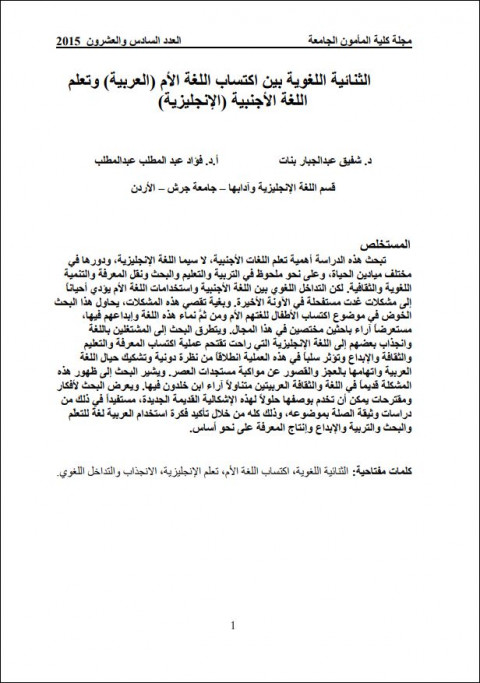 الثنائية اللغوية بين اكتساب اللغة الأم (العربية) وتعلم اللغة الأجنبية (الإنجليزية) Year of publication: 2015 Author: Fuad Abdul Muttalib | Shafeeq Banat Corporate author: AlMamon University College تبحث هذه الدراسة أهمية تعلم اللغات الأجنبية، لا سيما اللغة الإنجليزية، ودورها في مختلف ميادين الحياة، وعلى نحو ملحوظ في التربية والتعليم والبحث ونقل المعرفة والتنمية اللغوية والثقافية. لكن التداخل اللغوي بين اللغة الأجنبية واستخدامات اللغة الأم يؤدي أحياناً إلى مشكلات غدت مستفحلة في الآونة الأخيرة. وبغية تقصي هذه المشكلات، يحاول هذا البحث الخوض في موضوع اكتساب الأطفال للغتهم الأم ومن ثمَّ نماء هذه اللغة وإبداعهم فيها، مستعرضاً آراء باحثين مختصين في هذا المجال.ويتطرق البحث إلى المشتغلين باللغة وانجذاب بعضهم إلى اللغة الإنجليزية التي راحت تقتحم عملية اكتساب المعرفة والتعليم والثقافة والإبداع وتؤثر سلباً في هذه العملية انطلاقاً من نظرة دونية وتشكيك حيال اللغة العربية واتهامها بالعجز والقصور عن مواكبة مستجدات العصر. ويشير البحث إلى ظهور هذه المشكلة قديماً في اللغة والثقافة العربيتين متناولاً آراء ابن خلدون فيها. ويعرض البحث لأفكار ومقترحات يمكن أن تخدم بوصفها حلولاً لهذه الإشكالية القديمة الجديدة، مستفيداً في ذلك من دراسات وثيقة الصلة بموضوعه، وذلك كله من خلال تأكيد فكرة استخدام العربية لغةً للتعلّم والبحث والتربية والإبداع وإنتاج المعرفة على نحوٍ أساس. Bilingualism Between Mother Tongue (Arabic) Acquisition and Foreign Language (English) Learning Year of publication: 2015 Author: Fuad Abdul Muttalib | Shafeeq Banat Corporate author: AlMamon University College This research work considers the importance of learning of foreign languages, especially English, and their role in education, research, knowledge transfer, language and cultural growth. Language overlapping, between English and Arabic, leads sometimes to acute problems. To approach these problems, the work tries to discuss the acquisition of children of their mother tongue, its expansion and its use creatively in different disciplines.The work tackles the attraction of English to some experts in their fields, the thing that drives them to look suspiciously and down at Arabic accusing it of incompetence to catch up with new changes. Since language overlapping is an old problem, this has entailed a reference to Iben Khaldoun’s diagnosis of it with commentary. The work asserts eventually the essential use of Arabic as a language of education, research, culture and knowledge production, without neglecting foreign languages learning, above all English. The work is carried out in the light of the available studies on this issue.