
Resources
Explore a wide range of valuable resources on GCED to deepen your understanding and enhance your research, advocacy, teaching, and learning.
49 Results found
 El Bullying Homofobico y Transfobico en los Centros Educativos: Taller de Sensibilizacion para su Prevencion; Guía de facilitación Year of publication: 2015 Author: María C. Arango-Restrepo | José Angel Aguilar-Gil | Esther Corona-Vargas Corporate author: UNESCO Santiago Este manual práctico se presenta como una estrategia de apoyo a docentes y autoridades educativas con el objetivo de abordar la violencia de carácter homofóbico y transfóbico desde un enfoque de derechos humanos. A través de una serie de lecciones conformadas de conceptos, actividades y reflexiones, se busca hacer énfasis en la importancia de visibilizar y respetar la diversidad sexual mediante la adquisición de conocimientos, procesos de sensibilización y el fortalecimiento de competencias que necesitan los y las docentes para superar los estigmas y prejuicios.
  School-related violence and bullying on the basis of Sexual Orientation and Gender Identity or Expression (SOGIE) - Synthesis Report on China, the Philippines, Thailand and VietNam Year of publication: 2018 Corporate author: UNESCO Bangkok School related violence and bullying is a problem in all countries. UNESCO is committed to ensuring that all children and young people have access to safe, inclusive, health-promoting learning environments as part of its strategy on education for health and well-being. This synthesis report on school related violence and bullying on the basis of Sexual Orientation and Gender Identity or Expression (SOGIE), covering China, the Philippines, Thailand and Viet Nam, was developed to broaden awareness and understanding about this issue, while also identifying best practices and policies. It also aims to mobilize support for advocacy among educators, research institutions, policy makers and activists at the national and regional levels.
  Connet with respect: preventing-gender based violence in schools; classroom programme for students in early secondary school Year of publication: 2016 Corporate author: UNESCO Bangkok Students learn best in schools that provide safety and social support. However, some young people experience violence and harassment in, around, and on the way to school. This includes gender-based violence (GBV), which can take many different forms.As a teacher, you can play an important role in preventing the expression of gender-based violence in the school setting. Teachers, school principals and the broader education system can provide positive role models, empower children and youth to have healthy and respectful relationships, and deliver a violence prevention programme within their curriculum.This tool has been created to help schools in Asia and the Pacific to do all of these things.
 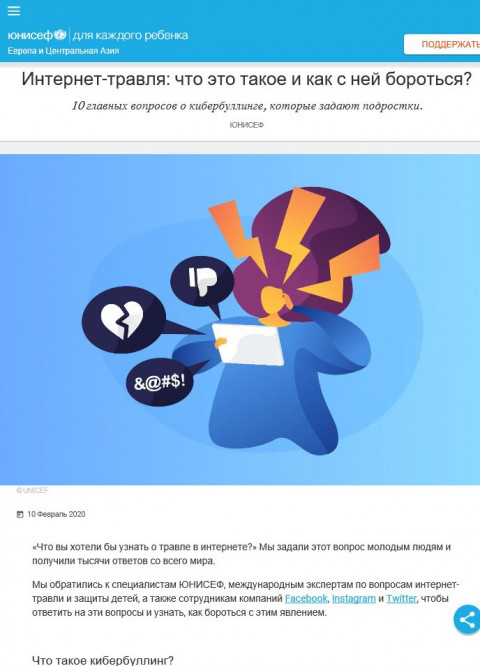 Internet Bullying: What is It and How to Deal with It? ; Top 10 Cyberbullying Questions Asked by Teens Year of publication: 2020 Corporate author: UNICEF Europe and Central Asia In the article, UNICEF experts, international experts on Internet bullying and child protection, as well as employees of Facebook, Instagram and Twitter, answer questions about how to deal with Internet bullying. Top 10 Cyberbullying Questions: How to understand that I am being harassed on the Internet? How to distinguish a joke from bullying? How does Internet bullying affect a person? Who should I talk to if someone is chasing me on the Internet? Why is it important to report bullying? I am being harassed by the Internet, but I’m afraid to talk to my parents about it. How do I turn to them for help? How can I help my friends report online bullying, especially if they don’t want to do this? The Internet gives me access to a lot of information, but it also means that I can become a victim of online violence. How can you protect yourself from cyberbullying without refusing to use the Internet? How to avoid using my personal information to manipulate or humiliate me on social networks? Is there any punishment for Internet harassment? Internet companies are not trying to solve the problem of cyberbullying. Are they responsible for this? Are there any online tools to combat bullying of children or youth? Интернет-травля: что это такое и как с ней бороться? ; 10 главных вопросов о кибербуллинге, которые задают подростки Year of publication: 2020 Corporate author: UNICEF Europe and Central Asia В статье специалисты ЮНИСЕФ, международные эксперты по вопросам интернет-травли и защиты детей, а также сотрудники компаний Facebook, Instagram и Twitter отвечают на вопросы о том, как бороться с интернет травлей. 10 главных вопросов о травле в интернете: Как понять, что меня преследуют в интернете? Как отличить шутку от травли? Как интернет-травля влияет на человека? С кем мне поговорить, если кто-то преследует меня в интернете? Почему важно сообщать о случаях травли? Я подвергаюсь интернет-травле, но боюсь поговорить с родителями об этом. Как мне обратиться к ним за помощью? Как мне помочь друзьям сообщить об интернет-травле, особенно, если они не хотят этого делать? Интернет дает мне доступ к большому количеству информации, но это также означает, что я могу стать жертвой насилия в сети. Как можно оградить себя от кибербуллинга, не отказываясь от использования интернета? Как избежать использования моей личной информации для манипуляции или унижения меня в соцсетях? Существует ли какое-то наказание за интернет-травлю? Интернет-компании не пытаются решить проблему кибербуллинга. Несут ли они за это ответственность? Существуют ли какие-нибудь онлайн-инструменты для борьбы с травлей детей или молодёжи?
  School-related violence and bullying on the basis of Sexual Orientation and Gender Identity or Expression (SOGIE): synthesis report on China, the Philippines, Thailand and Viet Nam Year of publication: 2018 Corporate author: UNESCO Bangkok School related violence and bullying is a problem in all countries. UNESCO is committed to ensuring that all children and young people have access to safe, inclusive, health-promoting learning environments as part of its strategy on education for health and well-being. This synthesis report on school related violence and bullying on the basis of Sexual Orientation and Gender Identity or Expression (SOGIE), covering China, the Philippines, Thailand and Viet Nam, was developed to broaden awareness and understanding about this issue, while also identifying best practices and policies. It also aims to mobilize support for advocacy among educators, research institutions, policy makers and activists at the national and regional levels.
  School Violence and Bullying: Global Status Report Year of publication: 2017 Corporate author: UNESCO School violence and bullying occurs throughout the world and affects a significant proportion of children and adolescents. It not only negatively impacts their educational outcomes, but harms their physical health and emotional well-being.This report aims to provide an overview of the most up-to-date available data on the nature, extent and impact of school violence and bullying and efforts to address the problem. It was prepared by UNESCO and the Institute of School Violence and Prevention at Ewha Womans University for the International Symposium on School Violence and Bullying: From Evidence to Action, Seoul, Republic of Korea, 17 – 19 January, 2017.
  Stopping violence in schools: a guide for teachers Year of publication: 2014 Corporate author: UNESCO “Stopping Violence in Schools: A Guide for Teachers” examines various forms of violence that take place in schools, and offers practical suggestions as to what teachers can do to prevent them. Ten action areas are proposed, each with specific examples that teachers can adapt to address and prevent violence. Excerpts from relevant international normative instruments as well as a list of links to online resources for stopping violence in schools are annexed at the end of the book. En finir avec la violence à l'école: guide à l'intention des enseignants Year of publication: 2014 Corporate author: UNESCO “Stopping Violence in Schools: A Guide for Teachers” examines various forms of violence that take place in schools, and offers practical suggestions as to what teachers can do to prevent them. Ten action areas are proposed, each with specific examples that teachers can adapt to address and prevent violence. Excerpts from relevant international normative instruments as well as a list of links to online resources for stopping violence in schools are annexed at the end of the book. Poner fin a la violencia en la escuela: guía para los docentes Year of publication: 2014 Corporate author: UNESCO “Stopping Violence in Schools: A Guide for Teachers” examines various forms of violence that take place in schools, and offers practical suggestions as to what teachers can do to prevent them. Ten action areas are proposed, each with specific examples that teachers can adapt to address and prevent violence. Excerpts from relevant international normative instruments as well as a list of links to online resources for stopping violence in schools are annexed at the end of the book.