
Resources
Explore a wide range of valuable resources on GCED to deepen your understanding and enhance your research, advocacy, teaching, and learning.
56 Results found
 Good practices in education for sustainable development: using the Earth Charter Year of publication: 2007 Corporate author: UNESCO | Earth Charter International Secretariat This publication has been envisioned to offer stories – case studies from around the world – that highlight how groups and individuals are using the Earth Charter as a tool for education for sustainable development. These stories come from non-formal and formal educational settings and describe a variety of experiences, including the development of guidebooks for primary school teachers, the inclusion of sustainability values in universities’ departments of education, law, engineering and general studies; the reshaping of local, regional and national curricula; and, the creation of vital and engaging programs and workshops for children and youth. Education for sustainable development good practices in early childhood Year of publication: 2012 Corporate author: UNESCO To support the growing interest in early childhood issues and ESD, UNESCO is publishing this volume containing 12 examples of programmes addressing ESD in early childhood settings and practices. These good practices and shared experiences, which were provided by a range of different stakeholders, are concrete examples of successful implementation of ESD in different fields and sectors, from the political to the school level, and including formal, nonformal and informal learning situations.
 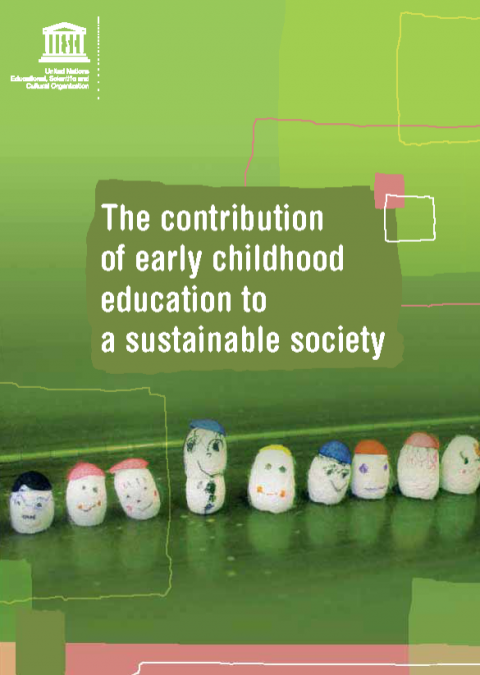 The contribution of early childhood education to a sustainable society Year of publication: 2008 Corporate author: UNESCO This report originates from the international workshop, ‘The Role of Early Childhood Education for a Sustainable Society’, jointly organized in Göteborg, Sweden, by Göteborg University, Chalmers University of Technology and the City of Göteborg, from 2 to 4 May 2007. It was attended by thirty-five participants from sixteen different countries (see ‘List of Participants’). The workshop was a follow-up to the international conference on education for sustainable development, ‘Learning to Change Our World’, held in May 2004, in Göteborg. It was one of four preparatory workshops leading to another international conference on education for sustainable development, to be organized in 2008 or 2009, in the same city. The aim of the four workshops is to discuss promoters and barriers related to learning for sustainability, and to propose recommendations for the upcoming international conference. The present workshop was conceived for the following reasons. First, our societies urgently require new kinds of education that can help prevent further degradation of our planet, and that foster caring and responsible citizens genuinely concerned with and capable of contributing to a just and peaceful world. Second, these new kinds of education must be available to all – not only a handful of people – and take place in various settings, including families and communities. Third, they must begin in early childhood, as the values, attitudes, behaviours and skills acquired in this period may have a long-lasting impact in later life. Thus, early childhood education clearly has an important place in the efforts to bring about sustainable development. Education for sustainable development; good practices in addressing biodiversity Year of publication: 2012 Corporate author: UNESCO To support the growing interest in biodiversity issues and ESD, UNESCO is publishing this volume containing 24 examples of programmes addressing biodiversity in ESD settings and practices. These good practices and shared experiences, which were provided by a range of different stakeholders, are concrete examples of successful implementation of ESD in different fields and sectors, from the political to the school level, and including formal, non-formal and informal learning situations.
  Collection des meilleures pratiques en éducation pour une citoyenneté mondiale en Afrique centrale Year of publication: 2015 Corporate author: UNESCO This collection of best practices in human rights education in Central Africa and Ethiopia was prepared in order to respond to UNESCO’s demand to promote such initiatives and to ensure a multiplier effect considering human rights education in the region. The objective is to support the concept of UNESCO’s ‘Global Citizenship Education’ in the field of human rights education in identifying its best practices. In order to identify the best practices, UNESCO’s activities in the field of human rights education in the region were mapped out. This mapping out has shown big differences in implementing the initiatives focused on achieving global citizenship education through human rights education, particularly in primary and secondary education, as indicated in the first phase of the World Programme for human rights education. Nevertheless, various initiatives collected are either conducted/supported by UNESCO or not, in terms of three themes: citizenship education, intercultural dialogue, and the peace and security which are considered to be relevant to Africa in general and particularly to Central Africa, in order to address the main theme of global citizenship education. The selected best practices deal with the tertiary level and are in line with the second phase of the World Programme for human rights education, covering the period between 2009 and 2014 and focusing on higher and vocational education. The practices include 1) citizenship education which supports the principles set out in the Universal Declaration of Human Rights and which is reiterated in the two phases of the World Programme for human rights education, 2) the intercultural dialogue which supports education for understanding and evaluating unity in diversity, and which fits well with the objectives of the UN Decade of Education for Sustainable Development proclaimed by the UN General Assembly and managed by UNESCO, and 3) education for peace and security.It is obvious that many linkages exist among the three subjects mentioned above. Therefore, the examples presented in this collection can affect one or several problems. Each example is presented with the following sequence: identification, background, implementation, and results.
 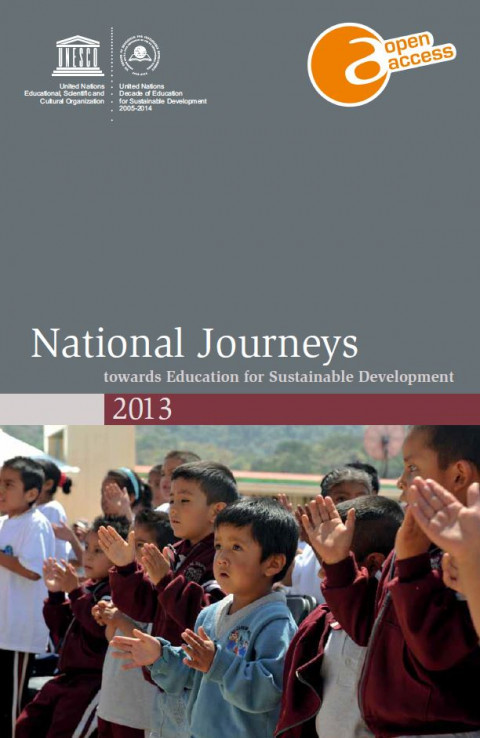 National journeys towards education for sustainable development, 2013: reviewing national ESD experiences from Costa Rica, Morocco, South Africa, Sweden, VietNam Year of publication: 2013 Corporate author: UNESCO This publication has sourced information from a series of national reviews commissioned by UNESCO in 2011/2012 and was written by experts in Costa Rica, Morocco, South Africa, Sweden and Viet Nam. The countries presented in this report are not necessarily the ‘best’ examples of the region, as many other countries are also progressing effectively towards implementing Education for Sustainable Development (ESD). Rather, the countries selected illustrate the wide diversity of ESD approaches and initiatives taking place in different parts of the world. The national studies were then edited and harmonized before common themes and lessons learnt were identified to support other national efforts in moving towards the end of the UN Decade of Education for Sustainable Development. Education for sustainable development: good practices in addressing climate change Year of publication: 2012 Corporate author: UNESCO Since the beginning of the UN Decade of Education for Sustainable Development (DESD, 2005-2014), the DESD Secretariat at UNESCO Headquarters in Paris has received numerous requests for case studies and descriptions of good practices in Education for Sustainable Development (ESD). These requests have increasingly included issues of providing an educational response to climate change. The increasing number of requests is only one indicator that climate change education is increasingly recognized in the broader education community as an essential part of ESD and life-long learning. ESD is a complex and evolving subject, and how it is applied and implemented is a challenge for all countries. The Decade aims to see ESD implemented in thousands of local situations on the ground, involving its integration into a multitude of different learning situations. These initiatives can be catalysts for action and contribute to the goals and objectives of the Decade. In such ways, organizations, local communities and individuals can be actors within the global movement for sustainable development. To support the growing interest in climate change issues and ESD, UNESCO is publishing this volume containing 17 examples of programmes addressing climate change in ESD settings and practices. These good practices and shared experiences, which were provided by a range of different stakeholders, are concrete examples of successful implementation of ESD in different fields and sectors, from the political to the school level, and including formal, nonformal and informal learning situations.
  The right to higher education and gender equality: briefing note compendium Year of publication: 2023 Corporate author: UNESCO International Institute for Higher Education in Latin America and the Caribbean (IESALC) The right to higher education and gender equality Table of ContentsForeword ................................................................................................................................................................................4Introduction ..........................................................................................................................................................................5UNESCO and the right to higher education ..............................................................................................................5Aim of this compendium..................................................................................................................................................6Key findings...........................................................................................................................................................................7Gender equality in Higher Education - Maximising impacts– Gillian Cowell................................................8Gender equality and higher education: The Afghan case – Aisha Khurram............................................... 12An analysis of gender equality policies and practices in higher education institutions and their effectiveness in promoting gender equity – Angel Mbuthia........................................................ 14Gender identity and access to higher education – Martin Perea.................................................................... 16What can be done to ensure the right to higher education? – Bhavani Rao.............................................. 18Gender equality in higher education still a pending issue in Peru – Patricia Ruiz Bravo ....................... 22Gender equality in higher education: state of play and implications across OECD countries, and reflections on potential responses for policy and practice – François Staring.................................. 24
  EIU Best Practice Series No. 5: Peace and human rights education through education for sustainable development: lessons from four case studies in the Philippines Year of publication: 2007 Corporate author: APCEIU The four case studies showed that EIU through peace and human rights education in the context of education for sustainable development can build a critical mass of Filipinos who will reject wars and promote social security. Education can play a role to direct the children, youth, and adults toward peace building and better understanding of cultural differences. It should also be noted that when institutions adopt a peace culture, establishing local and international organizations and putting up resources for various peace-building initiatives become possible. Educational intervention can effect changes in the minds of men and build a lasting and substantive foundation for peace based on justice and respect for human rights.
 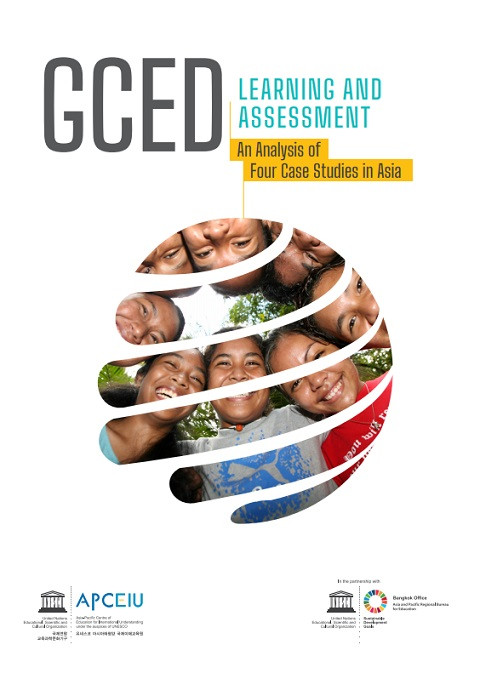 GCED Learning and Assessment: An Analysis of Four Case Studies in Asia Year of publication: 2020 Corporate author: APCEIU | UNESCO Bangkok “GCED Learning and Assessment: An Analysis of Four Case Studies in Asia” is a result report of research jointly led by UNESCO Asia-Pacific Regional Bureau for Education, the Asia-Pacific Centre of Education for International Understanding (APCEIU) and the Asia-Pacific Regional GCED Network. The report encompasses four case studies of GCED Learning in the region and its assessment. Four leading researchers in the field of GCED, Satya Bushan from the National Council of Educational Research and Training (NCERT), India; Sayaka Matsukura of Ageo Oishi Junior High School, Japan; Dawon Kim from Gwangju National University of Education, Republic of Korea; and Le Anh Vinh from the Vietnam National Institute of Educational Science (VNIES), Viet Nam, contributed to this research. Through presenting and sharing the cases of India, Japan, Republic of Korea and Viet Nam, the publication is expected to shed light on the assessment on how GCED is implemented in the region and further inspire and encourage the GCED practitioners on the ground to take another step forward to reflect GCED in their respective educational systems. <List of Contents>ForewordAcknowledgementsAcronymsExecutive summaryChapter 1: IntroductionChapter 2: Schoollevel approaches at integrating GCEDChapter 3: Assessment of GCED learning Chapter 4: Reflections on GCED learning assessment Chapter 5: Conclusions and recommendations References