
Resources
Explore a wide range of valuable resources on GCED to deepen your understanding and enhance your research, advocacy, teaching, and learning.
154 Results found
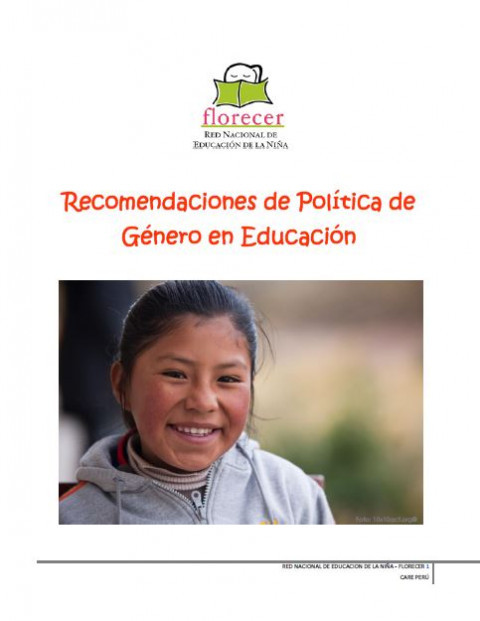 Gender Policy Recommendations in Education Year of publication: 2015 Corporate author: Red Nacional de Educación de la Niña This document synthesizes the proposals of the Florecer Network to advance in gender equality, convinced that the commitment to a more just and more human world necessarily involves the assumption of equality between men and women. The principle that the rights of women and girls are an integral, inalienable and indivisible part of universal human rights has been reaffirmed from the various international forums. Greater equity between men and women is also beneficial for the development of the country. A country with educated girls and women has a lower birth rate, improves their health and productivity conditions. This document synthesizes the main proposals of the Gender and Citizenship Forum: imperative for a quality education, organized by Red Florecer in May 2013 year. We want to put them in the hands of decision-makers and citizens in general to help concretize the mandates of equality between men and women in education. It is time not to give up dreams because they have become possible. Recomendaciones de Política de Género en Educación Year of publication: 2015 Corporate author: Red Nacional de Educación de la Niña Este documento sintetiza las propuestas de la Red Florecer para avanzar en la igualdad de género, convencidos de que la apuesta por un mundo más justo y más humano pasa necesariamente por la asunción de la igualdad entre hombres y mujeres. Desde los diversos foros internacionales se ha reafirmado el principio que los derechos de las mujeres y las niñas son parte integral, inalienable e indivisible de los derechos humanos universales. Una mayor equidad entre hombres y mujeres es además beneficiosa para el desarrollo del país. Un país con niñas y mujeres educadas tiene menor tasa de natalidad, mejora sus condiciones de salud y productividad.Este documento sintetiza las principales propuestas del Foro Género y Ciudadanía: imperativo para una educación de calidad, organizado por la Red Florecer en mayo del 2013 año. Queremos ponerlas en manos de los decisores y de la ciudadanía en general para contribuir a concretar los mandatos de igualdad entre hombres y mujeres en la educación. Es el momento de no desistir de los sueños porque estos se han tornado posibles.
 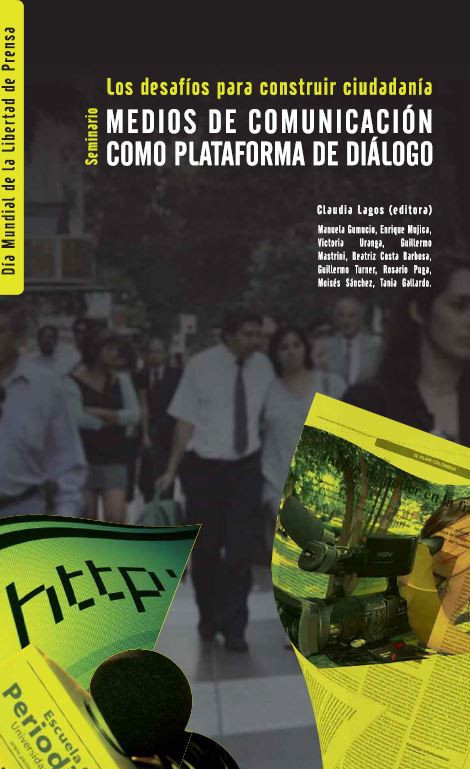 The Challenges to Build Citizenship: Media as a Platform for Dialogue Year of publication: 2010 Author: Claudia Lagos Corporate author: Universidad de Chile The OREALC / UNESCO Santiago and the UNESCO National Commission, the Regional Delegation for Cooperation in the Southern Cone and Brazil, the French Embassy in Chile, the Freedom of Expression Program of the Institute of Communication and Image of the University of Chile and the UNESCO Chair "Media and citizen participation" of the Universidad Diego Portales, commemorated the World Day for Press Freedom 2009 with the seminar "The challenges to build citizenship. Media as a platform for dialogue ", held on May 5, 2009 at the Central House of the University of Chile. The meeting, with national and international guests, made it possible to reflect on and discuss the main issues -although not the only ones- that are currently in the hands of issues related to the promotion of pluralism and diversity; the challenges for journalism and the media in a context of high technological renewal and economic crisis; the lines of work in the matter for the design and execution of public policies, and research in communication. This publication collects the presentations of the speakers during the Seminar, as well as leaves testimony of the commitments assumed by the presidential candidates that we hope will become an agenda not only for the 2010-2014 administration, but also for the political sectors that represent each one of those who signed the document. Seminario Los Desafíos para Construir Ciudadanía: Medios de Comunicación como Plataforma de Diálogo Year of publication: 2010 Author: Claudia Lagos Corporate author: Universidad de Chile La OREALC/UNESCO Santiago y la Comisión Nacional UNESCO, la Delegación Regional de Cooperación para el Cono Sur y Brasil, de la Embajada de Francia en Chile, el Programa de Libertad de Expresión del Instituto de la Comunicación e Imagen de la Universidad de Chile y la Cátedra UNESCO “Medios de comunicación y participación ciudadana” de la Universidad Diego Portales, conmemoraron el Día Mundial por la Libertad de Prensa 2009 con el seminario “Los desafíos para construir ciudadanía. Medios de comunicación como plataforma de diálogo”, realizado el 5 de mayo de 2009 en la Casa Central de la Universidad de Chile. El encuentro, con invitados nacionales e internacionales, permitió reflexionar y discutir sobre los principales -aunque no los únicos- problemas que hoy están en carpeta en cuestiones referidas al fomento del pluralismo y la diversidad; los desafíos para el periodismo y los medios en un contexto de alta renovación tecnológica y crisis económica; las líneas de trabajo en la materia para el diseño y ejecución de políticas públicas, y la investigación en comunicación. Esta publicación recoge las presentaciones de los expositores durante el Seminario, así como también deja testimonio de los compromisos asumidos por los candidatos presidenciales que esperamos se transforme en una agenda no sólo para la administración 2010-2014, sino que también para los sectores políticos que representa cada uno de quienes suscribieron el documento.
  Construction of Citizenship: Experience of Implementing an Index of Citizen Participation in Latin America Year of publication: 2006 Author: Isidro Adúriz | Pablo Ava Corporate author: Universidad de Salamanca The aim of this paper is to establish the main conceptual and methodological lines in order to carry out an investigation about levels and forms of citizen participation. This paper is the result of the formation of a Citizen Participation Index in Latin America in its 2005 edition. It was promoted by the Inter-American Network for Democracy and implemented by the Economic and Social Research Foundation. Construcción de Ciudadanía: Experiencia de Implementación de un Índice de Participación Ciudadana en América Latina Year of publication: 2006 Author: Isidro Adúriz | Pablo Ava Corporate author: Universidad de Salamanca El objetivo del presente documento es establecer los principales lineamientos conceptuales y metodológicos para llevar a cabo una investigación que dé cuenta de los niveles y modalidades de participación ciudadana. El mismo está basado en la experiencia de la construcción del Índice de Participación Ciudadana en América Latina en su edición del año 2005 impulsado por la Red Interamericana para la Democracia e implementado por la Fundación de Investigaciones Económicas y Sociales.
  Anthropology of Citizenship? ... Ethnic. Under Construction from Latin America Year of publication: 2007 Author: Xochitl Leyva Solano The main argument of this article develops around the concept of citizenship which I will examine taking as a starting point contributions made in the fields of law studies, philosophy and anthropology. There have been considerable advances in the social sciences with the proposition and discussion of new composite concepts such as “multicultural citizenship”, “intercultural citizenship”, and “ethnic citizenship”. With “ethnic citizenship” in particular, scholars have been trying to respond to the history and nature of the demands, claims and struggles that indigenous organizations and communities, movements and their leaders have made in Latin America over the past three decades. ¿Who proposed this concept, and when, where and for what purposes was it developed? What are the advantages and limits of “ethnic citizenship”? Who is using this concept now and in what social and political contexts? This discussion leads me to ask whether it is possible to speak of an emerging, alternative Latin American model of interpretation. ¿Antropología de la Ciudadanía?... Étnica. En Construcción desde América Latina Year of publication: 2007 Author: Xochitl Leyva Solano En este artículo tomo como hilo conductor el concepto de ciudadanía haciéndolo cruzar desde los campos de interés propios del derecho y la filosofía hacia el de la antropología. Ello es posible hacerlo hoy gracias a que científicos sociales de varias latitudes han acuñado términos como “ciudadanía cultural”, “ciudadanía multicultural”, “ciudadanía intercultural” y “ciudadanía étnica”. Este último concepto ha sido acuñado atendiendo principalmente la historia y la naturaleza de las demandas, los reclamos y las luchas que han llevado a cabo, desde el último cuarto del siglo XX, las comunidades, líderes, organizaciones y movimientos indígenas de América Latina. ¿Quiénes lo acuñaron? ¿Cuándo, dónde y para qué? ¿Qué aportes y qué límites encontramos al usarlo? ¿Quiénes lo están utilizando y bajo qué contextos? Tomando como punto de partida dicho término ¿se podría hablar de la existencia de un modelo interpretativo alternativo, emergente y propiamente latinoamericano?
  The Right to Education of Migrants and Refugees Year of publication: 2014 Author: Vernor Muñoz Villalobos The focus of this report is on those who have crossed national borders, who generally are at risk of marginalization and specifically to discrimination in the provision of education. The research addresses six core issues, the consideration of which follows an analysis of the contextual background. Attention to these issues is viewed as indispensable in meeting the educational challenges and opportunities related to migration. These core, but inevitably interrelated themes are: the legal and normative framework; social and cultural issues; language and curriculum; teachers; accreditation and lifelong learning. The preparation of the report has benefitted greatly from the active and constructive engagement of many relevant actors including Governments, international organizations, academics, non-governmental organizations and concerned individuals. Together they have offered a wealth of different perspectives and which form the basis of a number of recommendations ending the text. El Derecho a la Educación de las Personas Migrantes y Refugiadas Year of publication: 2014 Author: Vernor Muñoz Villalobos El objetivo de este artículo es sobre las personas que han cruzado las fronteras nacionales, quienes generalmente se encuentran en riesgo de exclusión social y se enfrentan a la discriminación en el acceso y las oportunidades educativas. El texto aborda seis temas principales, seguido de un análisis del marco contextual. La atención a estas cuestiones es indispensable para enfrentar los desafíos y las oportunidades educativas relacionadas con la migración. Los temas tratados están inevitablemente interrelacionados son el marco legal y normativo, las cuestiones sociales y culturales, el lenguaje y el currículo, los maestros, acreditación y el aprendizaje a lo largo de la vida. La elaboración de la investigación que nutre este artículo se ha beneficiado en gran medida de la participación activa y constructiva de muchas partes interesadas, incluidos los gobiernos, organizaciones internacionales, académicos, organizaciones no gubernamentales y personas interesadas. Juntos han ofrecido una gran cantidad de diferentes perspectivas y que forman la base de una serie de recomendaciones con las que termina el texto.