
Resources
Explore a wide range of valuable resources on GCED to deepen your understanding and enhance your research, advocacy, teaching, and learning.
12 Results found
 Podcast: Learning for the Future; Digital Citizenship; Tools to Prevent and Eradicate Cyberbullying Year of publication: 2022 Author: Alheli Arona | Patricio Romero Corporate author: Chile Foundation | Educarchile One of the dimensions of digital citizenship is protection and security. This includes digital harassment or cyberbullying, a problem that affected more than 22% of students in Chile during the months of October and December 2021, according to the Citizen Participation Survey “Together against cyberbullying and digital violence” applied by the Superintendency of Education. What can we, as teachers, management teams and education professionals, do to prevent and eradicate this type of violence and help our students? Podcast: Aprendizaje para el futuro; Ciudadanía digital; Herramientas para prevenir e irradicar el ciberacoso Year of publication: 2022 Author: Alheli Arona | Patricio Romero Corporate author: Chile Foundation | Educarchile Una de las dimensiones de la ciudadanía digital es la protección y la seguridad. Dentro de esta se encuentra el acoso digital o ciberacoso, un problema que durante los meses de octubre y diciembre de 2021 afectó a más de un 22% de estudiantes en Chile según la Encuesta de Participación Ciudadana “Juntos frente al ciberacoso y la violencia digital” aplicada por la Superintendencia de Educación. ¿Qué podemos hacer las y los docentes, equipos directivos y profesionales de la educación para prevenir y erradicar este tipo de violencia y ayudar a nuestros estudiantes?
 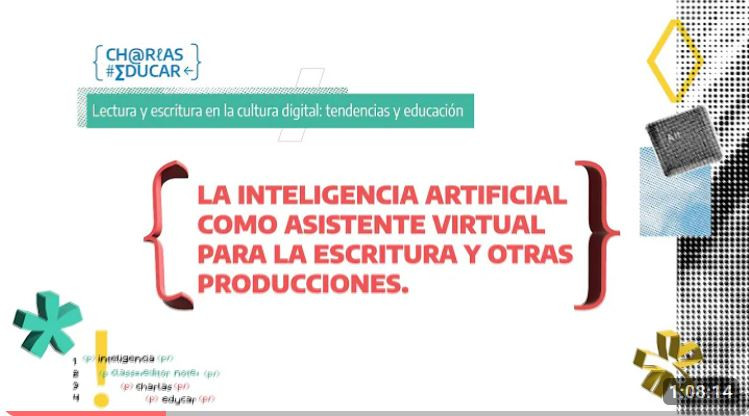 Reading and Writing in Digital Culture: Trends and Education Year of publication: 2023 Author: Carina Maguregui Corporate author: Educ.ar This video presents an expanded talk whose central theme or narrative thread, «Reading and writing in digital culture: trends and education», provides a contextual framework for three possible itineraries or expansions: a.) Artificial intelligence as a virtual assistant for writing and other productions; b) Ecosystem of screens and platforms, and c) The right to digital disconnection.Each expansion—itinerary or talk—is self-contained, has a presentation, development and closure. However, the three complement each other and, in some way, dialogue with each other. The most important thing is that they provide a much richer overview. Lectura y escritura en la cultura digital: tendencias y educación Year of publication: 2023 Author: Carina Maguregui Corporate author: Educ.ar Este video presenta una charla expandida cuyo tema central o hilo narrativo, «Lectura y escritura en la cultura digital: tendencias y educación», da marco contextual a tres itinerarios posibles o expansiones: a.) La inteligencia artificial como asistente virtual para la escritura y otras producciones; b) Ecosistema de pantallas y plataformas, y c) El derecho a la desconexión digital.Cada expansión —itinerario o charla— es autoconclusiva, tiene presentación, desarrollo y cierre. Sin embargo, las tres se complementan y, de algún modo, dialogan entre sí. Lo más importante es que brindan una visión de conjunto mucho más rica.
  Critical and Reflective Digital Literacy: Digital Citizenship Year of publication: 2024 Corporate author: Innovation Center Mineduc Coni helps her grandfather do the online shopping for the house and her grandfather helps her understand how apps work and become more aware of her privacy. Join Coni and her friends to discover what digital citizenship is and how they exercise it from home and school. This is the first of a series of four capsules that introduces us to the dimension of “Critical and reflective digital literacy”, which is understood as the acquisition of knowledge and the development of skills and attitudes to autonomously use, understand and evaluate digital technologies. Alfabetización digital crítica y reflexiva: Ciudadanía digital Year of publication: 2024 Corporate author: Innovation Center Mineduc Coni ayuda a su abuelo a hacer las compras de la casa en línea y su abuelo la ayuda a entender cómo funcionan las apps y a estar más consciente de su privacidad. Acompaña a Coni y a sus amigos y amigas a descubrir lo qué es la ciudadanía digital y cómo la ejercen desde su casa y colegio. Esta es la primera de una serie de cuatro cápsulas nos introduce en la dimensión de la “Alfabetización digital crítica y reflexiva”, la que se entiende como la adquisición de conocimientos y el desarrollo de habilidades y actitudes para usar, comprender y evaluar autónomamente las tecnologías digitales.
  Media and Information Literacy: A Practical Guidebook for Trainers; Media Development Year of publication: 2018 Author: Sylvia Braesel | Thorsten Karg Corporate author: DW Academy The Media and Information Literacy (MIL) guide provides trainers with background information, ideas, methodology and practical exercises for training. Literacy is the ability to read and write. Media and Information Literacy (MIL) is the ability to understand how the media works and how it can be used to participate in public debate. MIL includes social media such as Facebook as well as traditional media such as books, newspapers, radio and television. This practical guide provides MIL trainers with background information, ideas, methodology and practical exercises for training. Alfabetización mediática e informacional: Una guía práctica para capacitadores; Desarrollo de medios Year of publication: 2018 Author: Sylvia Braesel | Thorsten Karg Corporate author: DW Academy La guía en Alfabetización Mediática e Informacional (AMI) brinda a los capacitadores información de trasfondo, ideas, metodología y ejercicios prácticos para la capacitación. Alfabetización es la capacidad de leer y escribir. Alfabetización Mediática e Informacional (AMI) es la capacidad para comprender cómo funcionan los medios de comunicación y cómo se pueden utilizar para participar en el debate público. AMI incluye redes sociales como Facebook, así como a los medios de comunicación tradicionales como libros, periódicos, radio y televisión. Esta guía práctica brinda a los capacitadores en AMI información de trasfondo, ideas, metodología y ejercicios prácticos para la capacitación.
  Citizenship and Digital Literacy Plan 2024 Year of publication: 2024 Corporate author: Chile. Ministerio Secretaría General de Gobierno | Chile. Ministerio de Educación The Ministry of the General Secretariat of the Government together with the Ministry of Education have launched the “Citizenship and Digital Literacy” Plan with the aim of addressing the growing challenges, opportunities and risks involved in the use of digital technologies in everyday life. The actions presented in the plan seek to strengthen the skills of citizens in general and also with a focus on educational communities, supported by the frameworks of digital citizenship and media, information and digital literacy. This plan includes three axes: 1.) Training for citizenship and digital literacy; 2.) Incorporation of media literacy and digital citizenship in the national school curriculum; and 3.) Resources and guidelines for strengthening citizenship and digital literacy. Plan ciudadanía y alfabetización digital 2024 Year of publication: 2024 Corporate author: Chile. Ministerio Secretaría General de Gobierno | Chile. Ministerio de Educación El Ministerio Secretaria General de Gobierno junto al Ministerio de Educación han lanzado el Plan “Ciudadanía y Alfabetización Digital” con el objetivo de abordar los crecientes desafíos, oportunidades y riesgos que implica el uso de tecnologías digitales en la vida cotidiana. Las acciones presentadas en el plan buscan fortalecer las competencias de la ciudadanía en general y también con foco en las comunidades educativas, amparados en los marcos de ciudadanía digital y de alfabetización mediática, informacional y digital. Este plan contempla tres ejes: 1.) Formación para la ciudadanía y alfabetización digital; 2.) Incorporación de la alfabetización mediática y la ciudadanía digital en el currículum escolar nacional; y 3.) Recursos y orientaciones para el fortalecimiento de la ciudadanía y la alfabetización digital.