
Resources
Explore a wide range of valuable resources on GCED to deepen your understanding and enhance your research, advocacy, teaching, and learning.
358 Results found
 Educación para la ciudadanía mundial: temas y objetivos de aprendizaje Year of publication: 2015 Corporate author: UNESCO This publication, titled Global Citizenship Education: Topics and learning objectives, is the first pedagogical guidance from UNESCO on global citizenship education. It is the result of an extensive research and consultation process with experts from different parts of the world. This guidance draws on the UNESCO publication Global Citizenship Education: Preparing learners for the challenges of the 21st century and the outcomes of three key UNESCO events on global citizenship education: the Technical Consultation on Global Citizenship Education (September 2013), as well as the First and Second UNESCO Fora on Global Citizenship Education, organized in December 2013 and January 2015 respectively. Before it was finalized, the guidance was field-tested by education stakeholders in selected countries in all regions to ensure its relevance in different geographical and socio-cultural contexts. Following the foundational work of UNESCO to clarify the conceptual underpinnings of global citizenship education and provide policy and programmatic directions, this document has been developed in response to the needs of Member States for overall guidance on integrating global citizenship education in their education systems. It presents suggestions for translating global citizenship education concepts into practical and age-specific topics and learning objectives in a way that allows for adaptation to local contexts. It is intended as a resource for educators, curriculum developers, trainers as well as policy-makers, but it will also be useful for other education stakeholders working in non-formal and informal settings.
  Educação para a cidadania global: preparando alunos para os desafios do século XXI Year of publication: 2014 Corporate author: UNESCO The United Nations Secretary-General’s Global Education First Initiative (GEFI) has established education as a means to ‘foster global citizenship’ – one of its three priority areas. To support this, UNESCO organized two landmark meetings on GCE in 2013. This publication aims to define the parameters of GCE by using the collective expertise, experience and wisdom of those participants who gathered at these landmark events, and to plan for future action in line with emerging thinking and other ongoing work. The review establishes that GCE has a critical role to play in equipping learners with competencies to deal with the dynamic and interdependent world of the twenty-first century. While GCE has been applied in different ways in different contexts, regions and communities, it has a number of common elements, which include fostering in learners. In formal settings, GCE can be delivered as an integral part of an existing subject (such as civic or citizenship education, social studies, environmental studies, geography or culture), or as an independent subject area. Integrated models appear to be more common. Some less traditional, but at least as effective, pathways for GCE have included the following: the use of information and communication technologies and social media, sport competitions and the use of art and music, and youth-led initiatives employing a wide variety of approaches. Both traditional and new horizons for GCE are profiled in this review. This publication also explores a number of enabling conditions for the promotion and implementation of GCE. These include: the existence of an open environment for universal values, the implementation of transformative pedagogy and support for youth-led initiatives. The review acknowledges that there are a number of ongoing tensions with the concepts of global citizenship and global citizenship education. While these tensions vary, they all point to the fundamental question of how to promote universality (e.g. common and collective identity, interest, participation, duty), while respecting singularity (e.g. individual rights, self-improvement). Some ways forward to resolve these tensions are suggested, whilst maintaining that challenges around theoretical elements of GCE should not undermine its practice. The processes documented in this publication have strengthened partnerships, built coalitions and contributed to improving the evidence base on the theory and practice of global citizenship education. While there are tasks that remain, this foundation bodes well for improving the enabling conditions and the practices highlighted in this review. By preparing learners to fulfil their potential in an increasingly globalized world, we are promoting transformed societies that are also better equipped to deal with the twenty-first century challenges and to seize twenty-first century opportunities. Education à la citoyenneté mondiale: préparer les apprenants aux défis du XXIe siècle Year of publication: 2015 Corporate author: Organisation des Nations Unies pour l'éducation, la science et la culture (UNESCO) The United Nations Secretary-General’s Global Education First Initiative (GEFI) has established education as a means to ‘foster global citizenship’ – one of its three priority areas. To support this, UNESCO organized two landmark meetings on GCE in 2013. This publication aims to define the parameters of GCE by using the collective expertise, experience and wisdom of those participants who gathered at these landmark events, and to plan for future action in line with emerging thinking and other ongoing work. The review establishes that GCE has a critical role to play in equipping learners with competencies to deal with the dynamic and interdependent world of the twenty-first century. While GCE has been applied in different ways in different contexts, regions and communities, it has a number of common elements, which include fostering in learners. In formal settings, GCE can be delivered as an integral part of an existing subject (such as civic or citizenship education, social studies, environmental studies, geography or culture), or as an independent subject area. Integrated models appear to be more common. Some less traditional, but at least as effective, pathways for GCE have included the following: the use of information and communication technologies and social media, sport competitions and the use of art and music, and youth-led initiatives employing a wide variety of approaches. Both traditional and new horizons for GCE are profiled in this review. This publication also explores a number of enabling conditions for the promotion and implementation of GCE. These include: the existence of an open environment for universal values, the implementation of transformative pedagogy and support for youth-led initiatives. The review acknowledges that there are a number of ongoing tensions with the concepts of global citizenship and global citizenship education. While these tensions vary, they all point to the fundamental question of how to promote universality (e.g. common and collective identity, interest, participation, duty), while respecting singularity (e.g. individual rights, self-improvement). Some ways forward to resolve these tensions are suggested, whilst maintaining that challenges around theoretical elements of GCE should not undermine its practice. The processes documented in this publication have strengthened partnerships, built coalitions and contributed to improving the evidence base on the theory and practice of global citizenship education. While there are tasks that remain, this foundation bodes well for improving the enabling conditions and the practices highlighted in this review. By preparing learners to fulfil their potential in an increasingly globalized world, we are promoting transformed societies that are also better equipped to deal with the twenty-first century challenges and to seize twenty-first century opportunities.
 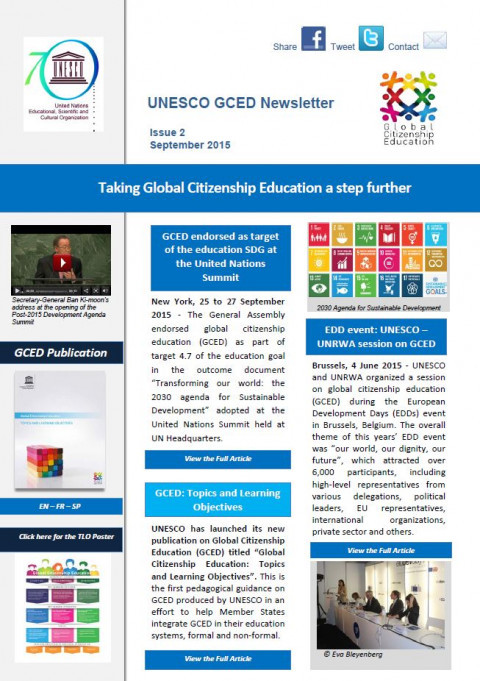 UNESCO GCED eNewsletter Issue 2 Year of publication: 2015 Corporate author: UNESCO Featuring:Taking Global Citizenship Education a step furtherGCED endorsed as target of the education SDG at the United Nations SummitGCED: Topics and Learning ObjectivesEDD event: UNESCO-UNRWA session on GCEDCapacity-building workshops-providing assistance for GCED implementationGCED for West African countries – building on peace and human rights educationTool for writing textbooks free of prejudiceOrientation and Capacity Building on GCED for Latin American and Caribbean countriesKey tweetsUpcoming events
 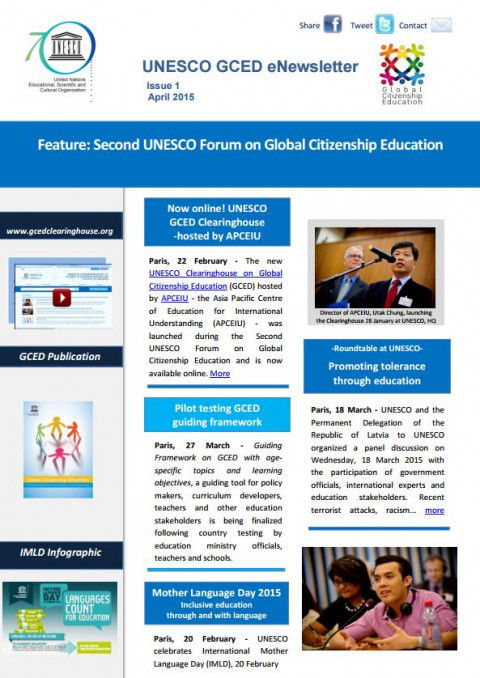 UNESCO GCED eNewsletter Issue 1 Year of publication: 2015 Corporate author: UNESCO Feature: Second UNESCO Forum on Global Citizenship EducationNow online! UNESCO GCED Clearinghouse hosted by APCEIUPilot testing GCED guiding framework(Roundtable at UNESCO) Promoting tolerance through educationMother Tongue Day 2015: inclusive education through and with language(Interview) Roland Villamero speaks on GCED at the community levelHIghlights: Second UNESCO Forum on Global Citizenship Education, 28-30 January 2015, Paris HQSecond UNESCO Forum on GCED puts spotlight on Post-2015 developmentGlobal citizenship must be placed in the centre of education systemsAmira Yahyaoui's feature presentation at the Second UNESCO GCED ForumJoint Youth Statement2nd GCED Forum photo gallery UNESCO ECM e Bulletin Bulletin Numéro 1 Year of publication: 2015 Corporate author: Organisation des Nations Unies pour l'éducation, la science et la culture (UNESCO) Caractéristique: Deuxième Forum de l'UNESCO sur l'éducation sur la citoyenneté mondialeMaintenant en ligne! UNESCO ECM Centre hébergé par APCECIcadre d'orientation Piolot test ECM(Table ronde à l'UNESCO) Tolérance Promouvoir par l'éducationLangue maternelle Jour 2015: l'éducation inclusive à travers et avec la langue(Interview) Roland Villamero parle sur ECM au niveau communautaireHighlights: Deuxième Forum de l'UNESCO sur l'éducation sur la citoyenneté mondiale, 28-30 Janvier 2015, HQ ParisDeuxième Forum de l'UNESCO sur ECM met les projecteurs sur L'après 2015 le développementLa citoyenneté mondiale doit être placé au centre des systèmes éducatifsfonction de la présentation de Amira Yahyaoui lors du deuxième Forum ECM UNESCODéclaration des jeunes mixte2ème Forum ECM galerie photo
  글로벌시민교육: 21세기 새로운 인재 기르기 Year of publication: 2014 Corporate author: 유네스코 이 보고서는 글로벌시민교육을 주제로 열렸던 두 차례의 국제회의 - 글로벌시민교육 전문가회의(2013년 9월 9-10일, 대한민국 서울)와 제1차 유네스코 글로벌시민교육 포럼(2013년 12월 2-4일, 태국 방콕) - 결과를 토대로 교육정책 입안자, 교육 실천가, 시민사회단체 및 청소년 리더들을 위해 만들어졌다. 글로벌시민교육을 처음 접하거나 이미 실천하고 있는 모든 독자들에게 유용한 지침서가 될 것이다. 머리말감사의 말약어개요배경1. 글로시민교육의 기본 개념과 논의 1.1 글로벌시민교육이란 무엇인가 1.2 글로벌시민교육의 개념을 둘러싼 갈등 1.3 글로벌시민교육을 가능케 하는 요소2. 글로벌시민교육의 실제 2.1 교과과정을 통한 접근 2.2 정보통신기술의 활용 2.3 스포츠나 예술에 기초한 접근법 2.4 공동체에 기초한 접근법 2.5 교사 훈련 2.6 청소년 주도의 창의적 활동 2.7 글로벌시민교육 모니터링과 측정3. 앞으로의 과제 참고문헌
  Global Citizenship Education: An Emerging Perspective Year of publication: 2014 Corporate author: UNESCO This document draws on inputs to, and common perspectives emerging from, a Technical Consultation on Global Citizenship Education organized by UNESCO and the Republic of Korea (i.e., the Ministries of Foreign Affairs and of Education, and the Asia-Pacific Centre of Education for International Understanding) in Seoul on 9-10 September 2013 . Informing this draft document are: a) responses from the expert participants to a questionnaire circulated by UNESCO in advance of the consultation; b) presentations from experts during the consultation; c) discussions during the consultation; and d) reference material contributing to, and prepared for, the consultation. The final draft of this document was prepared by UNESCO’s Division of Education for Peace and Sustainable Development at Headquarters in Paris, with the assistance of a drafting team. Éducation à la Citoyenneté Mondiale:Nouveaux sujets de discussions éducatifs Year of publication: 2014 Corporate author: UNESCO Ce document se fonde sur les entrées et les perspectives communes qui sortent d'une Consultation Technique sur l'Éducation à la Citoyenneté Mondiale organisée par l'UNESCO et la République de Corée (ie, les Ministères des Affaires Étrangères et de l'Éducation, et le Centre Asie-Pacifique de l'Éducation pour la Comprendre) à Séoul les 9-10 Septembre 2013. Informer ce projet de document sont: a) les réponses des participants d'experts à un questionnaire diffusé par l'UNESCO à l'avance de la consultation; b) des présentations d'experts lors de la consultation; c) des discussions au cours de la consultation; et matériel d) de référence contribuant à, et préparé pour la consultation. La version finale de ce document a été préparé par la Division de l'Éducation pour la Paix et le Développement Durable au Siège de l'UNESCO à Paris, avec l'aide d'une équipe de rédaction.
  Promotion and implementation of global citizenship education in crisis situations Year of publication: 2017 Author: Robiolle Moul, Tina Corporate author: UNESCO Crisis situations affect the realization of human rights of many people and communities across all regions of the world. Within UNESCO’s relevant areas of work, GCED is a powerful approach to education that can empower people to recover from crises and transform their communities into peaceful and sustainable societies. UNESCO commissioned a desk study that aimed at reviewing existing research on the promotion and implementation of GCED and related programs in countries affected by crisis situations, with particular attention to initiatives benefiting the refugee population. This study unveils the key challenges these programs encounter in such contexts, as well as promising practices that can guide the design and implementation of future GCED in crisis situations.This report is a synthesis of this desk study and supports the evidence that, after analyzing the context and the available means, GCED and related programs can and should be systematically adapted and implemented in crisis situations, including in response to refugee crises.