
Resources
Explore a wide range of valuable resources on GCED to deepen your understanding and enhance your research, advocacy, teaching, and learning.
358 Results found
 L'éducation pour la paix et le développement durable: concepts, la clarté et la cohésion Year of publication: 2013 Corporate author: Mahatma Gandhi Institute of Education for Peace and Sustainable Development (MGIEP) La mise au point de l'UNESCO MGIEP réside dans l'exploration et la collaboration avec les liens étroits entre la paix et le développement durable et faire des interventions dans les systèmes éducatifs pour communiquer ces principes. La première publication de «L'éducation pour la paix et le développement durable: concepts, la clarté et la cohésion de l'Institut explore les liens et les interdépendances de l'éducation pour la paix et l'éducation pour le développement durable. La monographie contient quatre documents de réflexion qui élaborent sur les liens entre l'éducation, la paix et le développement durable, définissent les lacunes dans l'approche actuelle de l'éducation pour la paix et le développement durable et plaident en faveur d'une approche globale des questions de paix et de développement durable à incorporer dans l'éducation systèmes. UNESCO MGIEP vise à développer un cadre théorique pour examiner les liens entre la paix et le développement durable d'une manière holistique et cette monographie est le premier exercice à la construction de ce discours.
  Address by Irina Bokova, Director-General of UNESCO, on the occasion of Seminar on Global Citizenship Education, UNHQ; New York, 6 March 2015 Year of publication: 2015 Corporate author: UNESCO. Director-General, 2009-2017 (Bokova, I.G.) This document is an address by Irina Bokova, Director-General of UNESCO on the occasion of "Seminar on Global Citizenship Education" in New York, 6 March 2015. She highlights the importance of GCED for education in the 21st century.
  The Elusive and Exclusive Global Citizen Year of publication: 2015 Author: Jill Koyama Corporate author: Mahatma Gandhi Institute of Education for Peace and Sustainable Development (MGIEP) In this paper, the author interrogate the notion of global citizenship, both as an aspiration and an improbable practice, by situating it within contemporary understandings of citizenship and globalization.It is a conceptualization that suffers from the dangers inherent in the term “citizenship” and misconceptions of the terms “global,” and it is rooted in the West’s long engagement in normative undertakings in non-Western countries. The writer refute ideas of the autonomous and agentic global citizen. he encourage a rethinking of global citizenship and global citizenship education (GCE) and offer recommendations for redirecting attention to contemporary global stratifications and issues of human rights to address the issues of social justice and inequality that, due to the problematic definition of global citizenship, are currently inadequately covered in existing GCE curricula.
 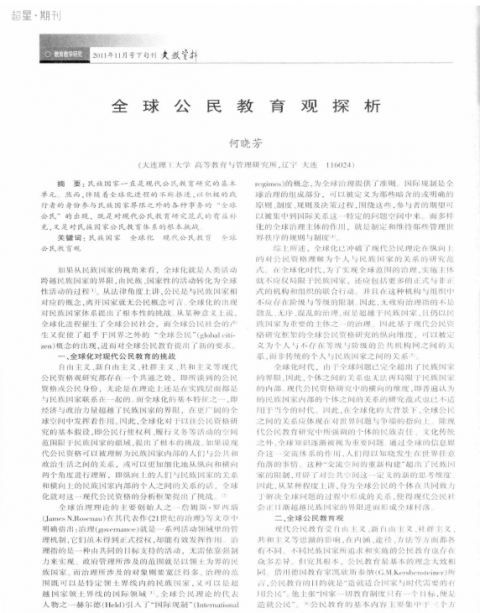 An Analysis of Global Citizenship Education Year of publication: 2011 Author: He Xiaofang The nation-state has always been the basic unit of modern civic education research. However, with the continuos advancement of the globalization process, there are an increasing more people participate in various global matters as a "global citizens". This is not only a useful complement to the modern civic education paradigm, but also a fundamental challenge of the civic education system in the nation-state. 全球公民教育观探析 Year of publication: 2011 Author: He Xiaofang 民族国家一直是现代公民教育研究的基本单元。然而,伴随着全球化进程的不断推进,以积极的践行者的身份参与民族国家界限之外的各种事务的“全球公民”的出现,既是对现代公民教育研究范式的有益补充,又是对民族国家公民教育体系的根本挑战。
  Global Citizenship: Lessons from the Ancients (Curriculum on the Move Global, Thematic Notes No.5) Year of publication: 2022 Author: Conrad Hughes Corporate author: UNESCO International Bureau of Education (IBE) "Curriculum On The Move" is a new UNESCO-IBE Series aim at reflecting, debating, producing and disseminating knowledge and ways forward on emerging issues in curriculum-related aspects. The Series emerges from a bottom-up approach, with teachers and students providing their perspectives and experiences on the curriculum.The goal is to rethink the way curriculum is understood and practiced via Webinars, Concept Notes and Global Debates (via Blogs, Twitter, etc.) by involving in a participatory way youth and school practitioners.Right at the centre of the mission statement of many schools, universities and organisations is the phrase “global citizen”. But what does it mean to be a global citizen?
 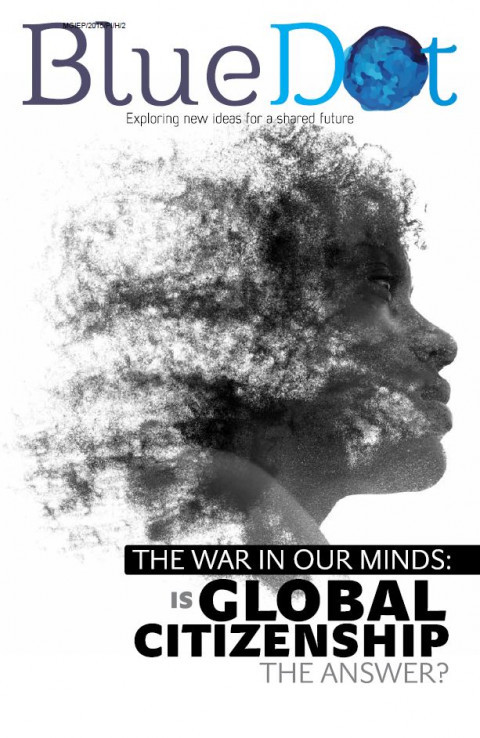 The war in our minds: is global citizenship the answer? (Blue Dot issue 1) Year of publication: 2015 Corporate author: Mahatma Gandhi Institute of Education for Peace and Sustainable Development (MGIEP) Feature Global Citizenship Education: A New Educational, Pedagogical and Political Narrative in the World System? (by Carlos A. Torres) In Pursuit of a Global Civics (by Hakan Altinay) Global Citizenship: Necessary and Possible (by Paul and Anne Ehrlich) Cover Story YOUth Speak for a better today and tomorrow (by Piyali Sarkar Debnath, UNESCO MGIEP) Essays Unlocking the Civic Sense of Young Minds (by Karthik Shankar) Shared Home, Shared Hopes and Shared Actions (by Trang T. Nguyen) Redesigning the Education System for Global Citizenship (by Ayodeji Ojo) Youth Voices Who is a global citizen? News What we have been up to UNESCO MGIEP Crossword Event Calendar
  It's about us!: reflections on education for active citizenship within the European Union Year of publication: 2013 Author: Milana Marcella, Tarozzi Massimiliano The article is structured in three main parts. Grounded in the scientific literature, the authors unpack the notion of citizenship as key educational concept based on multiple and diverse identities. Then, they outline the major steps undertaken at EU level to formalise and expand citizenship rights and to endorse citizenship education across the Union’s nationals, by showing that citizenship education is promoted more as a strategy for legitimising the Union rather than a participatory practice aimed at fostering democratic processes within Europe. Finally, they discuss the implications of these policy advancements from a social justice perspective, by advancing a critique of their political assumptions and, to some extent, the pedagogical approach they suggest.
 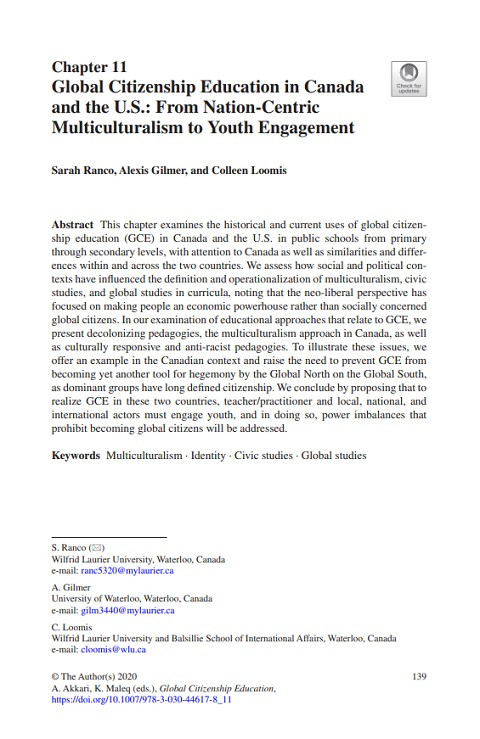 Global Citizenship Education in Canada and the U.S.: From Nation-Centric Multiculturalism to Youth Engagement Year of publication: 2020 Author: Sarah Ranco | Alexis Gilmer | Colleen Loomis Corporate author: Cham Springer This chapter examines the historical and current uses of global citizenship education (GCE) in Canada and the U.S. in public schools from primary through secondary levels, with attention to Canada as well as similarities and differences within and across the two countries. The authors assess how social and political contexts have influenced the definition and operationalization of multiculturalism, civic studies, and global studies in curricula, noting that the neo-liberal perspective has focused on making people an economic powerhouse rather than socially concerned global citizens. In their examination of educational approaches that relate to GCE, the authors present decolonizing pedagogies, the multiculturalism approach in Canada, as well as culturally responsive and anti-racist pedagogies. To illustrate these issues, the authors offer an example in the Canadian context and raise the need to prevent GCE from becoming yet another tool for hegemony by the Global North on the Global South, as dominant groups have long defined citizenship. They conclude by proposing that to realize GCE in these two countries, teacher/practitioner and local, national, and international actors must engage youth, and in doing so, power imbalances that prohibit becoming global citizens will be addressed.
 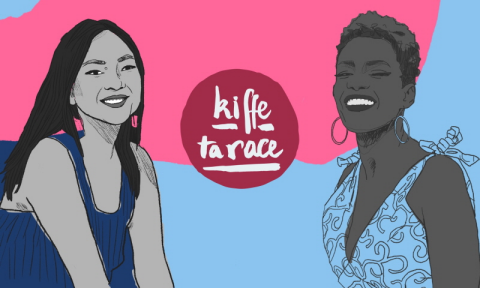 Kiffe Ta Race Year of publication: 2018 Corporate author: Binge Audio Pourquoi le mot « race » est-il tabou ? Qu’en est-il quand on est, à la fois, victime de discriminations raciales et sexuelles ? Comment assumer son identité plurielle ? Un mardi sur deux, Rokhaya Diallo et Grace Ly reçoivent un·e invité·e pour explorer les questions raciales sur le mode de la conversation et du vécu. Why is the word "race" taboo? What happens when you are both a victim of racial and sexual discrimination? How do you come to terms with your plural identity? Every other Tuesday, Rokhaya Diallo and Grace Ly welcome a guest to explore racial issues in a conversational, real-life setting.