
Resources
Explore a wide range of valuable resources on GCED to deepen your understanding and enhance your research, advocacy, teaching, and learning.
358 Results found
 Artificial intelligence in education: challenges and opportunities for sustainable development Year of publication: 2019 Author: Pedró, Francesc | Subosa, Miguel | Rivas, Axel | Valverde, Paula Artificial Intelligence is a booming technological domain capable of altering every aspect of our social interactions. Ineducation, AI has begun producing new teaching and learning solutions that are now undergoing testing in differentcontexts. This working paper, written for education policymakers, anticipates the extent to which AI affects the education sector to allow for informed and appropriate policy responses. This paper gathers examples of the introduction of AI in education worldwide, particularly in developing countries, discussions in the context of the 2019 Mobile Learning Week and beyond, as part of the multiple ways to accomplish Sustainable Development Goal 4, which strives for equitable, quality education for all. First, this paper analyses how AI can be used to improve learning outcomes, presenting examples of how AI technology can help education systems use data to improve educational equity and quality in the developing world. Next, thepaper explores the different means by which governments and educational institutions are rethinking and reworking educational programmes to prepare learners for the increasing presence of AI in all aspects of human activity. Thepaper then addresses the challenges and policy implications that should be part of the global and local conversations regarding the possibilities and risks of introducing AI in education and preparing students for an AI-powered context. Finally, this paper reflects on future directions for AI in education, ending with an open invitation to create new discussions around the uses, possibilities and risks of AI in education for sustainable development.
  Ré-inventer le Monde Year of publication: 2023 Corporate author: L'Agence Française du Développement (AFD) Réinventer le Monde est un programme pédagogique créé par l’Agence française de développement pour sensibiliser les jeunes au développement durable et à la solidarité internationale et leur donner envie de s’engager. Conçu comme un voyage sonore, ce programme permet de découvrir à travers les histoires d’habitants de la planète, les Objectifs de développement durable et les interconnexions entre ici et là-bas. Il mêle éducation au développement durable (EDD) et éducation aux médias et à l’information (EMI) et propose une approche centrée sur l’apprentissage de la citoyenneté mondiale. Reinventing the World is an educational program created by the French Development Agency to raise young people's awareness of sustainable development and international solidarity, and inspire them to get involved. Conceived as an audio journey, the program uses the stories of the planet's inhabitants to discover the Sustainable Development Goals and the interconnections between here and there. It blends education for sustainable development (ESD) and media and information literacy (MIM), and offers an approach focused on learning about global citizenship.
 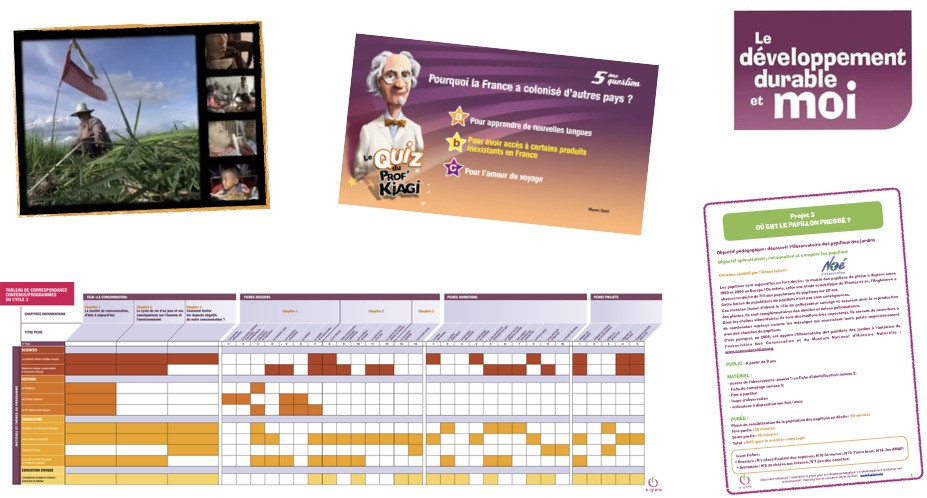 Le développement durable et moi Year of publication: 2010 Corporate author: E-graine Les mallettes pédagogiques constituent un des supports historiques d’e-graine dans sa batterie d’outils pédagogiques. Destinées en premier lieu aux enseignants dans les années 2010, elles ont été pensées comme des outils clés en mains pour éduquer au développement durable et à la solidarité internationale. A l’aide d’un tableau de correspondance pédagogique fourni avec la mallette, un enseignant pouvait, dans les différentes disciplines, intégrer facilement ces vidéos à ses cours. Le dispositif était idéal pour appuyer les écoles ne disposant pas toujours des moyens financiers permettant de faire appel à des animateurs spécialisés. Il était également possible pour le grand public de se procurer ces mallettes pour une utilisation dans le cadre familial.Pour toucher le plus grand nombre et parcequ’elle modernise ses outils pour rester à la pointe de l’innovation pédagogique, e-graine fait le choix de les proposer gratuitement en ligne pour le plus grand nombre. Le contenu que vous trouverez ci-dessous en vidéo demeure évidemment une bonne base d’initiation pour une cible 8-12 ans. Teaching kits are one of e-graine's long-standing educational tools. First designed for teachers in the 2010s, they were conceived as turnkey tools for teaching sustainable development and international solidarity. Using a pedagogical correspondence table supplied with the kit, teachers could easily integrate the videos into their lessons in any subject. The system was ideal for supporting schools that don't always have the financial resources to hire specialized animators. It was also possible for the general public to purchase the kits for use in the home. In order to reach as many people as possible, and because it is constantly updating its tools to remain at the cutting edge of educational innovation, e-graine has decided to make them available free of charge online. The video content you'll find below is obviously a good introduction for 8-12 year-olds.
  Itinéraire d'un téléphone portable Year of publication: 2019 Corporate author: E-graine E-graine te propose de te familiariser à la notion de citoyenneté mondiale, à travers un objet du quotidien : le smartphone.Tu pourras découvrir le système complexe de fabrication du téléphone, les impacts qu’il provoque sur l’Homme et l’environnement... et surtout comment tu as, en tant que citoyen et consommateur, la capacité de faire des choix pour un monde plus solidaire et plus responsable. Chez e-graine, nous sommes persuadés que c’est la prise de conscience que nous faisons tous partie d’une même humanité qui nous permettra de nous emparer de notre futur. E-graine introduces you to the concept of global citizenship through an everyday object: the smartphone. You'll be able to find out about the complex way a phone is made, the impact it has on people and the environment... and, above all, how, as a citizen and consumer, you have the ability to make choices for a more caring and responsible world. At e-graine, we are convinced that it is the realisation that we are all part of the same humanity that will enable us to take control of our future.
  La famille Kiagi Year of publication: 2018 Corporate author: E-graine Suivez les aventures en dessins animés de la famille Kiagiqui décide d’agir au quotidien pour des sociétés solidaires et responsables. Follow the cartoon adventures of the Kiagi family who decide to take action every day to promote responsible, caring societies.
  Le guide qui rend ton évènement plus éco-citoyen Corporate author: eventecocitoyen Ce guide sert à faciliter le passage à l’action de tous et toutes en proposant des conseils, outils, témoignages et ressources pratiques pour rendre les concerts et/ou festivals de Belgique plus éco-citoyens ! Pour permettre un questionnement, une remise en question en soi, qui implique ensuite des changements de comportements. Ici on vous donne des conseils/trucs et astuces mais aussi des ressources pour vous permettre de réfléchir autrement, d’agrandir notre angle de vue. This guide serves: To help everyone take action by offering advice, tools, testimonials and practical resources to make Belgium's concerts and/or festivals more eco-citizen! To enable questioning, self-questioning, which then implies changes in behavior. Here we give you tips and tricks, but also resources to help you think differently, to widen our angle of vision.
  Learning to live together: education for conflict resolution, responsible citizenship, human rights and humanitarian norms Year of publication: 2013 Author: Margaret Sinclair Corporate author: Education Above All (Qatar) Education cannot offer immediate remedies to the local and global problems that we see on the news screens every day, but it can contribute to solving them over the longer term. This book examines specifically the contribution that education for learning to live together can make, even in countries where teacher training and classroom resources are limited. Many countries have diverse populations (ethnic, linguistic, religious, etc) and seek to maintain harmony among the different groups. In some countries, however, especially where economic stress or climate change have intensified arguments over resources, tensions have led to armed conflict. This brings with it all the misery of death, injury, displacement and poverty, along with disruption of education systems. In some instances education itself has been a contributory factor to the outbreak of conflict, notably through unequal education opportunities for different groups, and through biased school curricula.Civil conflict has brought untold suffering in recent years, and in a globalised world it has negative spill-over effects to neighbouring and other countries. It is vital to develop education policies and curricular reforms that can help convey values and skills for learning to live together to young people, to help lessen tensions, within and between countries.Education policy-makers can help lay the foundations for a better future by adjusting the content and process of education to reflect skills and values for human rights, humanitarian norms, peaceful resolution of conflicts, sustainable development and other issues as elements of local, national and global citizenship.Education reform is not enough, of course, to resolve the numerous problems of our times. The focus of this volume is on the contribution that can be made through aligning the content of education to the goal of learning to live together. This work will have greater impact when it takes place within education systems and policies that are consistent with human rights values and of course when other sectors besides education make their respective contributions.This book shows that transformative education for conflict resolution and peace, for local, national and global citizenship, for human rights and humanitarian values can be implemented even under difficult conditions if there is a policy commitment to do so. Authors have provided examples and lessons learned from their own experiences as eminent practitioners in the field. Learning to live together: education for conflict resolution, responsible citizenship, human rights and humanitarian norms Year of publication: 2013 Author: Margaret Sinclair Corporate author: Education Above All (Qatar) L'éducation ne peut offrir des remèdes immédiats aux problèmes locaux et mondiaux que nous voyons sur les écrans d'information tous les jours, mais elle peut contribuer à les résoudre sur le long terme. Ce livre examine spécifiquement la contribution que l'éducation peut apporter pour vivre ensemble même dans les pays où la formation des enseignants et les ressources en classe sont limitées.De nombreux pays ont des populations diverses (ethniques, linguistiques, religieuses, etc.) cherchent à maintenir l'harmonie entre les différents groupes. Dans certains pays, cependant, en particulier lorsque le stress économique ou les changements climatiques ont intensifié les arguments sur les ressources, les tensions ont conduit à des conflits armés. Cela apporte avec elle toute la misère de la mort, les blessures, le déplacement et la pauvreté, ainsi que la perturbation des systèmes éducatifs. Dans certains cas, l'éducation elle-même a été un facteur contributif à l'éclatement du conflit, notamment grâce à des possibilités d'éducation inégales pour les différents groupes, et à travers les programmes scolaires biaisés.La guerre civile a causé des souffrances indicibles au cours des dernières années, et dans un monde globalisé, il a des effets négatifs de débordement vers les pays voisins et d'autres pays. Il est essentiel d'élaborer des politiques de l'éducation et la réforme des programmes qui peuvent aider à transmettre les valeurs et les compétences pour apprendre à vivre ensemble pour les jeunes, pour aider à réduire les tensions, à l'intérieur et entre les pays.Education décideurs politiques peuvent aider à jeter les bases d'un avenir meilleur en ajustant le contenu et le processus de l'éducation afin de refléter les compétences et les valeurs des droits de l'homme, des normes humanitaires, la résolution pacifique des conflits, le développement durable et d'autres questions comme éléments de local, national et citoyenneté mondiale.Réforme de l'éducation ne suffit pas, bien sûr, de résoudre les nombreux problèmes de notre temps. L'objectif de ce volume est sur la contribution qui peut être faite par le biais d'aligner le contenu de l'éducation à l'objectif d'apprendre à vivre ensemble. Ce travail aura un plus grand impact quand il a lieu au sein des systèmes et politiques d'éducation qui sont conformes aux valeurs des droits de l'homme et bien sûr, quand d'autres secteurs en dehors de l'éducation font leurs contributions respectives.Ce livre montre que l'éducation transformatrice pour la résolution des conflits et la paix, à la citoyenneté locale, nationale et mondiale, des droits de l'homme et des valeurs humanitaires peut être appliqué même dans des conditions difficiles, s'il y a un engagement politique de le faire. Les auteurs ont fourni des exemples et les enseignements tirés de leurs propres expériences en tant que praticiens éminents dans le domaine.
  Exploration on the Developmental Track of Chinese Civil Educational Outlook Year of publication: 2006 Author: Zhu Xiaoman, Feng Xiujun By tracking down the development of Chinese civil education outlook, we can see that Chinese civil educational outlook and western civil educational outlook show the trend of moving vis-à-vis in the relations among the citizens, the country and social relations, between civil rights and duties and between civil education and moral education. They have the possibility of mutual congelation with Chinese traditional moral educational ideology in ontological foundation, educational mechanism and value orientation. 中国公民教育观发展脉络探析 Year of publication: 2006 Author: Zhu Xiaoman, Feng Xiujun 通过对中国公民教育观的发展脉络进行溯源性追寻, 可以看到,中国公民教育观与西方公民教育观在公民与国家、社会关系,公民权利与义务关系,公民教育与道德教育关系等方面呈现相向运动的趋势,与中国传统道德教育思想在本体基础、教育机制、价值取向等方面存在相互融通的可能。