
Resources
Explore a wide range of valuable resources on GCED to deepen your understanding and enhance your research, advocacy, teaching, and learning.
10 Results found
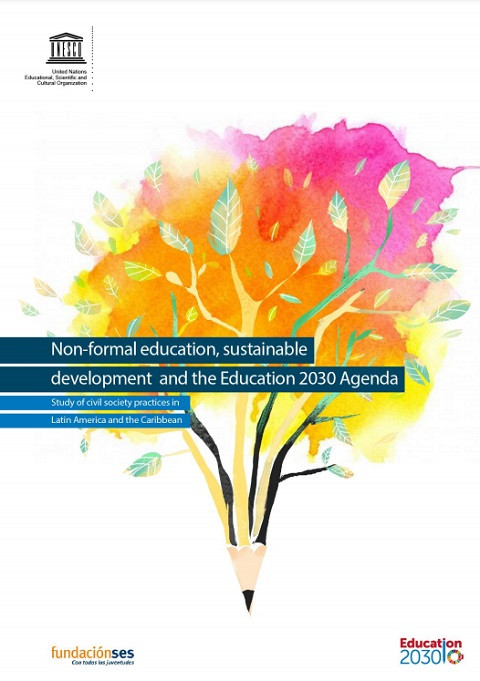 Non-Formal Education, Sustainable Development and the Education 2030 Agenda: Study of Civil Society Practices in Latin America and the Caribbean Year of publication: 2020 Corporate author: UNESCO Santiago | UNESCO Mexico This publication shows 27 civil society initiatives from various countries in Latin America and the Caribbean that work to promote actions and programs to comply with Target 4.7 within non-formal education. The study seeks that these organizations show their work, the challenges they face as regards the implementation of their programs and their greatest achievements.
  Research on Citizen Participation in the Construction of Service-Oriented Government—Taking Yilong County as an Example Year of publication: 2020 Author: Luo Jian Using a particular county as an exmple, this paper analyses the role of civic participation in transforming local government into service-oriented government, and provides suggestions for improvement.
  The Idea and Innovation of Digitized Public Participation Year of publication: 2016 Author: Ji Yuanyuan This paper analyses the existing problems of public participation in public affairs through digitial tools and provides suggestions for improvement.
  Democratic Elections and Meritocracy in the Perspective of Public Choice Theory Year of publication: 2020 Author: Meng Lingguang This paper analyses the the pros and cons of two political systems based on the idea of democracy and meritocracy respectivey, and discusses the possibility of combining the two.
 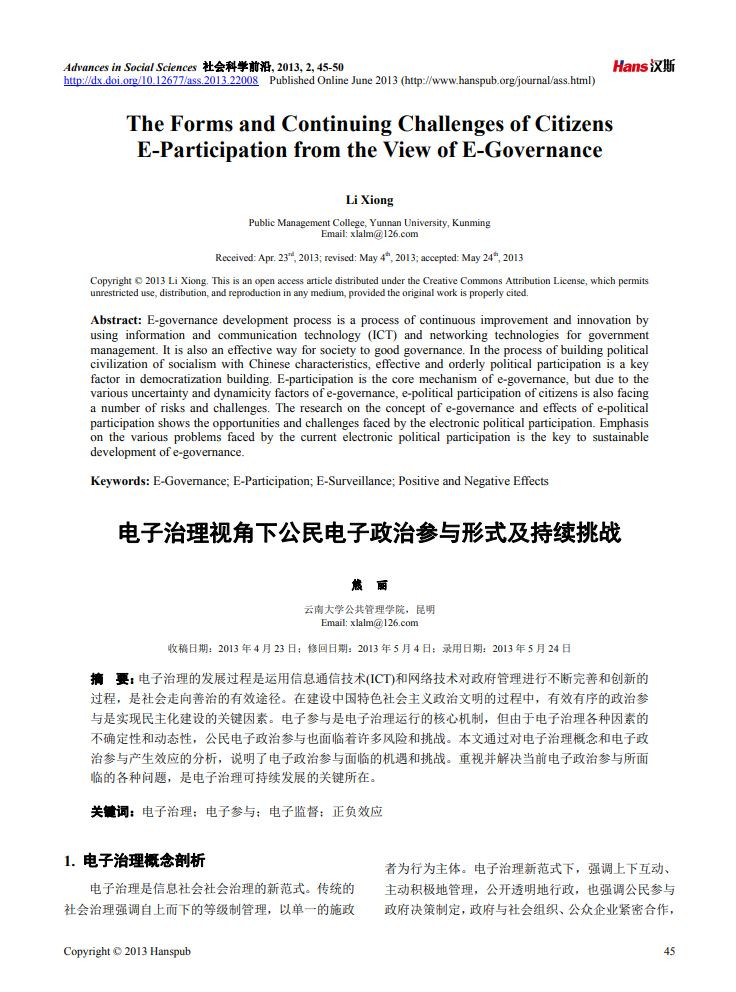 The Forms and Continuing Challenges of Citizens E-Participation from the View of E-Governance Year of publication: 2013 Author: Xiong Li This paper discusses civic participation through ICT in the context of e-governance and analyses the chanllenges to a form of e-democracy.
 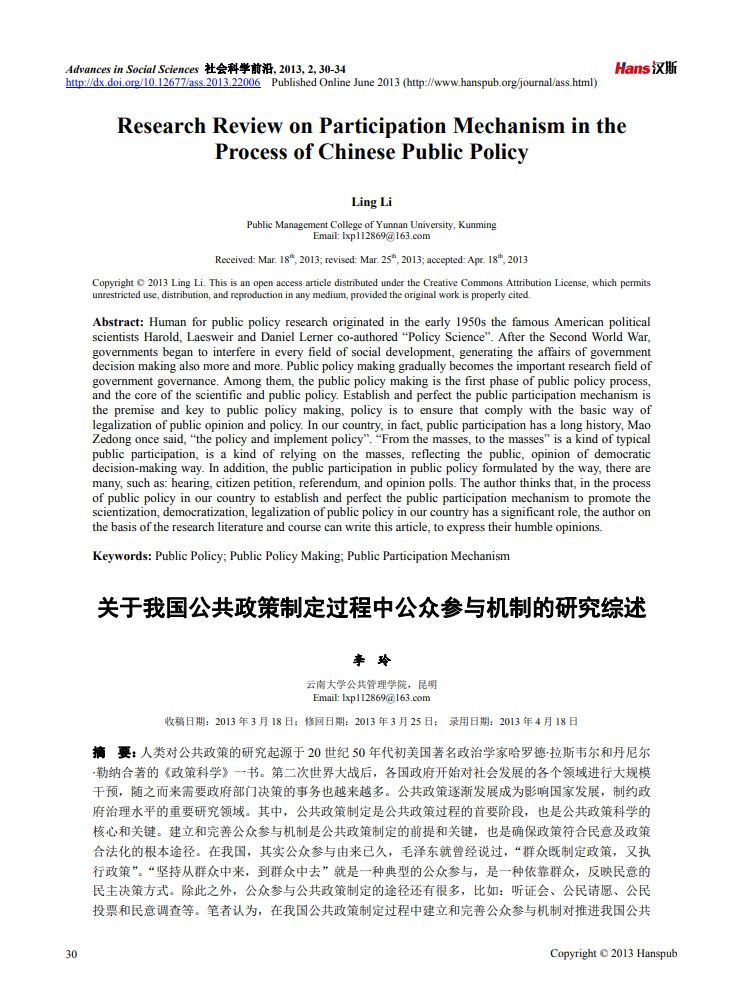 Research Review on Participation Mechanism in the Process of Chinese Public Policy Year of publication: 2013 Author: Li Ling This paper discusses the mechanism of public participation in public policy-making, and analyses the existing problems as well as possible solutions.
 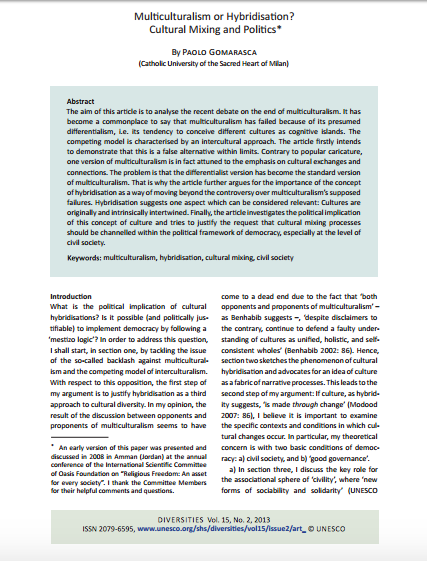 Multiculturalism or Hybridisation?: Cultural Mixing and Politics Year of publication: 2013 Author: Paolo Gomarasca The aim of this article is to analyse the recent debate on the end of multiculturalism. It has become a commonplace to say that multiculturalism has failed because of its presumed differentialism, i.e. its tendency to conceive different cultures as cognitive islands. The competing model is characterised by an intercultural approach. The article firstly intends to demonstrate that this is a false alternative within limits. Contrary to popular caricature, one version of multiculturalism is in fact attuned to the emphasis on cultural exchanges and connections. The problem is that the differentialist version has become the standard version of multiculturalism. That is why the article further argues for the importance of the concept of hybridisation as a way of moving beyond the controversy over multiculturalism’s supposed failures. Hybridisation suggests one aspect which can be considered relevant: Cultures are originally and intrinsically intertwined. Finally, the article investigates the political implication of this concept of culture and tries to justify the request that cultural mixing processes should be channelled within the political framework of democracy, especially at the level of civil society.
  Development Strategy of Uzbekistan: Civil Society; Training and Methodology Complex Year of publication: 2019 Author: M.N. Primov | T. Norboev Corporate author: Uzbekistan. Ministry of Higher and Secondary-Specialized Education | Tashkent Institute of Finance The document is a collection of training materials on the conditions and prospects for the development of civil society in Uzbekistan, as well as the implementation of the main directions of the Action Strategy. The document also the role of local governments of citizens, non-governmental non-profit organizations in improving institutions civil society.A major role in this is played by new socio-political disciplines, which include the “Development Strategy of Uzbekistan. Civil society". This course reveals the basic scientific principles of the formation of civil society and the development strategy of Uzbekistan, analyzes the main stages of transformation, shows the irreversibility of the reforms carried out in the country, and helps to build the civic position of each member of the society. It is organically woven into the humanities system, forming a common logical chain with it; It helps to answer questions of modern policy of our state and to determine the place and role of each person in the grandiose transformations carried out in the country.
 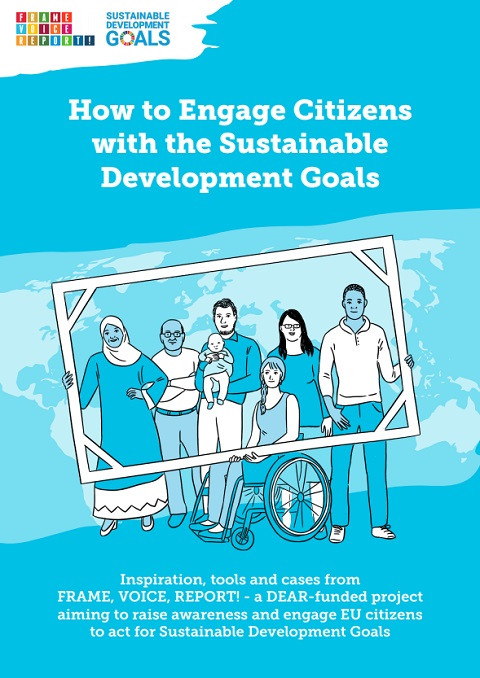 How to Engage Citizens with the Sustainable Development Goals Year of publication: 2020 Corporate author: Finnish Development NGOs Fingo The purpose of this booklet is to share reflections, successes and learning outcomes from the FRAME, VOICE, REPORT! (FVR) project.It can be used to find inspiration from other civil society organisations (CSOs) working on the same topics and themes you do, but also as a source for ideas for new ways of looking at old issues.This booklet covers both the more theoretical approaches and concrete cases from CSOs across Europe. These cases are examples of the many projects funded by the FVR.The project had its roots in the previous successes and tried and tested approaches of the partner organisations. The aim of FVR! was to secure resources and develop the value-based, high quality work of civil society organisations. The second aim was to enable smaller organisations to learn about EU project funding and to build capacity on how to conduct high quality global citizenship education and development communications. Finally, the overarching aim of the project was to engage EU citizens with the SDGs.
  The Implications of the COVID-19 Pandemic on Fundamental Rights and Civic Space Year of publication: 2022 Author: Filip Pazderski | Giada Negri | Chayma Khazzani | Ivana Rosenzweigova | Boglarka Szalma | Luben Panov | Carlotta Besozzi Corporate author: European Economic and Social Committee (EESC) This report was compiled for the European Economic and Social Committee at the request of the Diversity Europe Group by a consortium of four partners - European Civic Forum, Civil Society Europe, European Center for Not-for-Profit Law and the Institute of Public Affairs. It examines how the COVID-19 pandemic has affected the work of civil society organisations (CSOs) across Europe. It also focuses on how solutions implemented in individual EU Member States have impacted CSOs' ability to exercise their fundamental rights and freedoms.The report is based on in-depth analysis of existing studies and reports, a survey, 29 expert interviews and three focus groups. It showcases a number of ways in which the pandemic has affected the functioning of civil society organisations in the EU. The observations emerging from the different stages of the research were characterised by a high degree of consistency, validating the picture depicted.