
Resources
Explore a wide range of valuable resources on GCED to deepen your understanding and enhance your research, advocacy, teaching, and learning.
4 Results found
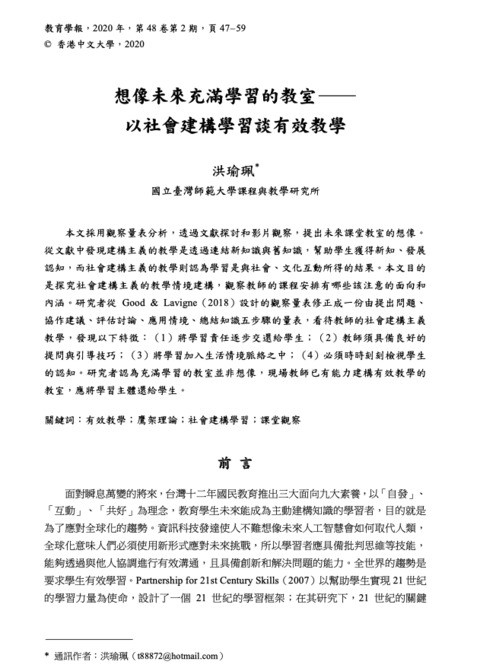 Imagining the Classroom Full of Learning in the Future: Effective Teaching With Social Constructive Learning (Educational Journal ; Vol.48, No.2) Year of publication: 2020 Author: 洪瑜佩 This article used an observation scale, together with literature exploration and film observation, to imagine the future classroom. From literature review, it was found that constructivist teaching helps students acquire new knowledge and develop cognition through connecting new and old knowledge. Teaching with the social constructivism approach regards learning as the result of interaction with society and culture. This article aimed to explore the social constructivist teaching context, as well as to observe which aspects and connotations teachers should pay attention to in curriculum arrangement. The researcher amended the observation scale designed by Good & Lavigne (2018) with five steps: (a) raising questions;(b) collaboration and suggestions; (c) assessment and discussions; (d) application to scenarios; and (e) summarizing knowledge. Teachers’ teaching was observed and assessed based on the five steps. The following results were found: (a) students should have the responsibilities of learning;(b) teachers must have good questioning and guidance skills; (c) teachers need to incorporate learning into real-life situations; (d) students’ cognition must be reviewed and monitored frequently. The researcher believes that a classroom full of learning is not imaginary. Teachers already have the ability to construct effective classrooms and should treat students as the learning agent. 想像未来充满学习的教室──以社会建构学习谈有效教学 (教育学报; Vol.48, No.2) Year of publication: 2020 Author: 洪瑜佩 本文采用观察量表分析,透过文献探讨和影片观察,提出未来课堂教室的想像。从文献中发现建构主义的教学是透过连结新知识与旧知识,帮助学生获得新知、发展认知,而社会建构主义的教学则认为学习是与社会、文化互动所得的结果。本文目的是探究社会建构主义的教学情境建构,观察教师的课程安排有哪些该注意的面向和内涵。研究者从good & lavigne(2018)设计的观察量表修正成一份由提出问题、协作建议、评估讨论、应用情境、总结知识五步骤的量表,看待教师的社会建构主义教学,发现以下特征:(1)将学习责任逐步交还给学生;(2)教师须具备良好的提问与引导技巧;(3)将学习加入生活情境脉络之中;(4)必须时时刻刻检视学生的认知。研究者认为充满学习的教室并非想像,现场教师已有能力建构有效教学的教室,应将学习主体还给学生。
 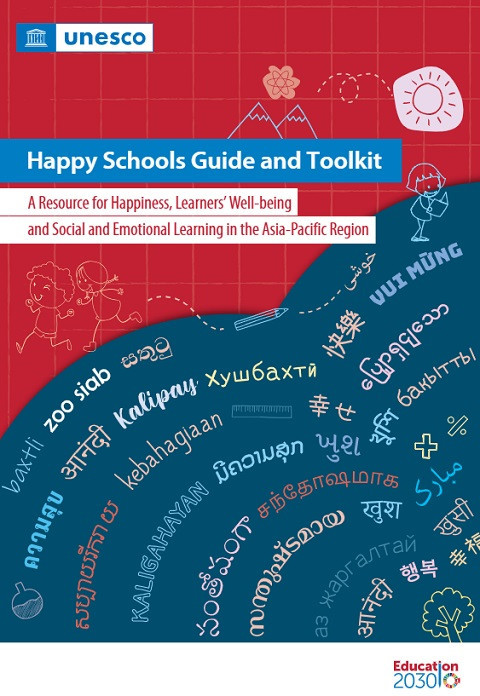 دليل ومجموعة أدوات المدارس السعيدة رافد ومصدر للسعادة ورفاه المتعلم والتعلم الاجتماعي والعاطفي في منطقة آسيا والمحيط الهادئ Year of publication: 2021 Corporate author: UNESCO | UNESCO Bangkok تم إعداد هذا الدليل بــهدف دعم المعــلمين والقــادة فــي مجالــي التعــليم األساســي والثــانوي فــي جميــع مناطــق آسيــا والمحيط الهــادئ فــي التــفكير فــي كيفيــة إنشــاء مدرســة ســعيدة، وهو بذلك يستند علــى عدة ركائز إلطــار عمل المدارس الســعيدة. وفــي حين أن دليل المدارس الســعيدة يستــهدف قــادة المدارس والمعــلمين فيمــا يتعلــق بــالمستوى اإلداري وتطوير عــلوم التربيــة، فــإن مجموعــة أدوات المدرســة الســعيدة قد صممت للمعــلمين علــى مستوى الصف الدراســي. Happy Schools Guide and Toolkit: A Resource for Happiness, Learners’ Well-Being and Social and Emotional Learning Year of publication: 2021 Corporate author: UNESCO | UNESCO Bangkok The Happy Schools Guide and Toolkit is designed to support teachers and school leaders in primary and secondary schools across the Asia-Pacific region, in thinking about how they can create their own Happy School. It has therefore drawn from aspects of the Happy Schools Framework, which can be most readily addressed at the school level. While the Happy Schools Guide is targeted towards school leaders and teachers at the school level of administration and pedagogy development, the Happy Schools Toolkit is conceived for teachers at the classroom level.