
Resources
Explore a wide range of valuable resources on GCED to deepen your understanding and enhance your research, advocacy, teaching, and learning.
71 Results found
 Girls’ Education and Climate Change: Investing in Education for Resilience Year of publication: 2021 Corporate author: Inter-agency Network for Education in Emergencies (INEE) This brief was developed to support dissemination of key messages in Mind the Gap 2: Seeking Safe and Sustainable Solutions for Girls’ Education in Crises. It provides an overview of evidence and gaps on the relationship between girls’ education and climate crises, and recommends actions to mitigate the impacts of climate change on girls’ education and promote resilience.
  The United Nations World Water Development Report 2020: Water and Climate Change Year of publication: 2020 Corporate author: UNESCO World Water Assessment Programme (WWAP) The 2020 edition of the UN World Water Development Report addresses the critical linkages between water and climate change in the context of sustainable development. It also serves as a guide for concrete actions to address these challenges. It outlines actions, supported by examples from across the world, in three areas: first, enabling people to adapt to the impacts of climate change; second, improving the resilience of livelihoods; and, third, reducing the drivers of climate change. Critically, measures to improve the efficiency of water use in agriculture is inextricably linked to multiple SDGs. These include those related to zero hunger (SDG 2), availability and access to water (SDG 6), climate action (SDG 13), and promoting the sustainable use of ecosystem services (SDG 15).The Report concludes that reducing both the impacts and drivers of climate change will require substantial changes in the way we use and reuse the Earth’s limited water resources. The experience and expertise needed to achieve this goal are brought together in the Report through UN-Water’s Members and Partners. It will support policy makers in tackling the challenges of climate change by harnessing the wide-ranging opportunities that improved water management offers for adaptation, mitigation and resilience in a rapidly changing world.
  [Summary] The United Nations World Water Development Report 2020: Water and Climate Change; Executive Summary Year of publication: 2020 Corporate author: UNESCO World Water Assessment Programme (WWAP) The 2020 edition of the United Nations World Water Development Report (WWDR) addresses the critical linkages between water and climate change in the context of the broader sustainable development agenda. The report is not meant to be a purely technical examination of the impacts of climate change on the hydrological cycle. Rather, the report focuses on the challenges, opportunities and potential responses to climate change – in terms of adaptation, mitigation and improved resilience – that can be addressed through improving how water resources are management and used, while providing water supply and sanitation services for all in a sustainable manner. In doing so, the report tackles two of the most critical crises the world will continue facing over the next several decades: Water (in)security and climate change.
  [Facts and Figures] The United Nations World Water Development Report 2020: Water and Climate Change; Facts and Figures Year of publication: 2020 Author: Engin Koncagül | Michael Tran | Richard Connor Corporate author: UNESCO World Water Assessment Programme (WWAP) Since the mid-20th century, changes in the intensity and frequency of extreme weather and climate events have been observed, including a decrease in cold temperature extremes, an increase in warm temperature extremes, an increase in extremely high sea levels and an increase in the number of heavy precipitation events in a number of regions (Min et al., 2011).Climate projections indicate with high confidence that extreme precipitation events will become more intense and frequent in many regions, but also that heatwaves will occur more often and last longer. The former will increase global flood risk (Hirabayashi et al., 2013), while the latter is expected to make droughts more intense (Trenberth et al., 2014). These risks are unevenly distributed geographically, and are generally larger for vulnerable people and communities in countries at all levels of development (IPCC, 2014a). Figure 1. Global water withdrawals throughout the previous centuryFigure 2. Climate change scenario trends in water availabilityFigure 3. Annual baseline water stressFigure 4. Seasonal variabilityFigure 5. World weather-related natural catastrophes by peril, 1980–2018Figure 6. Spatial distribution of water-related disasters (droughts, floods, landslides and storms), 2001–2018Figure 7. Spatial distribution of floods, 2001–2018Figure 8. Spatial distribution of droughts, 2001–2018Figure 9. Electricity consumption in the water sector by process, 2014–2040Figure 10. Number of people living under water stress under the Baseline Scenario
 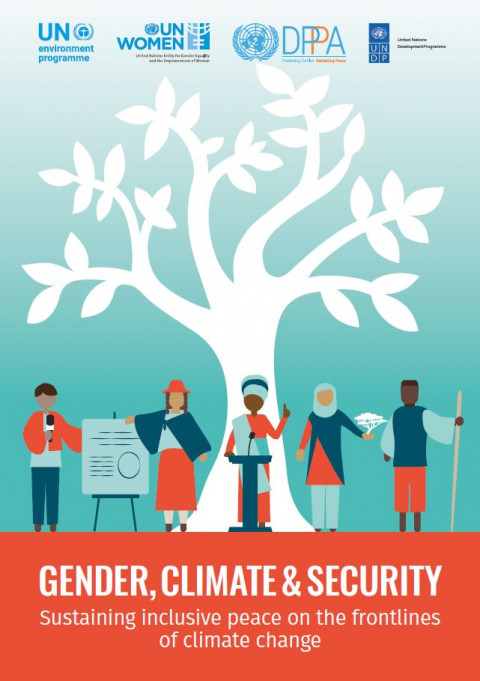 Gender, Climate & Security: Sustaining Inclusive Peace on the Frontlines of Climate Change Year of publication: 2020 Corporate author: United Nations Environment Programme (UNEP) | United Nations Entity for Gender Equality and the Empowerment of Women (UN Women) | United Nations Development Programme (UNDP) Climate change is a defining threat to peace and security in the 21st century – its impacts felt by everyone, but not equally. Gender norms and power dynamics shape how women and men of different backgrounds experience or contribute to insecurity in a changing climate. Grounded in a series of case studies from research and programming experience, this report offers a comprehensive framework for understanding how gender, climate and security are inextricably linked. The report assesses entry points for action across existing global agendas and suggests concrete recommendations for how policymakers, development practitioners and donors can advance three inter-related goals: peace and security, climate action and gender equality.
 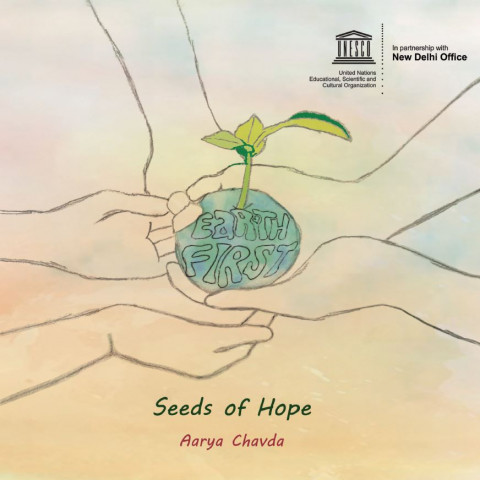 Seeds of Hope Year of publication: 2020 Author: Aarya Chavda Corporate author: UNESCO At an age of 10, author and illustrator of her 3 books, Aarya Chavda extends her support by donating her art proceeds to fundraise for the welfare of underpriviledge Cancer patients.Through her campaign on 'Preservation of Cultural Heritage', She also demonstrates her commitment and contributes in spreading awareness through her programs at government and private institutions.In this series of narrative illustrations, she portrays that climate change will not occur at some point in the distance future - "It is happening her and now". She urges everyone to treasure this thought of saving our planet for the future generation.
  The Climate Dictionary: Speak Climate Fluently Year of publication: 2023 Corporate author: United Nations Development Programme (UNDP) The Climate Dictionary is a guide to understanding climate change. It aims to bridge the gap between complex scientific jargon and the general public, making climate concepts accessible and understandable to people of different backgrounds and levels of expertise. It is based on the belief that empowering people with knowledge is crucial to fostering collective action and responsibility in the face of climate change. Using a creative combination of engaging images, concise explanations and engaging storytelling, The Climate Dictionary effectively communicates complex climate concepts in a visual and easy-to-consume way.
  Environmental Education Toolkit Guide for Latin America and the Caribbean Year of publication: 2023 Author: Eloísa Tréllez Solís Corporate author: United Nations Environment Programme (UNEP) The Environmental Education Toolkit is aimed primarily at teachers, multipliers and facilitators in Latin America and the Caribbean (LAC), and aims to promote interdisciplinary approaches, with a view to the transversality of environmental education. In the new context of a post-COVID-19 health emergency world, this approach becomes more relevant and necessary to achieve a better vision and understanding of the relationships between humans and nature; between societies, cultures and with the ecosystems on which they depend. In the chapters that make up this publication, an approach is proposed through a methodological proposal for reflection and action, the Interdisciplinary Roundtables for Environmental Education towards Sustainability, whose main objective is to strengthen and complement the environmental education processes that are carried out both in educational centers and in community groups, from an interdisciplinary, transversal perspective and with systemic thinking.
  Emerging Horizons: Youth Insights on Climate Change and Breakthrough Solutions; 2024 Leading Minds on Climate Action Year of publication: 2024 Corporate author: UNICEF Innocenti | United Nations Development Programme (UNDP) This paper shares insights from a participatory foresight workshop designed and facilitated by UNICEF Innocenti in the framework of the Youth4Climate: Sparking Solutions event co-hosted by UNDP and the Government of Italy. This convened 100 youth-led solutions in the areas of climate education, energy, food and agriculture, and urban sustainability. By using the Three Horizons foresight approach, a dialogue was created that delineated the patterns of change young people envisaged, their shared visions for the future, and the high potential innovations they felt could be leveraged to bring that future about. The paper identifies research and policy questions to be further explored by young climate leaders, UNDP, UNICEF, and their partners.
 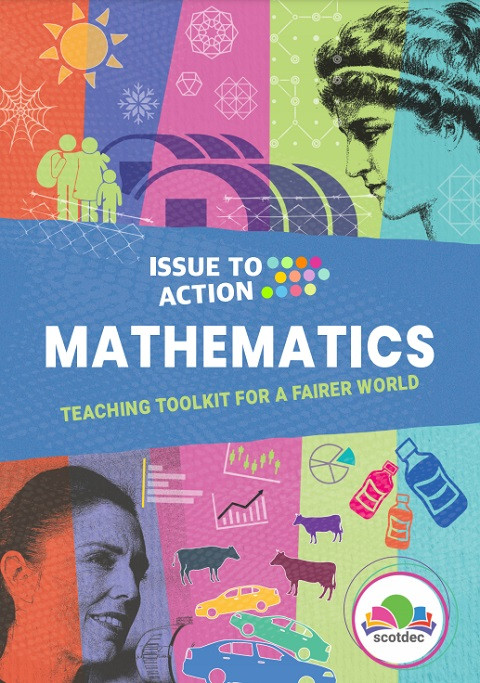 Issue to Action: Mathematics; Teaching Toolkit for a Fairer World Year of publication: 2021 Author: Corinne Angier Corporate author: Scotdec These resources offer maths teams an opportunity to take an applications approach within the BGE phase. You might want to make connections to the UN Sustainable Development Goals and you can find some introductory activities to the goals here.The materials explore 3 broad themes – climate change, gender equality and migration – with 2 sets of activities for each theme supported with a PowerPoint presentation.The lessons and worksheets in the booklet and accompanying PowerPoints are all free to download below. All activities are mapped to ‘Experiences and Outcomes’, benchmarks and core maths skills are highlighter.