
Resources
Explore a wide range of valuable resources on GCED to deepen your understanding and enhance your research, advocacy, teaching, and learning.
29 Results found
 Education in the twenty‐first century: Conflict, reconstruction and reconciliation1 Year of publication: 2005 Author: Alan Smith Corporate author: Taylor & Francis Ce papier tente d’établir un nouveau domaine d'étude de plus en plus important portant sur le lien entre l'éducation et les conflits. Le document fait valoir que les actions menées à travers différents « points d’entrée » à chaque niveau ont le potentiel d'exacerber ou bien d’atténuer les conflits. Le papier suggère qu'une analyse systémique des investissements dans les systèmes d'éducation contre les conflits devrait faire partie intégrante de la planification de l'éducation.
  Fearful symmetry: Palestinian and Jewish teachers confront contested narratives in integrated bilingual education The present paper deals with Jewish and Palestinian teachers who work in an integrated school in Israel, and shows the challenges and possibilities by examining these teachers' powerful historical narratives in the context of in-service training sessions. It is shown how these teachers essentially remain firmly rooted in the hegemonic historical narratives of their own community, even when their attitudes are challenged and clearer alternatives are considered to the reigning narratives. The findings highlight predominantly the failures, concerning the potential of educational efforts to help overcome situations of intractable conflict, even within contexts specifically devised for this purpose; yet, some openings also become apparent in the process of negotiating competing narratives and inventing new dialogic possibilities. The paper suggests that schools with their historical tradition are places where it is difficult to reach change or to produce it—even in integrated schools in which partial structural change takes place—and teacher training may not always be the answer. However, it also indicates that an ongoing agonistics of raising critical issues regarding one's identifications with hegemonic narratives does offer openings to take responsibility for both the challenges and the dialogic possibilities that are created in the process.
  Global Security, Religion and Education Development: a Crisis for the Field of Comparative Education? Year of publication: 2011 Author: Yusuf Sayed | Lynn Davies | Mike Hardy | Abbas Madandar Arani | Lida Kakia | Masooda Bano Corporate author: Taylor & Francis Building common ground on shared values should be a high priority for a diverse and devout society in an era of religious conflict. Otherwise we might fall into the equally false and far more dangerous illusion that we agree on nothing at all – and perhaps we tend to assume that education helps to do this, which is not necessarily the case. There is a greater concern that education is not just failing to step up effectively to the task of contesting undifferentiated and negative views of religions, but that it might not always be a force for good at all. It may in some cases help reinforce difference and create the conditions for conflict.The relationship, therefore, between religious difference, security and the assumed supportive role of education is far from a simple one. Global security, religion and education development: a crisis for the field of comparative education? Year of publication: 2011 Author: Yusuf Sayed | Lynn Davies | Mike Hardy | Abbas Madandar Arani | Lida Kakia | Masooda Bano Corporate author: Taylor & Francis Partager des valeurs communes devrait être une priorité absolue dans une société diversifiée et dévote en cette période de conflits religieux. Autrement, on pourrait tomber dans l’illusion, fausse et dangereuse, que nous sommes d’accord en rien - et on pense, probablement que l'éducation contribue à cet état de choses, alors que ce n’est pas forcément le cas. On est de plus en plus préoccupé par la question suivante : celle de considérer que non seulement l'éducation échoue quand il s’agit de contester d’une manière solide et efficace les points de vues non nuancés et négatifs en matière de religions, mais aussi que l’éducation n’est finalement pas une bonne chose. Dans certains cas, elle peut contribuer à renforcer la différence et créer les conditions d'un conflit. La relation, donc, entre la différence religieuse, la sécurité et le rôle présumé de soutien de l'éducation est loin d'être simple.
 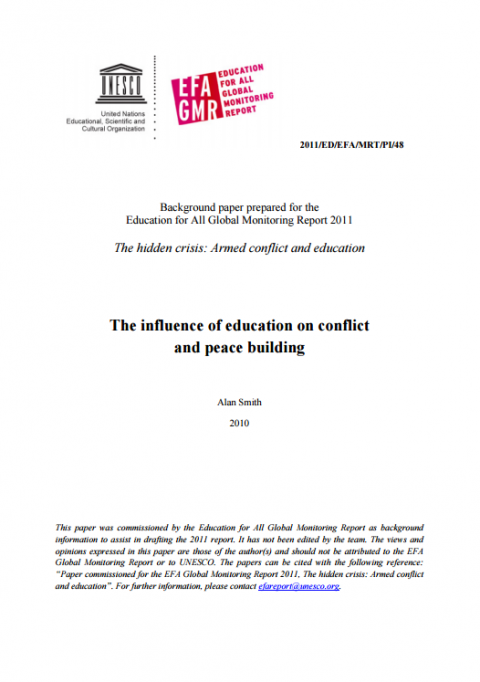 The Influence of education on conflict and peace building Year of publication: 2010 Author: Alan Smith Corporate author: UNESCO The purpose of this paper is to identify aspects of education that may have a positive influence on the dynamics of conflict or make a contribution to peacebuilding. The UN Secretary-General’s (2009) report on peacebuilding identifies a number of recurring priorities in conflict-affected situations, ‘establishing security, building confidence in a political process, delivering initial peace dividends and expanding core national capacity’. These priorities include ‘the provision of basic services, such as water and sanitation, health and primary education’. However, in conflict-affected situations education is also about more than service delivery because it is a means of socialization and identity development through the transmission of knowledge, skills, values and attitudes across generations. Education may therefore be a driver of conflict (fuelling grievances, stereotypes, xenophobia and other antagonisms), but can also be a way of contributing to ‘conflict transformation’ and ‘peacebuilding’.
 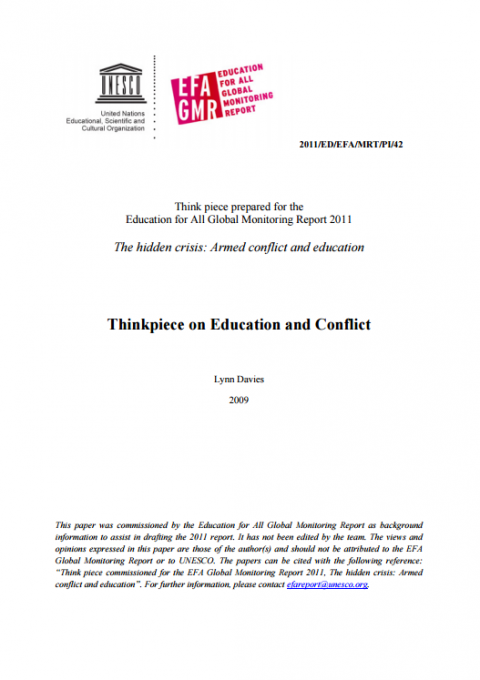 Thinkpiece on education and conflict Year of publication: 2009 Author: Lynn Davies Corporate author: UNESCO This paper looks first at the learning sites generally (violent schools, schools as a weapon of war, curriculum and textbooks). It then focuses on specific groups in conflict – gender, language, refugees, child soldiers. Thirdly it discusses education policy and donor intervention; and finally talks of the role of research. All these overlap hugely. This is not a prescription for how the Global Monitoring Report should be structured, but identification of themes and lessons learned that seem the most significant. Pensez pièce sur l'éducation et les conflits Year of publication: 2009 Author: Lynn Davies Corporate author: UNESCO Ce document examine d'abord les sites d'apprentissage en général (écoles violentes, les écoles comme une arme de guerre, programmes et manuels). Elle se concentre ensuite sur des groupes spécifiques dans les conflits - le sexe, la langue, les réfugiés, les enfants soldats. Troisièmement, il discute de la politique de l'éducation et de l'intervention des bailleurs de fonds; et, enfin, parle du rôle de la recherche. Tous ces chevauchent énormément. Ce n'est pas une prescription pour la façon dont le rapport Suivi mondial devrait être structuré, mais l'identification des thèmes et des leçons apprises qui semblent les plus importants.
  Global Citizenship: A plural and Transformative Vision of Society and School; Volume Ⅰ Year of publication: 2020 Author: Rafael Díaz-Salazar | Alfonso Díez Prieto | Antonio Roura | Begoña Carmona | Carme García Yeste | Carmen Magallón | César García-Rincón | Florencio Luengo | Gema Celorio | Gonzalo Fanjul | Juan Iglesias | Juan Pablo Rayo | Luis González Reyes | Manuela Mesa | María Laín | Mónica Cantón de Celis | Pedro Sáez | Pilar Álvarez Cifuentes | Rafael Feito | Regina Gairal | Santiago Álvarez Cantalapiedra | Victoria Camps | Violeta Velasco | Yayo Herrero | Augusto Ibañez Corporate author: SM Foundation The objective of this work, which brings together the voices of great specialists, reinforced by the vision of the school itself, is to promote and channel the debate on global citizenship towards an education oriented to the care of the person, society and nature. Understood in this way, education for global citizenship can help us form fulfilled people, prepared to intervene positively in a world in continuous change, and capable of adopting a sustainable way of life for ourselves, those around us and those who will succeed us. Ciudadanía Global: Una visión plural y transformadora de la sociedad y de la escuela; Volumen Ⅰ Year of publication: 2020 Author: Rafael Díaz-Salazar | Alfonso Díez Prieto | Antonio Roura | Begoña Carmona | Carme García Yeste | Carmen Magallón | César García-Rincón | Florencio Luengo | Gema Celorio | Gonzalo Fanjul | Juan Iglesias | Juan Pablo Rayo | Luis González Reyes | Manuela Mesa | María Laín | Mónica Cantón de Celis | Pedro Sáez | Pilar Álvarez Cifuentes | Rafael Feito | Regina Gairal | Santiago Álvarez Cantalapiedra | Victoria Camps | Violeta Velasco | Yayo Herrero | Augusto Ibañez Corporate author: SM Foundation El objetivo de esta obra, que recoge las voces de grandes especialistas, reforzadas por la visión de la propia escuela, es impulsar y canalizar el debate sobre la ciudadanía global hacia una educación orientada al cuidado de la persona, de la sociedad y de la naturaleza. Entendida así, la educación para la ciudadanía global puede ayudarnos a formar a personas plenas, preparadas para intervenir positivamente en un mundo en continuo cambio, y capaces de adoptar un modo de vida sostenible para nosotros, los que nos rodean y los que nos sucederán.