
Resources
Explore a wide range of valuable resources on GCED to deepen your understanding and enhance your research, advocacy, teaching, and learning.
8 Results found
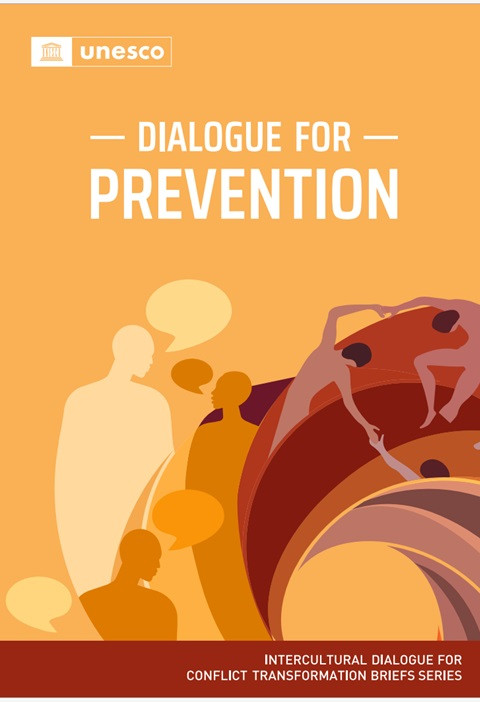 Dialogue for Prevention Year of publication: 2025 Corporate author: UNESCO In an era where geopolitical power struggles disrupt traditional peacebuilding, where identity and misinformation fuel divisions, and where trust in institutions is eroding, UNESCO’s Intercultural Dialogue for Conflict Transformation briefs series presents an adaptable, culturally grounded, and people-centred approach to peacebuilding. With 1.5 billion people living in contexts with low intercultural dialogue where global challenges such as absolute poverty, terrorism and forced displacement are more prevalent, this four-part series draws on firsthand experience, country case studies, and expert analysis to demonstrate the transformative potential of dialogue in fragile and conflict-sensitive settings. The Dialogue for Prevention brief, developed with the Auschwitz Institute for the Prevention of Genocide and Mass Atrocities, explores the powerful role intercultural dialogue can play in preventing large-scale identity-based violence, particularly in the upstream and downstream phases of conflict. Grounded in the idea that dialogue can bridge divides and foster mutual understanding, the brief argues that enabling environments for intercultural dialogue—marked by stability, inclusive governance, freedom of expression, horizontal equality, and social cohesion—also mitigate key risk factors for atrocity violence. Drawing on diverse examples from Cambodia, Colombia, Italy, and Kenya, it showcases creative, context specific applications of dialogue. Through practical guidance, the brief equips policymakers, practitioners and civil society seeking to embed dialogue into prevention strategies.
 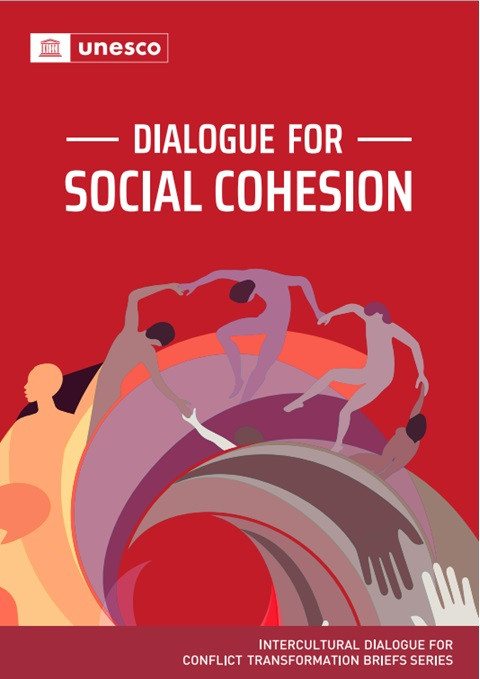 Dialogue for Social Cohesion Year of publication: 2025 Author: Isaure Vicarini | Euan Mackway-Jones Corporate author: UNESCO In an era where geopolitical power struggles disrupt traditional peacebuilding, where identity and misinformation fuel divisions, and where trust in institutions is eroding, UNESCO’s Intercultural Dialogue for Conflict Transformation briefs series presents an adaptable, culturally grounded, and people-centred approach to peacebuilding. With 89% of conflicts worldwide occurring in countries with limited capacity for intercultural dialogue, this four-part series draws on firsthand experience, country case studies, and expert analysis to demonstrate the transformative potential of dialogue in fragile and conflict-sensitive settings. The Dialogue for Social Cohesion brief—developed in collaboration with the Berghof Foundation and Search for Common Ground—bridges theory and practice to explore the horizontal (community-to-community) and vertical (citizen-to-state) dimensions of social cohesion and highlights how inclusive dialogue can support both. Case studies from Afghanistan, Germany, Somalia, and South Sudan illustrate how dialogue—whether through theatre, education, local governance, or environmental peacebuilding—can cultivate mutual understanding and trust, bridge identity-based divides, and restore, step by step, the social fabric in fractured societies. Through actionable recommendations, this brief equips practitioners, policymakers, and civil society with the essential guidance needed to tailor and embed dialogue in their respective contexts, helping to ensure that peace processes are inclusive, locally driven, and enduring.
  Manual on Citizenship Competencies: Citizenship Academy Project Year of publication: 2020 Corporate author: Organization of Ibero-American States for Education, Science and Culture (OEI) | Panamanian Debate Association (ASPADE) | Eduardo Morgan Foundation (FUNDAMORGAN) The Citizen Competencies Manual is a tool for facilitators of the Ibero-American Education Program in human rights, democracy and citizenship. Citizen Academy is an initiative led by the Organization of Ibero-American States (OEI) with the Panamanian Debate Association (ASPADE) and the Eduardo Morgan Foundation (FUNDAMORGAN). Within the Citizen Academy Program, various initiatives have been developed, all focused on the importance of citizen participation and the development of skills that contribute to the personal and professional growth of the participants. In this manual, teachers and trainers will be able to find a roadmap to learn and teach their students about: i) citizenship skills, ii) debate and democracy, iii) culture of legality, iv) good governance, v) human rights , vi) equity and diversity and vii) peaceful conflict resolution and the ImPacta methodology. Manual en competencias ciudadanas: Proyecto acdemia ciudadana Year of publication: 2020 Corporate author: Organización de Estados Iberoamericanos para la Educación, la Ciencia y la Cultura (OEI) | Panamanian Debate Association (ASPADE) | Eduardo Morgan Foundation (FUNDAMORGAN) El Manual de Competencias Ciudadanas es una herramienta para los facilitadores del Programa iberoamericano de educación en derecho humanos, democracia y ciudadanía. Academia Ciudadana es una iniciativa liderada por la Organización de Estados Iberoamericanos (OEI) con la Asociación Panameña de Debate (ASPADE) y Fundación Eduardo Morgan (FUNDAMORGAN). Dentro del Programa de Academia Ciudadana, se han desarrollado diversas iniciativas todas enfocadas en la importancia de la participación ciudadana y el desarrollo de habilidades que contribuyan al crecimiento personal y profesional de los participantes. En el presente manual, los docentes y formadores podrán encontrar una hoja de ruta para aprender y enseñar a sus estudiantes sobre: i) competencias ciudadanas, ii) debate y democracia, iii) cultura de legalidad, iv) buen gobierno, v) derechos humanos, vi) equidad y diversidad y vii) resolución pacífica de conflictos y la metodología ImPacta.
  Human Rights and Conflict Resolution: Palestinian Universities as a Case Study (Conceptual Paper) Year of publication: 2023 Author: Rashad Twam Corporate author: Palestinian Jurists Association Palestinian universities have consistently witnessed occasional conflicts, many of which have resulted in disrupting the educational process. While some of these conflicts originated outside the university walls, as an extension of societal violence, others stemmed from within the university itself, posing a threat to civil peace. This conceptual paper addresses this issue by examining the various forms of these conflicts over the past five years (2018-2022) and the stakeholders involved in resolving them. It adopts a differentiated approach between the perspectives and methodologies of human rights advocates and conflict resolution practitioners, with a focus on the case study of Birzeit University. حقوق الإنسان وحل النزاعات من منظور عملي: الجامعات الفلسطينية نموذجا (ورقة مفاهيمية) Year of publication: 2023 Author: Rashad Twam Corporate author: Palestinian Jurists Association ما انفكت الجامعات الفلسطينية تشهد بين الحين والآخر، حالات نزاع، كثيرا منها ما تسببت بتعطيل العملية التعليمية. وفيما بعض تلك النزاعات نفذت من خارج أسوار الجامعة، كامتداد لحالات عنف مجتمعية، فبعضها الآخر بالعكس، مصدرها داخل الجامعة، وكادت أن تمتد إلى خارج حرمها، مهددة السلم الأهلي. تعرض هذه الورقة المفاهيمية لهذا الإشكال، فتتناول أشكال تلك النزاعات خلال السنوات الخمسة الماضية (2018-2022)، والمتدخلين في حل هذا النزاعات، ضمن مقاربة التمييز بين منطلقات وأساليب عمل كل من فئة المدافعين عن حقوق الإنسان وفئة ممارسي حل النزاعات، وذلك بالتركيز على تجربة جامعة بيرزيت كحالة دراسية.
 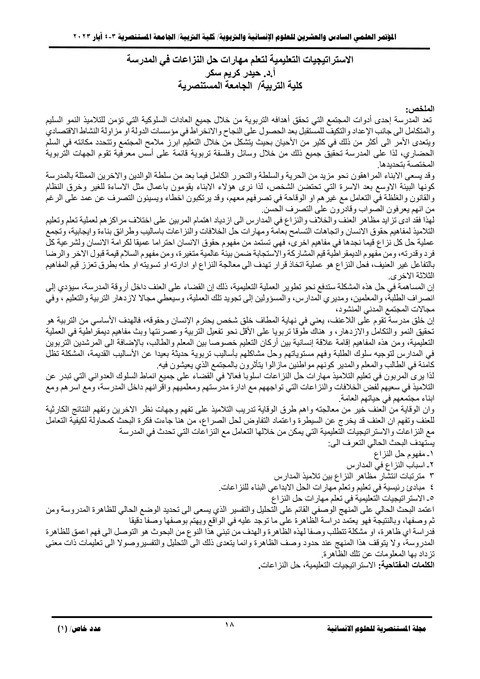 Instructional Strategies for Learning Conflict Resolution Skills in School (Mustansiriyah Journal of Humanities; Vol. 1-1, Special Issue) Year of publication: 2023 Author: Haider Kareem Sukar Corporate author: Mustansiriyah University The school is a community tool that achieves its educational goals through all behavioral habits that provide students with sound and integrated growth, as well as preparation and adaptation for the future after obtaining success and involvement in government institutions and the economy. In the civilizational scale, so the school must achieve all means of education and an educational philosophy based on foundations with educational entertainment Adolescent children may seek more freedom, power, and complete liberation later on from the authority of parents and others represented by the school, as it is the broader environment after the family that embraces the person, so we see these children doing actions such as abuse of others, violation of order and law, harshness in dealing with others, or rudeness in their behavior with them They may make mistakes and misbehave on purpose even though they know what is right and are able to act well. Therefore, the increasing manifestations of violence, disagreement and conflict in schools have led to an increase in the interest of educators of all positions in the process of learning and teaching students the concepts of human rights and the attitudes of tolerance in general and the skills of resolving differences and conflicts in constructive and positive ways and means. الاستراتيجيات التعليمية لتعلم مهارات حل النزاعات في المدرسة (مجلة المستنصرية للعلوم الإنسانية؛ Vol. 1-1، العدد الخاص) Year of publication: 2023 Author: Haider Kareem Sukar Corporate author: Mustansiriyah University تعد المدرسة إحدى أدوات المجتمع التي تحقق أهدافه التربوية من خلال جميع العادات السلوكية التي تؤمن للتلاميذ النمو السليم والمتكامل الى جانب الإعداد والتكيف للمستقبل بعد الحصول على النجاح والانخراط في مؤسسات الدولة او مزاولة النشاط الاقتصادي ويتعدى الأمر الى أكثر من ذلك في كثير من الأحيان بحيث يتشكل من خلال التعليم ابرز ملامح المجتمع وتتحدد مكانته في السلم الحضاري، لذا على المدرسة تحقيق جميع ذلك من خلال وسائل وفلسفة تربوية قائمة على أسس معرفية تقوم الجهات التربوية المختصة بتحديدها. وقد يسعى الابناء المراهقون نحو مزيد من الحرية والسلطة والتحرر الكامل فيما بعد من سلطة الوالدين والاخرين الممثلة بالمدرسة كونها البيئة الاوسع بعد الاسرة التي تحتضن الشخص، لذا نرى هؤلاء الابناء يقومون باعمال مثل الاساءة للغير وخرق النظام والقانون والغلظة في التعامل مع غيرهم او الوقاحة في تصرفهم معهم، وقد يرتكبون اخطاء ويسيئون التصرف عن عمد على الرغم من انهم يعرفون الصواب وقادرون على التصرف الحسن. لهذا فقد ادى تزايد مظاهر العنف والخلاف والنزاع في المدارس الى ازدياد اهتمام المربين على اختلاف مراكزهم لعملية تعلم وتعليم التلاميذ لمفاهيم حقوق الانسان واتجاهات التسامح بعامة ومهارات حل الخلافات والنزاعات باساليب وطرائق بناءة وايجابية.