
Resources
Explore a wide range of valuable resources on GCED to deepen your understanding and enhance your research, advocacy, teaching, and learning.
178 Results found
 2021 문화다양성 정책 연차보고서 Year of publication: 2022 Author: 윤소영 | 정보람 | 신아름 Corporate author: 한국문화관광연구원 2021 문화다양성 정책 연차보고서는 2021년 한 해 동안 중앙부처와 지방자치단체에서 추진한 문화다양성 보호·증진 정책 추진 현황 및 세부 이행결과에 대해 분석하고 평가결과를 정리하였다. 또한 2021년 문화다양성 정책 관련 국내외 환경변화 및 정책동향을 살피고 국내 문화다양성 정책 및 주요 의제로 중앙부처·지자체 문화다양성 정책 사업과 활동, 주요 대학·기관·산업계의 관련 활동을 분석하고 주요 국제기구 및 주요 협약 당사국의 문화다양성 정책 및 현황을 다루고 있다. 본 저작물은 문화체육관광부에서 2022년 작성하여 공공누리 제 4유형으로 개방한 '2021 문화다양성 정책 연차보고서(윤소영, 정보람, 신아름)'를 이용하였으며 해당 저작물은 문화체육관광부 누리집 (www.mcst.go.kr/)에서 무료로 다운받으실 수 있습니다.
 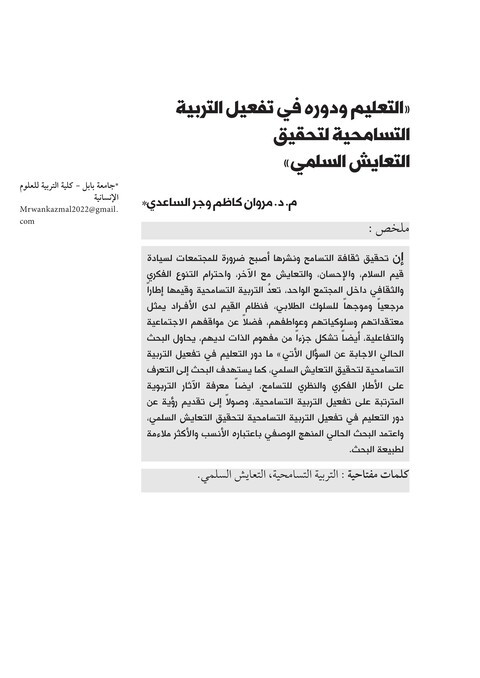 التعليم ودوره في تفعيل التربية التسامحية لتحقيق التعايش السلمي (مجلة حمورابي للدراسات; Vol. 1, No. 46) Year of publication: 2023 Author: Marwan Kadhim Wajar Al-Saedl Corporate author: Hammurabi Centre for Research and Strategic Studies إن تحقيق ثقافة التسامح ونشرها أصبح ضرورة للمجتمعات لسيادة قيم السلام، والإحسان، والتعايش مع الآخر، واحترام التنوع الفكري والثقافي داخل المجتمع الواحد، تعدُ التربية التسامحية وقيمها إطاراً مرجعياً وموجهاً للسلوك الطلابي، فنظام القيم لدى الأفراد يمثل معتقداتهم وسلوكياتهم وعواطفهم، فضلاً عن مواقفهم الاجتماعية والتفاعلية، أيضاً تشكل جزءاً من مفهوم الذات لديهم، يحاول البحث الحالي الاجابة عن السؤال الأتي" ما دور التعليم في تفعيل التربية التسامحية لتحقيق التعايش السلمي، كما يستهدف البحث إلى التعرف على الأطار الفكري والنظري للتسامح، ايضاً معرفة الآثار التربوية المترتبة على تفعيل التربية التسامحية، وصولاً إلى تقديم رؤية عن دور التعليم في تفعيل التربية التسامحية لتحقيق التعايش السلمي، واعتمد البحث الحالي المنهج الوصفي باعتباره الأنسب والأكثر ملاءمة لطبيعة البحث. Education and Its Role in Activating Tolerance Education to Achieve Peaceful Coexistence (Hammurabi Journal for Studies; Vol.1, No.46) Year of publication: 2023 Author: Marwan Kadhim Wajar Al-Saedl Corporate author: Hammurabi Centre for Research and Strategic Studies Achieving and spreading a culture of tolerance has become a necessity for societies to prevail the values of peace, benevolence, coexistence with others, and respect for intellectual and cultural diversity within the same society. Tolerant education and its values are a frame of reference and guide for students' behavior. The value system of individuals represents their beliefs, behaviors, and emotions, as well as their social and interactive attitudes; they also form part of their self-concept. The current research attempts to answer the following question: "What is the role of education in activating tolerance education to achieve peaceful coexistence?" The research also aims to identify the intellectual and theoretical framework of tolerance, and knowing the educational effects of activating tolerance education in order to provide a vision of the role of education in activating tolerance education to achieve peaceful coexistence. The current research adopts the descriptive approach as the most appropriate to the nature of this research.
 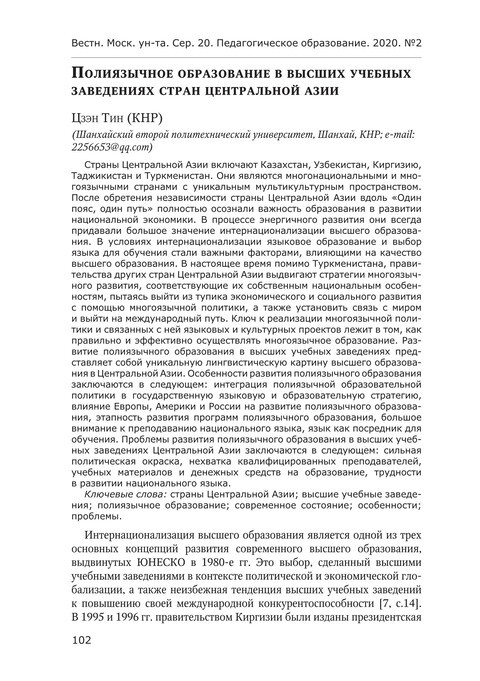 Multilingual Education in Central Asian Institutions of Higher Education (Journal of Moscow University. Series 20. Pedagogical Education; No.2, 2020) Year of publication: 2020 Author: Цзэн Тин In the context of internationalization, language education and the choice of language for teaching have become important factors affecting the quality of higher education. Currently, in addition to Turkmenistan, the Governments of other Central Asian countries are putting forward strategies for multilingual development that correspond to their own national characteristics. The problems of the development of multilingual education in higher educational institutions of Central Asia are as follows: strong political coloring, lack of qualified teachers, educational materials and funds for education, difficulties in the development of the national language. Полиязычное образование в высших учебных заведениях стран Центральной Азии (Вестник Московского университета. Серия 20. Педагогическое образование; No.2, 2020) Year of publication: 2020 Author: Цзэн Тин В условиях интернационализации языковое образование и выбор языка для обучения стали важными факторами, влияющими на качество высшего образования. В настоящее время помимо Туркменистана, правительства других стран Центральной Азии выдвигают стратегии многоязычного развития, соответствующие их собственным национальным особенностям. Проблемы развития полиязычного образования в высших учебных заведениях Центральной Азии заключаются в следующем: сильная политическая окраска, нехватка квалифицированных преподавателей, учебных материалов и денежных средств на образование, трудности в развитии национального языка.
  Education in Contexts of Cultural Diversity: A Study on Brazilian Educators (Iberoamerican Journal of Education; vol. 85, no. 2) Year of publication: 2021 Author: Valentín Martínez-Otero Pérez Corporate author: Organization of Ibero-American States for Education, Science and Culture (OEI) This article is interested in education in contexts of cultural diversity and the perspective of educators on their training needs. An ad hoc designed questionnaire was used and a mixed, quantitative and qualitative method was chosen. The questionnaire was applied to a sample of 237 Brazilian educators. The results reveal that attention to cultural diversity plays an important role in educational activity. Educators, as a whole, are sensitive to cultural diversity and its promotion, but the intercultural training received is insufficient. Little family participation is encouraged, resources are scarce and the intercultural dimension lacks pedagogical systematization. La educación en contextos de diversidad cultural: un estudio sobre educadores brasileños (Revista Ibero-americana de Educação; vol. 85, núm. 2) Year of publication: 2021 Author: Valentín Martínez-Otero Pérez Corporate author: Organización de Estados Iberoamericanos para la Educación, la Ciencia y la Cultura (OEI) Este artículo se interesa por la educación en contextos de diversidad cultural y por la perspectiva de los educadores sobre sus necesidades formativas. Se utilizó un cuestionario diseñado ad hoc y se opta por un método mixto, cuantitativo y cualitativo. El cuestionario se aplicó a una muestra de 237 educadores brasileños. Los resultados revelan que la atención a la diversidad cultural ocupa un papel importante en la actividad educativa. Los educadores, en su conjunto, son sensibles a la diversidad cultural y a su fomento, pero la formación intercultural recibida es insuficiente. Se fomenta poco la participación familiar, los recursos escasean y la dimensión intercultural carece de sistematización pedagógica.
  How to Coexist (with Different Cultures) without Dying Trying? Year of publication: 2022 Corporate author: CuriosaMente This video presents a perspective on cultural differences, how it is possible to identify, understand and adapt to them. Answer the questions What is interculturality? How can we live between different cultures? ¿Cómo convivir (con culturas diferentes) sin morir en el intento? Year of publication: 2022 Corporate author: CuriosaMente Este video presenta una perspectiva sobre las diferencias culturales, cómo es posible identificarlas, comprenderlas y adaptarse a las mismas. Responde las preguntas ¿Qué es la interculturalidad? ¿Cómo podemos vivir entre diferentes culturas?
 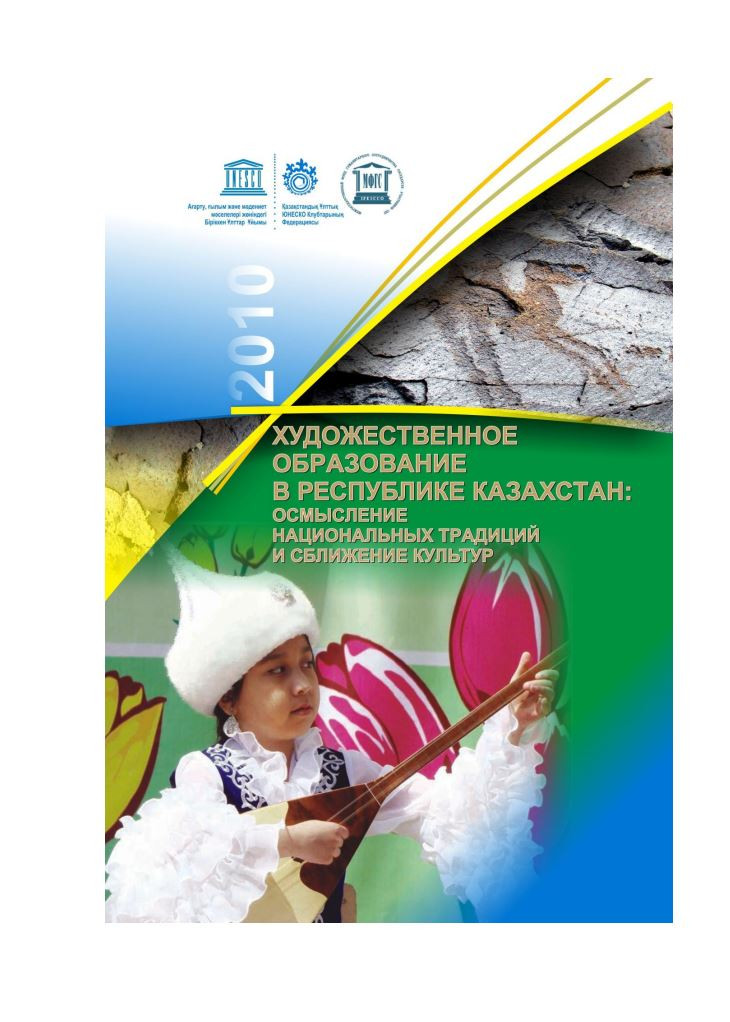 Art Education in the Republic of Kazakhstan: Perception of the National Traditions and Rapprochement of the Cultures; Research Paper Year of publication: 2010 Author: Rustam Muzafarov Kazakhstan has the unique feature of ethno-cultural diversity that appeared historically due to multi-ethnic and multi-confessional population's development. Such an environment urges the state to facilitate the revival and development of ethnic cultures and cross-cultural interaction for the benefit of national unity. The adoption of the concept of ethno-cultural education means that the creation of national education system would enhance the idea of cultural and linguistic pluralism, combining the advanced education techniques and information facilities with traditional cultural values. In fact, the educated personality feels real belonging to the historical and cultural traditions of the country.