
Resources
Explore a wide range of valuable resources on GCED to deepen your understanding and enhance your research, advocacy, teaching, and learning.
3 Results found
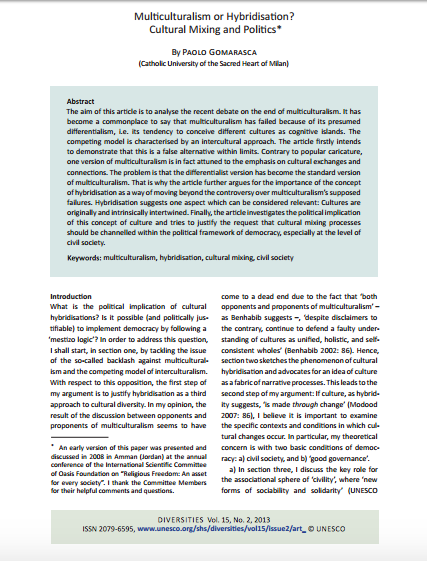 Multiculturalism or Hybridisation?: Cultural Mixing and Politics Year of publication: 2013 Author: Paolo Gomarasca The aim of this article is to analyse the recent debate on the end of multiculturalism. It has become a commonplace to say that multiculturalism has failed because of its presumed differentialism, i.e. its tendency to conceive different cultures as cognitive islands. The competing model is characterised by an intercultural approach. The article firstly intends to demonstrate that this is a false alternative within limits. Contrary to popular caricature, one version of multiculturalism is in fact attuned to the emphasis on cultural exchanges and connections. The problem is that the differentialist version has become the standard version of multiculturalism. That is why the article further argues for the importance of the concept of hybridisation as a way of moving beyond the controversy over multiculturalism’s supposed failures. Hybridisation suggests one aspect which can be considered relevant: Cultures are originally and intrinsically intertwined. Finally, the article investigates the political implication of this concept of culture and tries to justify the request that cultural mixing processes should be channelled within the political framework of democracy, especially at the level of civil society.
  Educator's Guide to Global Citizenship Education: From Asia-Pacific Perspectives Year of publication: 2025 Author: Athapol Anunthavorasakul | Keith C. Barton | Sicong Chen | Suzanne S. Choo | Thippapan Chuosavasdi | Li-Ching Ho | Aigul Kulnazarova | Mousumi Mukherjee | Mousumi Roy | Tania Saeed | Tanya Wendt Samu | Kyujoo Seol | Jun Teng Corporate author: APCEIU Educators’ Guide to Global Citizenship Education from Asia-Pacific Perspectives is designed to translate rich discussions from Rethinking Global Citizenship Education from Asia-Pacific Perspectives (2024) into a more accessible resource for educators. This Guide supports educators by presenting scholarly insights in practical and actionable ways. Serving as a bridge between theory and practice, it helps educators grasp key ideas of global citizenship education (GCED) from Asia-Pacific perspectives, reflect on their relevance to their own contexts, and apply them through concrete activities, stories, cases examples, and instructional strategies. This Guide, which is grounded in the diverse philosophies, religions, and lived realities of the Asia-Pacific region, is intended to serve as a practical companion that helps educators understand GCED from a decolonial perspective, adapt its ideas to their own contexts, and translate it all into meaningful learning experiences for their learners. It is our sincere hope that this Guide fosters ongoing dialogue, experimentation, and collaboration, and that it contributes to nurturing learners who think critically, act with empathy and justice, and participate responsibly in shaping a more harmonious and sustainable world.
  Rethinking Global Citizenship Education: From Asia-Pacific Perspectives Year of publication: 2024 Author: Sicong Chen | Suzanne S. Choo | Thippapan Chuosavasdi | Aigul Kulnazarova | Mousumi Mukherjee | Tania Saeed | Tanya Wendt Samu | Kyujoo Seol | Jun Teng Corporate author: APCEIU Rethinking Global Citizenship Education from Asia-Pacific Perspectives aims to rethink and reinterpret global citizenship and GCED in light of the cultural and historical contexts and political and economic conditions of the Asia-Pacific region. The edited volume offers an in-depth exploration of global citizenship and GCED through the contributions of nine scholars who examine the subject from a range of cultural, historical, and theoretical perspectives. Each chapter brings to light the complexities involved in fostering global citizenship in an era defined by both growing interconnectedness and intensifying political, social, and economic divides.This book is structured into three parts. The first part examines how various philosophical traditions from the Asia-Pacific region, such as Confucian cosmopolitanism, Tagore’s mindset, Pacific indigenous wisdom, and the Tianxia system, can inform and enrich the concept of GCED. The second part delves into the foundational ideas of global citizenship embedded within Asian religious and spiritual traditions, including Buddhist and Sufi perspectives. The third part provides case studies from Central and East Asia, highlighting the practical application of GCED in local contexts such as Kazakhstan, China, Japan, and South Korea. Together, these chapters offer a comprehensive analysis of the evolving challenges, opportunities, and innovations within GCED from Asia-Pacific viewpoints, emphasising the need for education systems to adapt and respond to the multifaceted nature of global citizenship.